
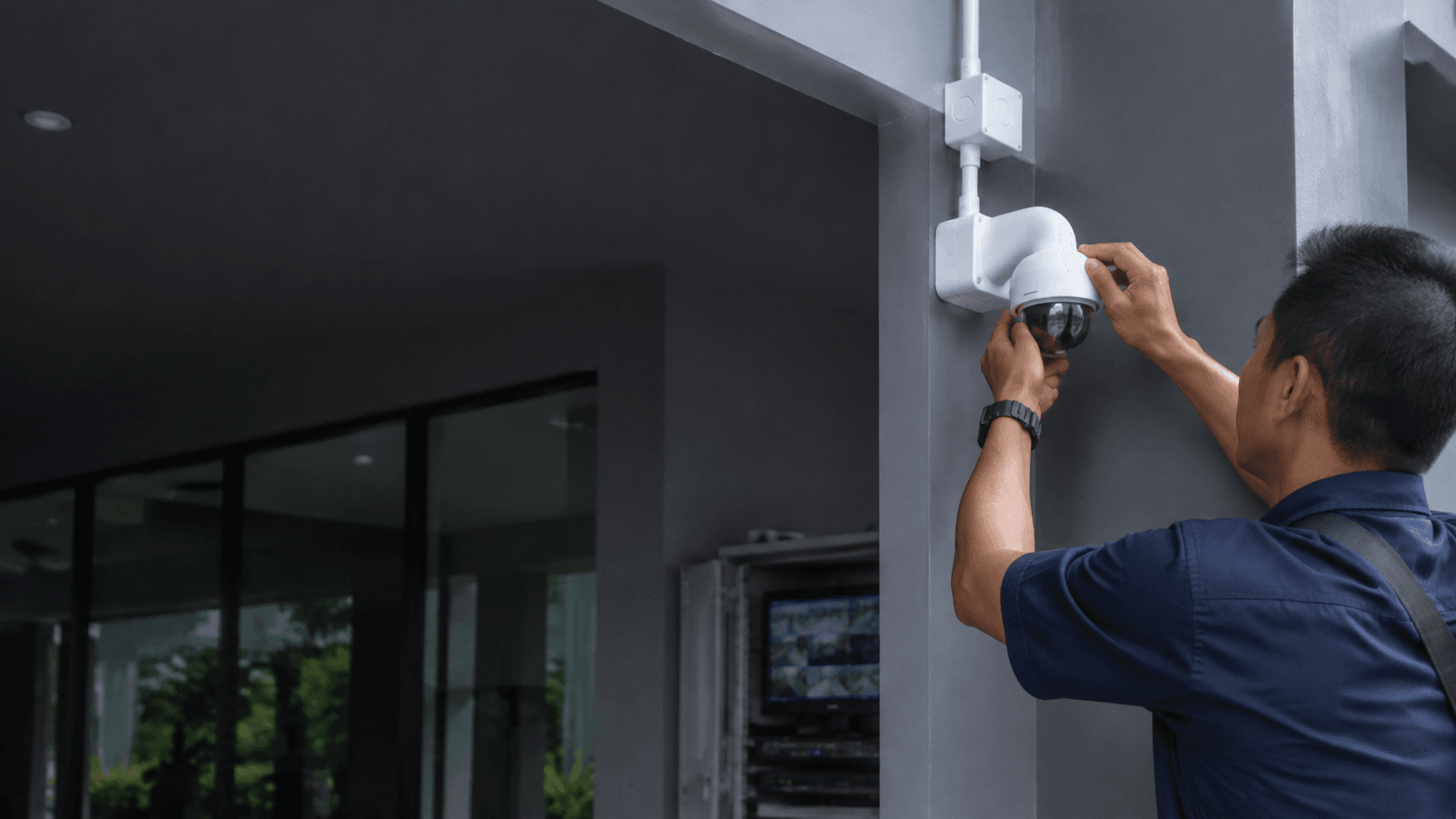
Most buyers start with a camera model and work backwards. The practical order runs the other way: decide what needs watching, check the light and cabling at each spot, then choose hardware that suits those conditions. Eyonic, a security system supplier in Sarawak, plans, supplies, and installs monitoring systems for homes, offices, shops, and industrial sites.
Competitor pages in this space are mostly product catalogues and ranked review lists. They rarely explain how a system gets planned for an actual house. That gap matters in Malaysia, where terrace houses, semi-detached units, and gated bungalows each present different entry points, roof lines, and cable routes.
Residential Security Camera System: What the Setup Actually Involves
A residential security camera system is not a single product. It is a small project with four stages, and each stage produces something the next one depends on.
- Site survey. The installer walks the property, notes entry points, existing lighting, power availability, and where cable can run without damaging finishes.
- System proposal. The survey findings become a written scope: how many cameras, where each one points, how recording is stored, and how remote viewing is set up.
- Installation. Cameras are mounted, cable is routed, the recorder is configured, and the network connection is tested.
- Handover. The installer confirms live view and playback work, then shows the owner how to check footage from a phone.
Eyonic's CCTV installation process follows exactly these four stages: site survey, system proposal, installation, and handover. Skipping the survey is the most common reason a home setup disappoints, because placement decisions made from a floor plan alone often miss glare, blind spots, and cable obstructions.
Why the survey comes before the hardware list
A camera that faces a wall, a tree, or a neighbour's window is wasted money regardless of its specification. The survey exists to catch those problems while they are still cheap to fix. It also establishes whether the property needs a wired run to a recorder or whether existing network points can carry the load.
Where cameras earn their place around a Malaysian home
Placement is the decision that most affects whether footage is useful. A camera covering the wrong angle records hours of nothing while missing the one event that mattered.
Entry points come first. The main gate, the front door, and any side or rear access are the positions where footage has the clearest purpose. A camera covering the gate approach shows who arrived and when. A camera at the rear service door covers the route that is usually least visible from inside the house.
Car porch and driveway coverage is common in Malaysian homes because vehicles sit outside overnight. The camera position needs to account for headlights, which can wash out an image if the lens faces oncoming traffic directly.
Compound and perimeter coverage depends on the property. A terrace house has limited side access and shared walls, so coverage concentrates on front and rear. A corner or end-lot unit has more exposed boundary, which changes both the number of positions and the cable route.
Checks made before confirming camera placement
- Confirm what each camera is meant to show, not just where it can be mounted.
- Check the light at that spot during the hours the camera matters most.
- Confirm power and cable access without cutting into finished surfaces unnecessarily.
- Check that the view is not blocked by a wall, beam, or future renovation.
These checks are cheap during a survey and expensive after installation. Moving a camera later means patching, re-routing, and re-testing.
Site survey, proposal, installation, handover
The four-stage sequence is the backbone of a properly delivered residential security camera system. Each stage has a defined output, and the handover is where the owner finds out whether the system actually works as described.
During the survey, the installer records the property layout, notes existing lighting, and identifies where cable can run. The proposal turns those notes into a scope with a camera count, positions, recording method, and remote viewing setup. Installation executes that scope. Handover confirms it.
Eyonic's documented project work shows how this plays out on larger sites. For the Kuching Immigration Office, the brief centred on arrival flow, staff areas, visitor movement, and dependable daily operation. Those are the same categories a homeowner cares about at a smaller scale: who arrives, what happens at the entrance, and whether the system keeps running without constant attention.
A second documented project, for KTA Sarawak Sdn Bhd, covered staff movement, visitor handling, tidy cabling, and clearer daily site control. Tidy cabling is not a cosmetic detail. Poorly routed cable is the most common source of intermittent faults, and it is the hardest thing to fix after the fact.
What handover should confirm
Handover is complete when live view works, recorded playback works, and the owner can reach both from a phone. If any of those three is untested at handover, the gap usually surfaces later as a support call.
Recording and remote viewing in plain terms
Recording and remote viewing are separate functions, and confusing them causes most of the frustration homeowners report.
Recording is what the system keeps. A recorder stores footage from the cameras, and the storage method determines how far back the record goes. Remote viewing is what the owner can see live or on playback from a phone or computer, wherever they are.
A system can record without remote viewing configured, and it can offer remote viewing while recording is limited. Both need to be confirmed at handover rather than assumed.
NVR setup is the part that ties the two together. The network video recorder receives the camera feeds, stores them, and serves them to the viewing app. If the recorder is configured but the network path is not, remote viewing fails even though recording continues.
Questions that come up after installation
Does remote viewing need the home internet to be fast? Remote viewing depends on the upload path from the recorder to the internet. A stable connection matters more than a fast one, because an unstable link drops the stream intermittently.
What happens if the internet goes down? Recording continues locally on the recorder. Remote viewing stops until the connection returns. This is why local recording and remote viewing are planned as separate capabilities.
Can cameras be added later? That depends on the recorder's channel capacity and whether spare cable runs were left during installation. Raising this during the survey is cheaper than raising it afterwards.
Lighting conditions decide more than the camera model
Lighting is the variable that most often decides whether footage is usable, and it is the one buyers think about least.
A position that looks well lit to the eye can still be difficult for a camera. A porch light directly beside a camera creates glare. A dark rear lane with no ambient light behaves differently from a front gate under a street lamp. A camera facing east catches direct morning sun; one facing west catches the afternoon.
Eyonic recommends checking actual lighting conditions before confirming placement for ColorVu-style cameras. That advice applies more broadly: the light at the position, at the hours that matter, should be assessed on site rather than assumed from a product description.
This is also why a survey done in daylight can miss problems. If the property's risk hours are at night, the placement check should account for how the position performs after dark, including any lighting the owner plans to add or change.
Where lighting changes the plan
If a position has no usable light and no practical way to add it, the plan may need a different camera position rather than a different camera. Moving the camera to a position with better ambient light often solves the problem more reliably than upgrading hardware at a position that was poorly chosen.
Costs packages and the next practical step
Eyonic publishes three package tiers at RM 1,599 each. The Hikvision CCTV Package covers camera supply and setup, basic recording configuration, and mobile viewing handover. The Hikvision Alarm System covers a control panel and sensors, siren and zone setup, and user testing and handover. The Autogate Package covers motor recommendation, remote-control setup, and safety testing and handover.
Those packages describe what is included at that tier. They are not a quotation for a specific property, because the camera count, cable runs, and placement work depend on the survey. A larger or more complex home will need a scope built around its actual layout.
For reference on how scope affects budget, Eyonic's documented project ranges run from RM 8,000 to RM 18,000 for the KTA Sarawak office setup and RM 12,000 to RM 28,000 for the Kuching Immigration Office work. Those are commercial and public-office projects, not residential quotes, but they show how much the scope of a site changes the total.
The practical next step is to establish the property's actual requirements before comparing hardware. Share the location, property type, and required system with Eyonic on WhatsApp at +60 11-5111 7959 to arrange the survey that produces a scope.
What to have ready before the survey
A clear idea of which areas matter most, whether the property already has network cabling, and whether any renovation is planned. Each of those changes the placement and routing decisions the survey will produce.
Eric Yong, founder of Eyonic Security Systems, has worked in the industry for more than 10 years and is experienced in technical installation of digital security solutions for commercial businesses in Sarawak. That installation background is what the survey draws on: the person assessing placement is the person who understands what the mounting and cabling will involve.