
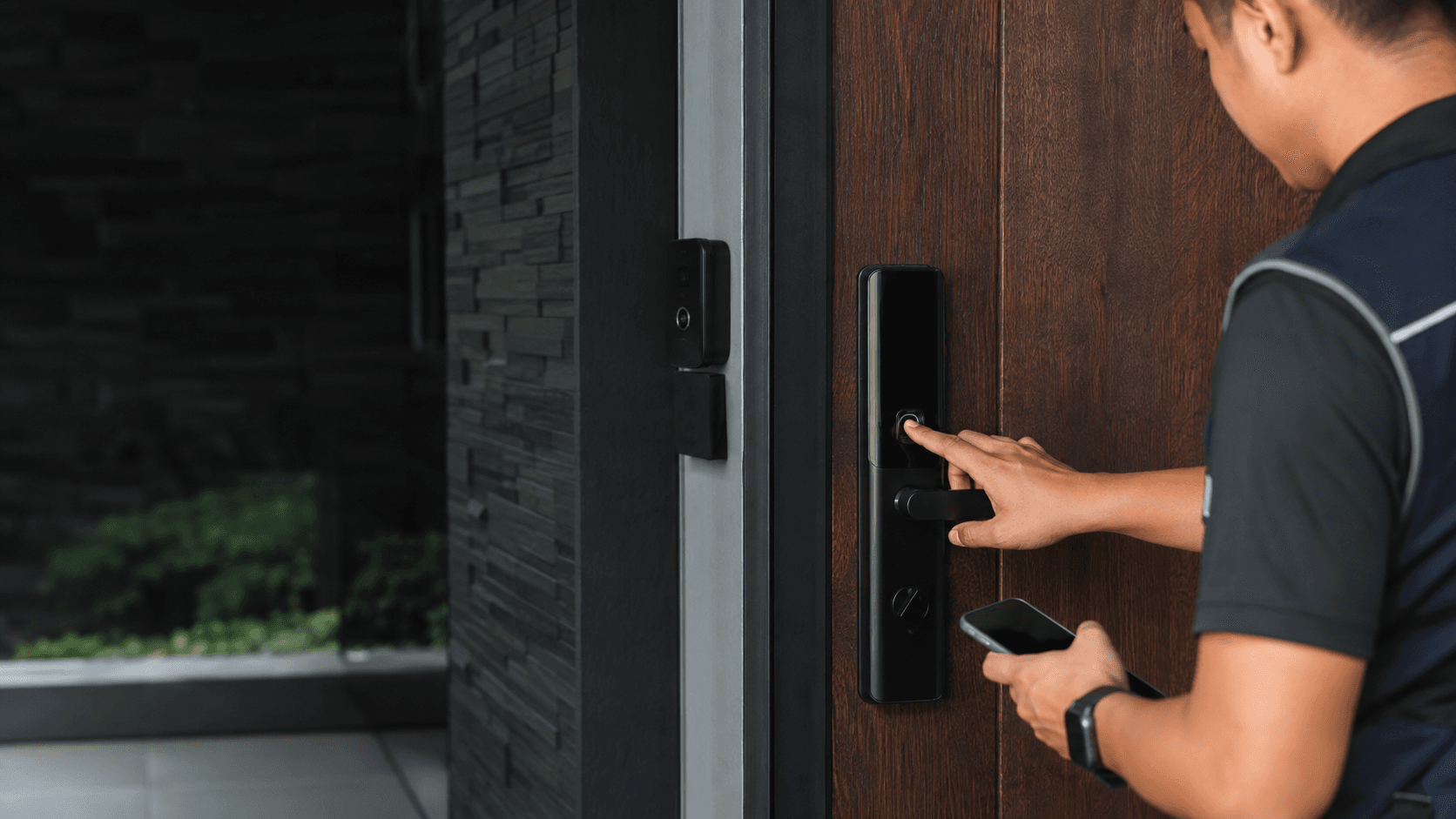
The brand behind the query is U-tec, the California company that makes ULTRALOQ smart locks and Ulticam cameras. Its locks are sold mainly as direct-to-consumer products in the United States, so a buyer in Malaysia is usually dealing with a supply-and-installation question rather than a simple checkout. That is the gap this page addresses: what the product family covers, what has to be checked on the door itself, and how the work is sequenced when a local supplier handles it.
U Tec Door Lock. what buyers in Sarawak are actually choosing
U-tec builds its locks around removing the key from daily use. The published product families include deadbolt models, latch models, and accessories, with unlocking handled by fingerprint, phone, watch, PIN code, auto unlock, tap, voice control, or a physical key as a fallback. The company also publishes a cloud platform and an accessory line, which matters because a lock that depends on an app is only as useful as the app and the network behind it.
For a Sarawak property, the practical question is not which model looks best on a product page. It is whether the door can take the hardware, whether the people using it can be given the right level of access, and what happens on the day the lock or its access method fails. Those three questions decide more outcomes than any feature comparison.
Eyonic's own position on this category is narrow and worth stating plainly. Smart lock door access is described as good for controlled convenience when user permissions and backup entry are planned properly. The same review notes that smart locks work best when door condition, user roles, and backup method are reviewed before installation, and that for business use the choice between a standalone smart lock and an access control panel is usually checked first.
How a U Tec Door Lock fits into a wider door access setup
A lock is one component in a door access setup, not the whole of it. On a single residential door, a standalone smart lock is often the entire system. On an office, shop, or industrial site, the same door may sit inside a wider arrangement that includes an access control panel, an intercom, a camera covering the entrance, and an alarm zone that arms when the premises close.
Eyonic supplies and installs CCTV, alarm systems, autogate systems, keyphone intercoms, and Starlink internet across Sarawak, and describes itself as an ELV systems supplier working with homes, offices, shops, and industrial sites. That range matters here because a door lock decision rarely stays isolated. A gate motor, an intercom at the entrance, and a camera above the door all touch the same daily routine.
The choice between a standalone smart lock and a panel-based system usually comes down to scale and control. A standalone lock suits a door with a small, stable set of users. A panel-based arrangement suits a site where access has to be granted, changed, and reviewed across many people and several doors, and where the record of who entered matters as much as the act of entering.
Door condition and user roles before a U Tec Door Lock is confirmed
Door condition is the first constraint, and it is the one most often skipped. A lock that fits one door may not fit the next, and the supplied evidence does not include verified door thickness ranges, locking mechanisms, or frame compatibility for any specific model. That means fitment has to be confirmed against the actual door rather than assumed from a product listing.
User roles are the second constraint. A household with three or four regular users has a simple permission structure. A business with staff, cleaners, contractors, and visitors has a different one, and the lock has to support the way access is granted and withdrawn. Eyonic's review of this category treats user permissions as a planning item, not an afterthought.
Backup entry is the third. Every access method can fail. a fingerprint reader can reject a registered finger, a phone can run out of power, a network can drop. A physical key or a second independent method is what keeps a door usable on a bad day. The review guidance is explicit that backup entry should be planned properly rather than discovered during a lockout.
Before a lock is confirmed, these checks are worth settling in order:
- Inspect the door and frame, and confirm the lock hardware suits the actual door rather than a catalogue description.
- List the people who need access and the level each one needs, including any temporary or recurring users.
- Agree the backup entry method and confirm it is independent of the primary access method.
- Decide whether a standalone lock is sufficient or whether the site needs an access control panel.
What a U Tec Door Lock handover should include
Handover is where a lock stops being hardware and starts being part of daily operation. Eyonic's installation process runs through site survey, system proposal, installation, and handover, and the same sequence applies to door access work. The survey establishes what the door and the site can take. The proposal sets out what will be supplied and installed. Installation fits and configures it. Handover is where the people who use the door learn how to use it.
A useful handover covers the access methods that will actually be used, the permissions assigned to each user, how access is added or removed, and what to do when the primary method fails. It should also cover the mundane failure cases: a flat battery, a lost phone, a staff member leaving. A lock that nobody knows how to administer becomes a lock that gets bypassed.
Eyonic's completed work in Sarawak includes the Kuching Immigration Office, where the focus was arrival flow, staff areas, visitor movement, and dependable daily operation, and the KTA Sarawak Sdn Bhd project, which covered staff movement, visitor handling, tidy cabling, and clearer daily site control. Both are examples of the same principle: access hardware is judged by how it performs on an ordinary working day, not by how it looks at handover.
Where a U Tec Door Lock sits alongside CCTV, alarm and intercom work
Door access rarely stands alone once a site has other security systems. A camera above an entrance records who arrives. An intercom lets a visitor be identified before the door is opened. An alarm zone covers the same door after hours. When these are planned together, the door lock becomes one layer in a sequence rather than a separate purchase.
Eyonic's project work in Kuching has covered offices and public buildings where movement through entrances, staff areas, and visitor routes had to work together. The Kuching Immigration Office project is the clearest example, with arrival flow and visitor movement treated as one operational picture. The KTA Sarawak project shows the same approach at a smaller scale, with tidy cabling and clearer daily site control as stated outcomes.
Eyonic's published package pricing covers a Hikvision CCTV package at RM 1,599, a Hikvision alarm system at RM 1,599, and an autogate package at RM 1,599. Those figures are for those packages and are not door lock prices. No verified U Tec Door Lock pricing for Malaysia is available in the supplied evidence, so any figure quoted for the lock itself would be unsupported.
U Tec Door Lock questions worth settling before installation
The most common unresolved question is fitment. Without verified door thickness ranges and mechanism details for a specific model, the only reliable answer comes from inspecting the door. A supplier who confirms fitment from a photograph is guessing.
The second is whether the lock should be standalone or part of a panel-based system. Eyonic's guidance is to check this for business use before installation, because the answer changes what gets supplied and how access is administered afterwards.
The third is what happens when the lock fails. A plan that covers the primary access method but not the backup is incomplete, and the failure tends to happen at the least convenient moment.
The fourth is who administers access after handover. If permissions are managed by someone who was not part of the installation, the handover has to include that person.
Eyonic Sdn Bhd is a security system supplier in Sarawak working on CCTV and ELV systems, with planning, supply, and installation for homes, offices, shops, and industrial sites. Eric Yong, the founder, has more than 10 years in the industry and works on technical installation of digital security solutions for commercial businesses in Sarawak. Share the location, property type, and required system with Eyonic on WhatsApp at +60 11-5111 7959 for the next practical step.