
The brand is a Taiwanese manufacturer with a long history in IP video surveillance, and its catalogue spans fixed dome, turret, bullet and PTZ cameras alongside recorders and management software. What that catalogue does not tell a buyer in Malaysia is whether the equipment can be supplied, installed and supported locally, or whether the chosen cameras will actually perform in the lighting and layout of a specific building.
That gap is where most Lilin CCTV projects succeed or fail. Model numbers and resolution figures are easy to compare on paper; the decisions that shape day-to-day results are placement, lighting, recording configuration and remote viewing, and those are settled on site rather than in a catalogue.
What Lilin CCTV covers in a typical system
A Lilin-based system is assembled from four functional layers, and each one has to match the others before the installation makes sense.
- Site survey to confirm coverage areas, cable routes and power or PoE availability.
- System proposal covering camera selection, recorder capacity and recording configuration.
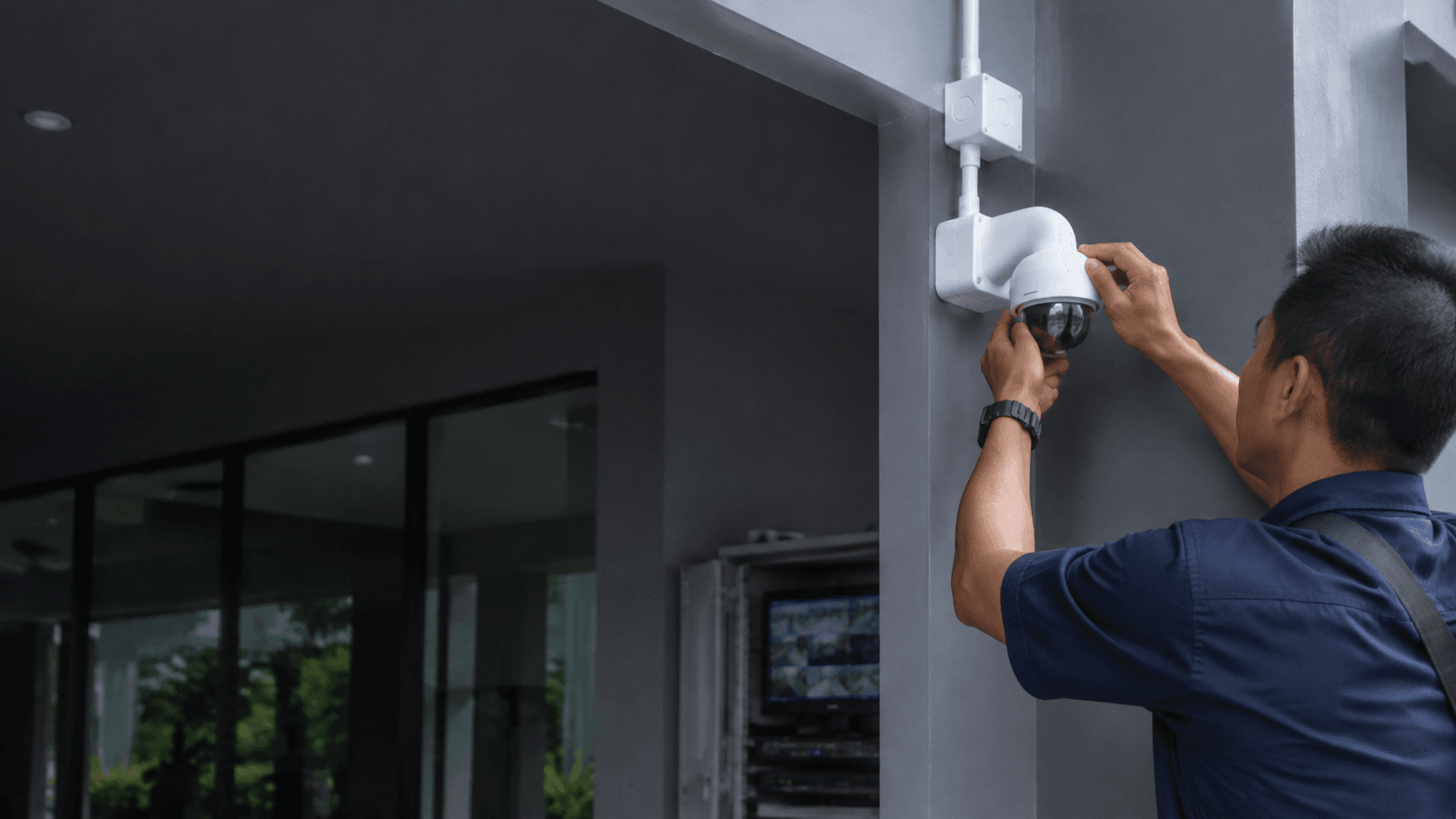
- Installation of cameras, recorder, cabling and network connection.
- Handover covering remote viewing setup, user access and basic operation.
The camera layer is the most visible. Lilin's range includes indoor and outdoor models in dome, turret, bullet and PTZ form factors, with fixed and vari-focal lens options across its published catalogue. The recorder layer is typically a network video recorder, sized by how many cameras it must accept, how many days of footage must be retained, and whether recording runs continuously or on motion. The software layer handles live viewing, playback and search. The network layer carries power and data to each camera and connects the recorder to the internet for remote viewing.
Two constraints decide most of the specification. Retention days and camera count together determine storage, because continuous recording at higher resolution consumes far more disk than motion-triggered recording at the same resolution. PoE availability determines whether a camera can be installed at a given point without a separate power run, which in turn affects cabling cost and where cameras can physically go.
How a Lilin CCTV installation is scoped in Sarawak
Scoping starts with the site, not the product list. Eyonic's CCTV installation process runs through site survey, system proposal, installation and handover, and the survey is where the practical answers are gathered: which entrances, counters, corridors and perimeter points need coverage, where cable can be routed tidily, and where the recorder can sit with ventilation and network access.
For a public-facing building, the survey questions differ from a home. The Kuching Immigration Office project focused on arrival flow, staff areas, visitor movement and dependable daily operation, which shows the pattern: coverage is planned around how people and vehicles actually move through the property, not around an even spread of cameras. A shop has different priorities again, usually counter coverage, entry and exit, and stock or cash areas.
Property type therefore changes the proposal more than brand preference does. A single-storey shop may need four to eight cameras and a compact recorder. A multi-level office or industrial site may need more cameras, longer cable runs, and a recorder sized for higher retention. The proposal should state camera positions, recorder capacity, retention target and how remote viewing will be delivered, because those four items are what the finished system is judged on.
What the survey should record
A useful survey records the coverage points and their purpose, the cable route for each camera, whether PoE is available at each point, the recorder location, and the lighting at each position during both day and night. It should also note anything that will obstruct a view later, such as shelving, signage, growing vegetation or planned renovation.
Lighting and placement checks that decide camera performance
Lighting is the single most common reason a camera underperforms after installation. A position that looks well lit to the eye can still be difficult for a camera, particularly where the light source sits behind the subject and turns it into a silhouette, or where a bright lamp sits inside the frame and pulls the exposure away from the area that matters.
Eyonic recommends checking actual lighting conditions before confirming placement for ColorVu-style cameras, and the same discipline applies to any low-light model. The check is straightforward. view the position at night, at the hours that matter, and confirm whether the area of interest is lit by ambient light, by the camera's own illuminator, or by nothing at all. If the answer is nothing, the camera choice or the position has to change.
Placement follows the same logic. A camera aimed at a face needs to be at a height and angle that captures it, which usually means lower and closer than a camera aimed at general movement. A camera covering a gate needs to see the vehicle and the driver's side, not just the road. A camera covering a long corridor needs to be positioned so the far end is still identifiable rather than a small patch of pixels.
Recording and remote viewing checks
Recording configuration should be confirmed before handover, not after an incident. That means knowing whether recording is continuous or motion-triggered, what retention period the storage actually delivers at the chosen resolution, and whether the recorder overwrites oldest footage automatically. Remote viewing should be tested on the devices that will actually be used, over the network that will actually be used, because a setup that works on the installer's phone in the car park may behave differently on a home connection.
What to compare before confirming a Lilin CCTV setup
Comparison should start with local supply and support, because a camera range that cannot be supplied, installed or serviced locally creates a practical problem regardless of how good the specifications look. Buyers should confirm who supplies the equipment, who installs it, who handles a failed camera or recorder, and what the response arrangement is.
The second comparison is fit against the site. Resolution, lens type, low-light capability and form factor should be matched to the specific positions identified in the survey, not chosen as a uniform specification across the whole property. A wide-angle camera covering an open yard and a narrow-angle camera covering a doorway are different jobs.
The third comparison is the total scope rather than the camera count. Two proposals with the same number of cameras can differ substantially in cable routing, recorder capacity, retention days, remote viewing setup and handover quality. Asking each supplier to state those items in writing makes the proposals comparable.
Where a buyer is weighing Lilin against another brand, the honest position is that brand-level specification comparisons are less useful than site-level ones. The same camera model can perform well at one position and poorly at another depending on light, distance and angle. A supplier who surveys the site and explains why each position was chosen is providing more useful information than a specification sheet.
Next practical step for a plan
The practical sequence is to define the coverage requirement first, then confirm local supply and support, then agree the survey and proposal before any equipment is ordered. Buyers who start with a camera model and work backwards usually end up adjusting placement after installation, which is more expensive than getting it right during the survey.
For properties in Sarawak, Eyonic plans, supplies and installs monitoring systems with camera placement, recording and remote viewing for homes, offices, shops and industrial sites. Share your location, property type and required system with Eyonic on WhatsApp at +60 11-5111 7959 for the next practical step.