
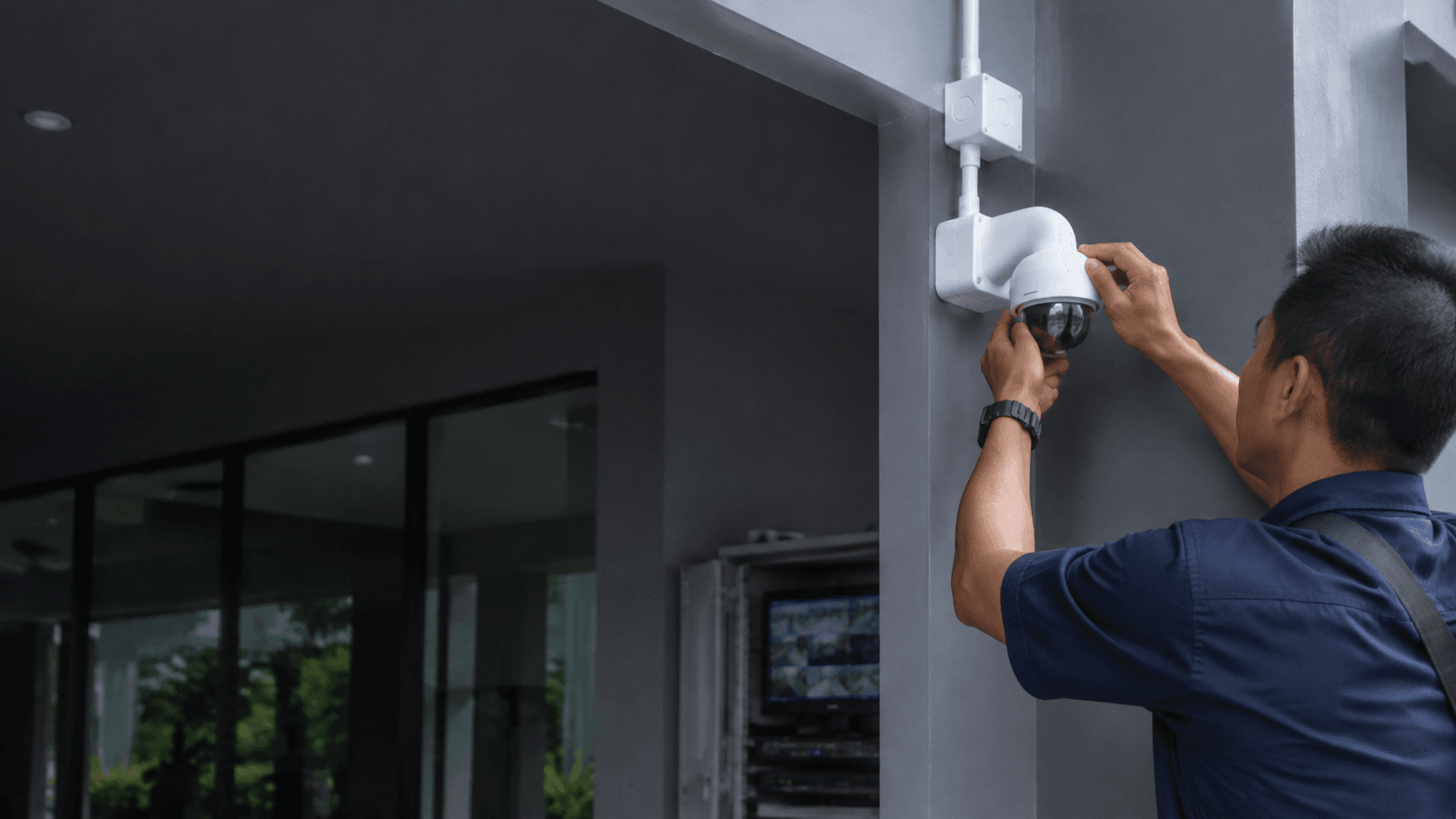
The exact-match query wireless outdoor cameras for home describes a category of equipment, but the decision that matters on a Malaysian property is rarely about the camera box alone. It is about where each unit points, how it gets power, where footage is stored, and whether remote viewing actually works on the day the installer leaves. Eyonic Sdn Bhd plans, supplies and installs monitoring systems with camera placement, recording and remote viewing for homes, offices, shops and industrial sites across Sarawak.
Wireless Outdoor Cameras For Home: What The Setup Involves
A wireless outdoor camera setup still needs three things resolved before any hardware is mounted: a viewing position that captures the area of interest, a power source for each camera, and a recording destination that someone can review later. "Wireless" usually refers to the video signal travelling without a cable run to a recorder, not to the camera operating without power. That distinction shapes the whole project.
Eyonic's CCTV service covers planning, supply and installation, with camera placement, recording and remote viewing handled as one scope rather than separate purchases. The practical sequence for a residential property runs through four stages.
- Site survey — the property is reviewed to establish where coverage is needed and what conditions each position presents.
- System proposal — a recommended setup is put together based on the survey findings.
- Installation — cameras, recording and supporting equipment are installed.
- Handover — recording configuration and mobile viewing are set up and explained.
That four-stage process is the same one Eyonic documents for its CCTV installation services in Sarawak, and it applies whether the property is a single home or a larger site.
Where Wireless Outdoor Cameras For Home Usually Get Placed
Placement is the decision that most often determines whether a system is useful or merely present. Common positions on a residential property include the main entrance and gate, the car porch, side passages, and any rear access point. Each position has a different job: an entrance camera needs to capture faces approaching the door, while a porch camera needs a wide enough view to cover vehicles and movement.
Lighting is the constraint that catches people out. Eyonic recommends checking actual lighting conditions before confirming placement for ColorVu-style cameras, because a position that looks adequate in daylight can behave very differently after dark. A camera aimed at a bright wall, a reflective surface, or a streetlight can produce a washed-out image, while a position with almost no ambient light needs different treatment again.
Two further placement constraints are worth settling during the survey rather than after installation. First, the field of view should avoid pointing directly into a neighbour's window or a public walkway where the camera captures more than the property needs. Second, the position needs a realistic path for power and for whatever carries the video signal, since a position that is ideal for coverage but impractical for cabling usually gets compromised later.
Power, Recording And Remote Viewing Decisions
Power and recording are the two choices that most affect day-to-day reliability, and both are better decided with the property in front of the installer rather than from a product listing.
On power, the realistic options are mains supply to each camera position, or a battery or solar arrangement where a cable run is genuinely impractical. Mains power removes the need to think about charging, but requires a route to each position. Battery and solar approaches trade that cabling work for ongoing attention to charge levels and panel placement. The right answer depends on the property, not on a general preference.
On recording, the choice sits between a local recorder and a cloud subscription. A local recorder keeps footage on the property and avoids an ongoing fee, but the recorder itself needs a suitable location with power and ventilation. Cloud storage removes the on-site recorder but introduces a recurring cost and a dependency on the internet connection staying up. Eyonic handles NVR setup as part of its CCTV scope, which means the recording destination is configured and tested rather than left to the property owner.
Remote viewing is the part that determines whether the system gets used. A handover that includes mobile viewing setup means the footage is reachable from a phone without a return visit. If remote viewing is configured but never tested on the actual phone and network at the property, problems tend to surface later, usually at the moment someone needs to check something.
What A Local Installation Process Looks Like
A local installer adds value mainly at the two ends of the project: the survey that decides what gets installed, and the handover that confirms it works. Eyonic's documented process runs site survey, system proposal, installation, and handover, and the survey stage is where placement, power and recording decisions get made together.
The handover stage matters more than it might appear. Camera supply and setup, basic recording configuration, and mobile viewing handover are all part of Eyonic's Hikvision CCTV Package, which is priced at RM 1,599. That package is a starting point for a residential setup rather than a specification for every property, since the number of cameras and the difficulty of each position vary from site to site.
For larger or more complex properties, the scope grows accordingly. Eyonic's work for the Kuching Immigration Office focused on arrival flow, staff areas, visitor movement and dependable daily operation, with an approximate budget range of RM 12,000 to RM 28,000 for that type of work. That project is a public office rather than a home, but it illustrates how coverage requirements and budget scale together when a site has multiple zones and continuous daily use.
Costs And Project Examples In Sarawak
Cost in this category is driven by camera count, position difficulty, and the recording arrangement, not by the word "wireless" itself. Eyonic publishes three packages at RM 1,599 each: a Hikvision CCTV Package covering camera supply and setup, basic recording configuration and mobile viewing handover; a Hikvision Alarm System covering control panel and sensors, siren and zone setup, and user testing and handover; and an Autogate Package covering motor recommendation, remote-control setup, and safety testing and handover.
For a residential property, the CCTV package is the relevant starting point. Where a home needs coverage across several zones, or where positions require more installation work, the project moves toward the range seen in Eyonic's larger site work. The KTA Sarawak Sdn Bhd project, an engineering consultancy office in Kuching, carried an approximate budget of RM 8,000 to RM 18,000 for a setup supporting staff movement, visitor handling, tidy cabling and clearer daily site control.
Two limits are worth stating plainly. Eyonic does not publish per-model technical specifications for wireless outdoor cameras, so resolution, battery life, wireless range and weather rating cannot be confirmed from its published material. Pricing for wireless camera hardware beyond the RM 1,599 Hikvision CCTV Package is likewise not published. Anyone comparing specific models should treat manufacturer documentation as the source for those figures.
Wireless Outdoor Cameras For Home: Practical Next Step
The decision that produces a working system is the survey, because placement, power and recording all depend on the specific property. A camera chosen from a specification list without a site review can end up pointing at the wrong area, sitting where power is awkward, or recording to a destination nobody checks.
Eyonic Sdn Bhd is a security system supplier in Sarawak specialising in CCTV and ELV systems, with planning, supply and installation for homes, offices, shops and industrial sites. The founder, Eric Yong, has worked in the industry for more than 10 years, with experience in technical installation of digital security solutions for commercial businesses in Sarawak.
Share your location, property type and required system with Eyonic on WhatsApp at +60 11-5111 7959 for the next practical step.