
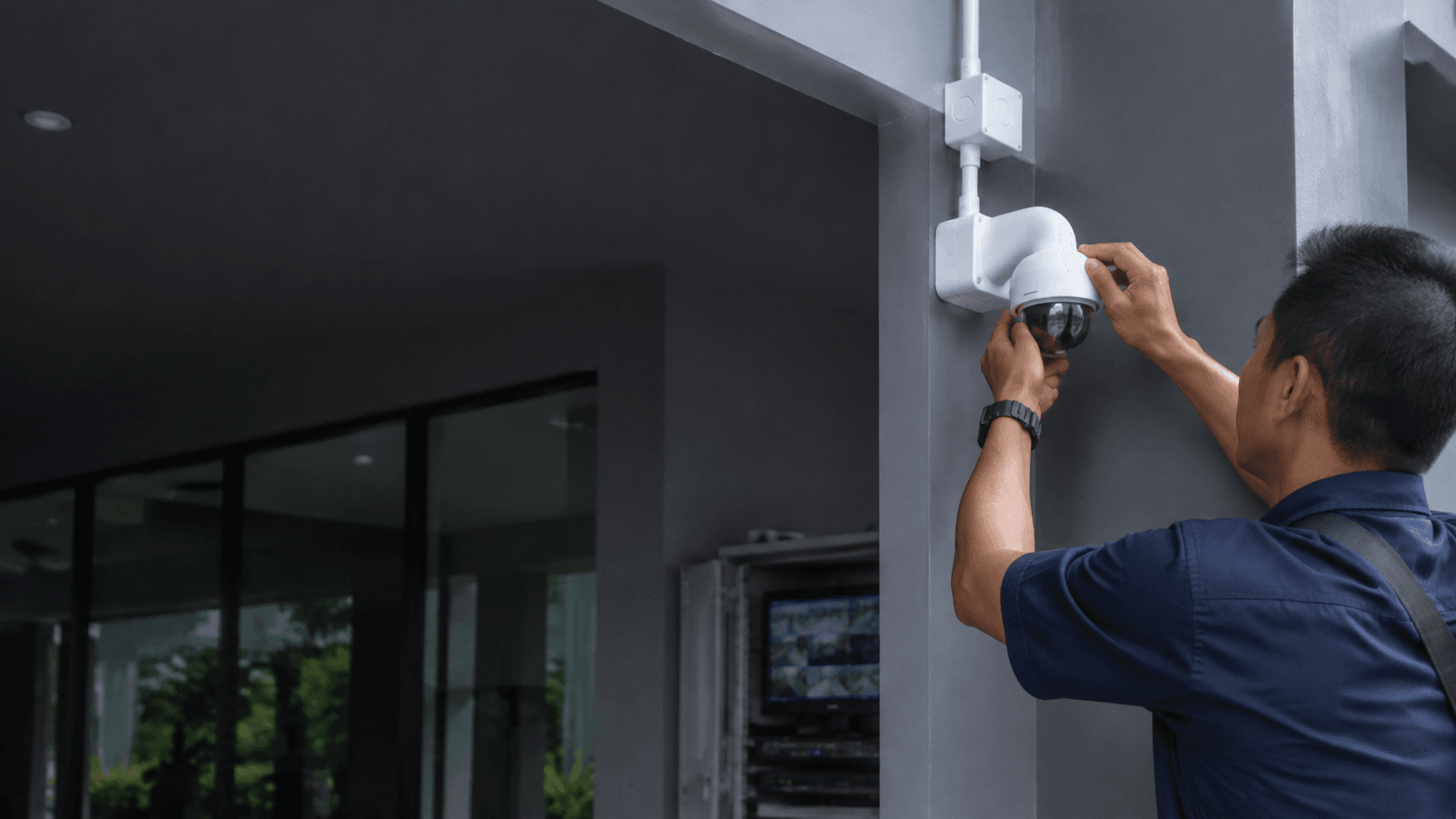
Most CCTV footage turns grey the moment the sun goes down. Colour is what lets a viewer tell a red car from a black one, or a blue shirt from a green one, without guessing. Dahua Colorvu is built around that problem, and the practical question for a Malaysian property is not whether the technology sounds good, but whether the light at the actual gate, porch or back lane will let it work.
What dahua colorvu changes after dark
Conventional night surveillance leans on infrared. Infrared illuminators are cheap and effective at showing shape and movement, but the image they produce is monochrome. A person in dark clothing against a dark wall can be almost impossible to describe afterwards.
Dahua Colorvu takes a different route. Instead of relying only on infrared, the camera uses a large-aperture lens and a built-in light source to keep the scene illuminated enough for the sensor to record colour. The result, when the conditions are right, is footage where clothing, vehicle paint and signage remain identifiable rather than reduced to shades of grey.
That difference matters most in the hours after a crime or incident, when someone is trying to match a recording against a description. Colour gives the viewer more to work with. It does not make a camera see in total darkness, and it does not remove the need for sensible placement.
Why the lens and light source matter together
A large aperture lets more light reach the sensor, which helps in dim conditions. The built-in illumination adds light where the scene is too dark for the aperture alone. Both elements work as a pair. A camera with a wide aperture but no supplementary light will still struggle in a genuinely unlit area, and a camera with strong illumination but a poor sensor will produce a bright but noisy image.
This is why the technology is best understood as a system rather than a single feature. The camera, the light it emits, and the ambient light already present at the site all contribute to the final picture.
What it does not do
Dahua Colorvu does not turn night into day. In a location with no ambient light and no reflective surfaces, the built-in illumination has to carry the whole scene, and the image will look different from a well-lit street. It also does not compensate for a camera pointed at a blank wall, a lens smeared with dust, or a mounting height that puts faces out of frame.
Buyers who expect a single camera to solve every lighting problem will be disappointed. Buyers who understand that the technology extends usable colour into lower light, within limits, will get more from it.
Where dahua colorvu suits Malaysian properties
Malaysia's lighting conditions vary enormously between a landed house in a suburban street and a shophouse backing onto an unlit service lane. The technology tends to perform best where some ambient light already exists, or where the property owner is willing to accept the camera's own illumination as part of the scene.
Typical situations where the approach makes sense include:
- Residential gates and car porches where vehicle colour and visitor appearance matter
- Shopfronts and entrances that already have some street or signage lighting
- Office reception areas and corridors with low overnight lighting
- Perimeter positions where a white-light source is acceptable at night
Situations where it is a weaker fit include large unlit industrial yards, remote sites with no power for supplementary lighting, and positions where a visible white light at night would be unwelcome to neighbours or would attract attention the owner wants to avoid.
Residential use
For a family home, the most common placements are the front gate, the car porch and the back door. These are the points where a colour recording is most useful, because they are the points where people and vehicles arrive. A camera covering the porch can show the colour of a car that pulls up, and a camera at the gate can show what a visitor is wearing.
The trade-off is the light itself. A camera that switches on a white illuminator at night is visible, and some households prefer that deterrent effect while others find it intrusive. That is a household decision, not a technical one, and it is worth settling before installation rather than after.
Commercial and office use
Offices, shops and clinics usually have some overnight lighting already, which gives the camera more to work with. Eyonic's work for the Kuching Immigration Office focused on arrival flow, staff areas, visitor movement and dependable daily operation, which is the kind of environment where colour detail at entrances and along visitor routes has practical value.
For commercial sites, the more important question is often coverage rather than colour. A colour camera covering the wrong angle is less useful than a standard camera covering the right one. Placement decisions should come first, and the imaging technology should follow.
Lighting checks before confirming camera placement
Eyonic recommends checking actual lighting conditions before confirming placement for ColorVu-style cameras. That advice applies directly to Dahua Colorvu, because the technology's performance depends on the light already present at the site.
A lighting check is not a formality. It is the step that determines whether a proposed position will produce usable colour footage at 2am, or whether the camera will fall back to a grainy image that defeats the purpose of choosing the technology in the first place.
What to look at during a check
- Note the light sources already present at each proposed position, including street lamps, porch lights, signage and neighbouring lighting.
- Check how those sources behave after midnight, when many commercial and residential lights are switched off.
- Identify reflective surfaces such as white walls, glass and polished floors that can bounce light back toward the camera.
- Confirm whether a white illuminator at that position is acceptable to the property owner and to anyone nearby.
Walking the site at night, rather than during a daytime survey, is the only reliable way to do this. A position that looks well lit at 3pm may be completely dark at 3am.
Placement trade offs
Higher mounting positions reduce the risk of tampering and give a wider view, but they also flatten faces and reduce the value of colour detail. Lower positions capture more identifiable features but are easier to reach. The right height depends on what the camera is there to record.
Angle matters too. A camera pointed directly at a bright light source will struggle, while a camera angled to use that light will perform better. These are the kinds of adjustments that a site survey is meant to resolve before any equipment is fixed to a wall.
How Eyonic plans a installation
Eyonic's CCTV installation process follows four stages: site survey, system proposal, installation, and handover. For a Dahua Colorvu deployment, the survey stage carries extra weight because the lighting assessment determines whether the technology is the right choice at all.
- Site survey. The property is reviewed for coverage requirements, existing lighting, cable routes and mounting positions.
- System proposal. A proposed system is put together based on what the survey found, including camera positions and recording setup.
- Installation. Cameras, recording equipment and cabling are installed and configured.
- Handover. The system is tested and the user is shown how to view footage and manage recordings.
Eyonic Sdn Bhd plans, supplies and installs monitoring systems with camera placement, recording and remote viewing for homes, offices, shops and industrial sites. The company is based in Sarawak and works across Kuching and the surrounding areas.
Eric Yong, founder of Eyonic Security Systems, has been in the industry for more than 10 years and is experienced in technical installation of digital security solutions for commercial businesses in Sarawak. That experience is most useful during the survey, when decisions about placement and lighting are still open.
What the proposal should cover
A useful proposal for a Dahua Colorvu system should state which positions are being covered, why those positions were chosen, and what the expected night-time result is at each one. It should also be honest about positions where the technology is not the best fit, and suggest an alternative rather than forcing a colour camera into a location where it will not perform.
Recording and remote viewing should be part of the same conversation. A camera that records colour at night is only useful if the footage can be found and reviewed afterwards, whether on site or remotely.
What to prepare before requesting a site survey
A survey is more productive when the property owner arrives with clear information. The details that matter most are the location, the type of property, and what the system is expected to do.
Useful things to have ready include:
- The property address and type, such as landed house, shophouse, office or industrial unit
- The specific areas that need coverage, such as gate, porch, back lane or entrance
- Whether night-time colour is a priority or whether standard night recording is acceptable
- Whether a visible white light at night is acceptable at each position
- Any existing cameras, cabling or recording equipment that should be reused or replaced
It also helps to know who will use the system day to day. A household that wants to check a phone occasionally has different requirements from an office that needs recorded footage reviewed by several staff.
Questions worth asking before committing
Ask which positions will use Dahua Colorvu and which will not, and why. Ask what the night-time image is expected to look like at each position. Ask how recordings will be stored and how long they will be kept. Ask what happens if the lighting at the site changes, for example if a neighbouring light is switched off or a new building blocks an existing source.
These questions are not objections. They are the difference between a system that works on the night it is needed and one that merely looks complete on the day it is installed.
Availability and fit
Dahua Colorvu is one option among several for low-light surveillance, and it is not the only approach Eyonic works with. The right choice depends on the site, the lighting, and what the footage needs to show. Where the technology fits, it offers a genuine advantage in colour detail after dark. Where it does not, a different camera or a different placement will serve the property better.
Share your location, property type and required system with Eyonic on WhatsApp at +60 11-5111 7959 for the next practical step.