
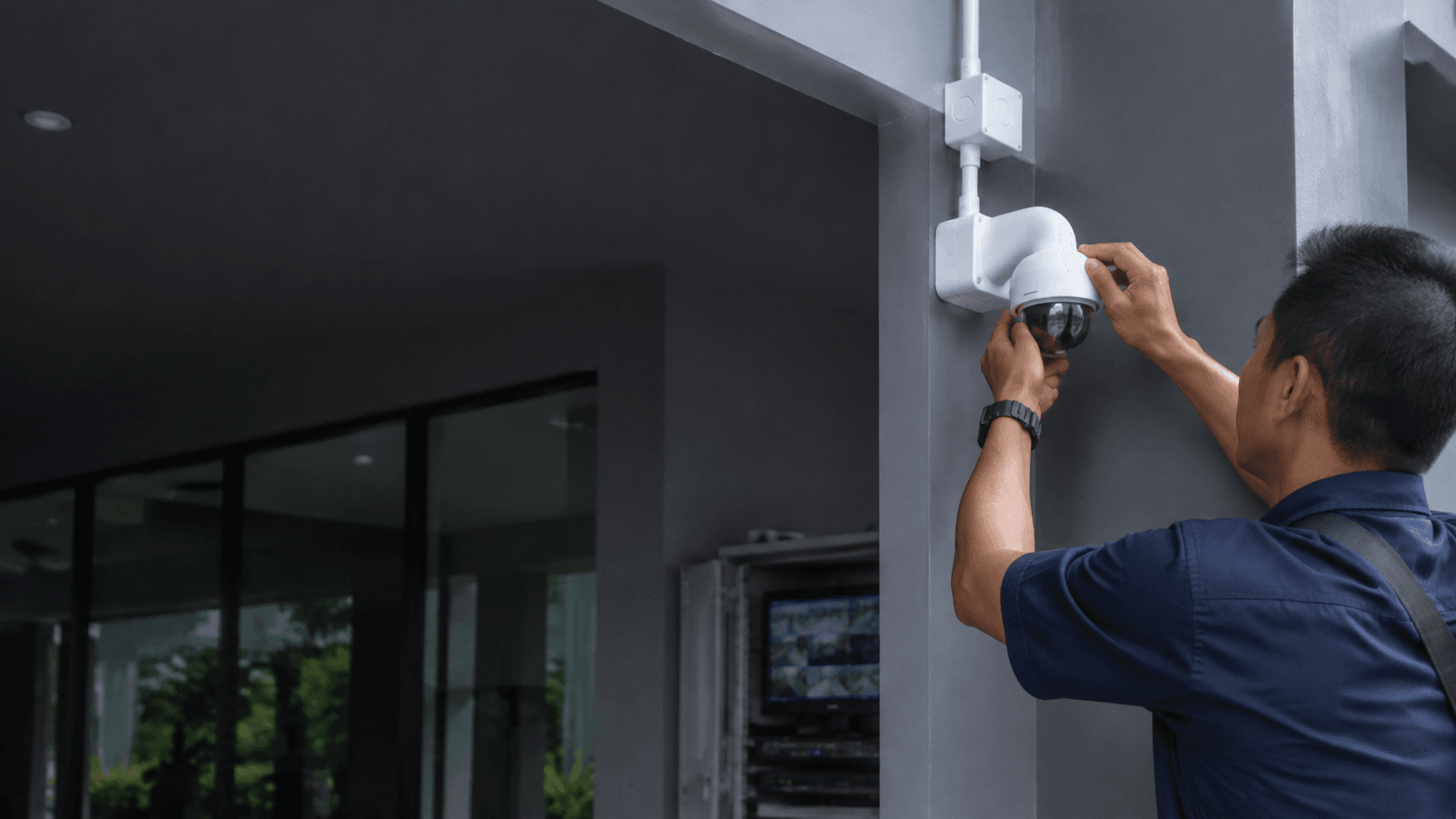
The appeal is simple. no trenching, no mains cable run, and no dependence on a single power point. The trade-off is equally simple. A solar camera only performs as well as its panel placement, its battery capacity and the amount of light the site actually receives. That is why the decision sequence below starts with the site, not the product box.
Solar Powered Cctv. What Matters Before Choosing
Most buying mistakes happen before any camera is selected. A solar panel that sits in shade for half the day will undercharge the battery, and a battery that never fully recovers will drop the camera offline during the hours that matter most. The practical order of work is.
- Confirm what the site needs to record, and when.
- Check real sunlight hours at each proposed camera position.
- Decide whether footage is stored locally, on a recorder, or in the cloud.
- Confirm how the camera connects — Wi-Fi, or a mobile network where no Wi-Fi reaches.
- Match panel and battery capacity to the site's worst month, not its best.
- Plan mounting height, angle and cable routing before drilling anything.
- Test the live view and playback before handover.
Eyonic's own installation process follows a comparable shape: site survey, system proposal, installation, and handover. The survey stage is where solar viability is settled, because panel angle and shading are physical facts that cannot be corrected later through software settings.
What Is Solar Powered Cctv?
Solar powered cctv is a camera system that draws its operating power from a solar panel charging a rechargeable battery, rather than from a fixed mains supply. The camera still needs a way to send video — typically Wi-Fi or a cellular connection — and a place to store it, whether that is a memory card, a network video recorder, or a cloud plan.
Two details separate a workable installation from a disappointing one. The first is that the panel charges the battery; the camera runs on the battery. A cloudy week is therefore a battery event, not a panel event. The second is that night operation, motion-triggered recording and spotlight use all draw more power than idle standby, so a camera that looks fine on a sunny afternoon can behave differently after several overcast days.
Solar cameras suit positions where running cable is expensive, disruptive or impossible: gate posts, perimeter fences, detached structures, temporary sites and rented premises where drilling and cabling are restricted. They suit fixed, well-lit positions far better than heavily shaded ones.
Choosing the Right Solar Powered Cctv
Selection comes down to four variables that interact: light, power budget, connectivity and storage. Changing one usually changes the others.
Light and panel placement
A panel needs unobstructed sun for a meaningful part of the day. Trees, roof overhangs, walls and even the camera's own mounting bracket can cut charging hours. Eyonic's guidance on ColorVu-style cameras makes the same point in a different context: check actual lighting conditions on site before confirming placement, rather than assuming from a floor plan or a product photo.
Battery capacity and recording behaviour
Continuous 24/7 recording drains a battery far faster than motion-triggered clips. Sites that need constant recording generally need either a larger panel and battery combination or a mains-powered camera. Sites that only need event clips — a gate opening, a vehicle arriving, a person crossing a line — are a much better fit for solar.
Connectivity
Wi-Fi solar cameras depend on a stable signal reaching the mounting point. Signal strength at ground level is not a reliable indicator of signal strength at the top of a pole or the far end of a fence line. Where no Wi-Fi reaches, a cellular camera removes the cabling problem but introduces a data plan and ongoing cost.
Storage and running costs
Local storage on a memory card or recorder usually carries no recurring fee. Cloud storage typically does. This is a genuine trade-off rather than a clear winner: local storage keeps costs predictable but puts the recording physically at the site, while cloud storage survives the theft or destruction of the camera itself.
Practical Considerations for
Several constraints show up repeatedly once a solar system is running in the field.
Weather and seasonality. Sarawak's rainfall and cloud cover vary through the year. A system sized for average conditions can still struggle through an extended overcast stretch, so headroom in panel and battery capacity is worth more than a marginal saving on hardware.
Night performance. Infrared or spotlight-assisted night recording draws more power than daytime standby. Cameras that switch on a spotlight when motion is detected look impressive in demonstrations but consume battery quickly in practice.
Mounting and access. A solar camera high on a pole is harder to reach for cleaning, repositioning or battery checks. Panel surfaces collect dust and debris, and a partially obscured panel charges less. Access planning belongs in the survey, not in a later service call.
Integration with an existing system. Where a site already runs a recorder and a set of wired cameras, adding solar units raises questions about whether footage lands in the same interface or in a separate app. Answering that before purchase avoids two disconnected viewing experiences.
Coverage versus convenience. Solar removes the cable, not the physics of camera placement. A well-positioned solar camera covering one gate will outperform a poorly positioned one covering a wide yard, regardless of resolution.
Making an Informed Choice About
The decision usually resolves into one of three situations.
Where mains power and network cable already reach the position, a wired camera remains the more predictable option: continuous power, no battery cycle, no dependence on weather. Where cable cannot reasonably be run and the position receives reliable daylight, solar powered cctv is a strong fit. Where the position is both shaded and cable-free, the honest answer is that solar may not be the right tool, and a different power or mounting approach should be considered.
For sites in Sarawak, Eyonic's completed work includes the Kuching Immigration Office, where the focus was arrival flow, staff areas, visitor movement and dependable daily operation, and KTA Sarawak Sdn Bhd, where the requirement was a practical office setup supporting staff movement, visitor handling and tidy cabling. Both illustrate the same principle: the camera list follows the site's movement patterns and operating hours, not the other way round.
Budget expectations are worth setting early. Eyonic's published packages for a Hikvision CCTV package, a Hikvision alarm system and an autogate package are each priced at RM 1,599, covering supply, basic configuration and handover. Larger multi-area projects sit in a different range; the Kuching Immigration Office project carried an approximate budget of RM 12,000 to RM 28,000, and the KTA Sarawak Sdn Bhd project an approximate budget of RM 8,000 to RM 18,000. Solar hardware, cellular data plans and cloud subscriptions sit outside those figures and should be costed separately.
One final check before committing: confirm the system can be maintained. A solar installation that cannot be safely reached for panel cleaning or battery service will degrade quietly. Eric Yong, founder of Eyonic Security Systems, has worked in the industry for more than 10 years, and the recurring lesson from installation work is that access and maintenance planning decide whether a system still performs in year three.
Share your location, property type and required system with Eyonic on WhatsApp at +60 11-5111 7959 for the next practical step.