
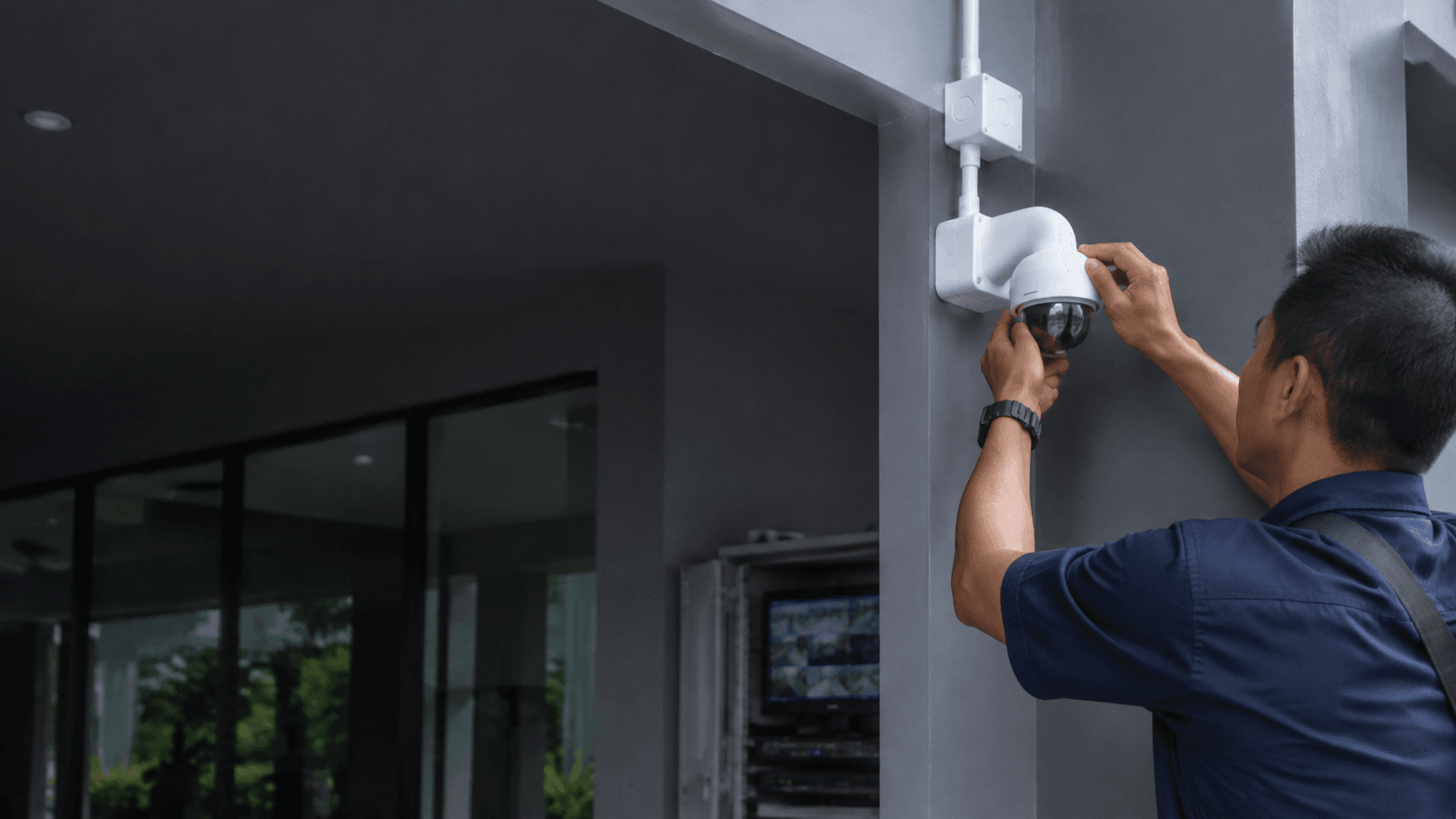
The exact-match query lorex outdoor camera describes a category rather than a single product. Lorex publishes outdoor models across several series, and the range includes wired PoE cameras and battery-powered Wi-Fi cameras. Because the range is broad, the buying decision usually turns on the property rather than the brand.
Malaysian properties add their own constraints. Terrace houses, shophouses, and industrial lots each present different cable routes, different lighting at night, and different points where a camera can actually be mounted. A model that suits one of those settings may not suit another.
What a Lorex Outdoor Camera Covers
An outdoor camera is built to watch an exterior area continuously or on motion. The coverage question is not how wide the lens is on paper, but which approach, gate, or walkway the camera can see without obstruction.
Lorex groups its outdoor options into a few practical shapes. Bullet cameras point along a wall or fence line. Turret cameras angle downward and suit corners. Pan-tilt models move to cover more ground from one mounting point. Floodlight and dual-lens models combine lighting or a wider view with recording.
Coverage also depends on what happens after recording. A camera connected to a recorder keeps footage locally. A standalone Wi-Fi camera usually stores to a card or a cloud plan. That difference affects both cost and how footage is retrieved later.
Where coverage usually matters most
Most exterior layouts need the same few views: the main entrance, the vehicle area, and any side or rear path that is not visible from inside the property. A camera that covers the entrance but leaves the rear lane unmonitored solves only part of the problem.
Overlapping views are more useful than a single wide view. Two cameras covering a gate from different angles make it harder for someone to approach without being seen from at least one direction.
Lighting and Placement Checks
Lighting is the check most often skipped. A camera that performs well in daylight can behave very differently at night, and the result depends on what light already exists at the mounting point.
Eyonic recommends checking actual lighting conditions before confirming placement for ColorVu-style cameras, which rely on available light to produce a colour image after dark. The same principle applies to any outdoor camera being considered for a night-time view.
Placement checks that change the outcome include:
- Whether a streetlight, porch light, or neighbouring light reaches the target area after dark.
- Whether the camera faces a strong light source that would wash out the image.
- Whether the mounting height allows a face-level view rather than a view of the top of heads.
- Whether trees, signage, or an awning will block part of the view during rain or wind.
- Whether the cable route from that point back to the recorder is practical.
A camera mounted under a deep eaves overhang may stay dry but lose the view of the area directly below it. A camera mounted lower may see more but sit within easier reach. That trade-off is decided on site, not from a specification page.
Wired, Wireless and Recording Choices
The wiring decision usually comes before the model decision. A wired camera needs a cable run from the camera to a recorder or power source. A wireless camera needs power or a charged battery plus a reliable Wi-Fi signal at the mounting point.
Wired systems tend to suit properties where cable can be routed during construction, renovation, or alongside other work. Wireless cameras suit retrofits where running cable through finished walls is impractical, provided the Wi-Fi signal reaches the exterior position.
Recording follows the same split. A recorder keeps footage on a local drive and does not depend on internet speed to store video. A standalone camera often depends on a card or a subscription plan, and remote viewing depends on the upload speed available at the property.
Remote viewing is a common requirement for owners who travel or manage more than one site. It works on both approaches, but the quality of the remote view depends on the internet connection at the property rather than on the camera alone.
Installation Steps in Sarawak
Eyonic's CCTV installation process follows a defined sequence, and the same sequence applies to an outdoor camera installation.
- Site survey to review the property layout, existing lighting, cable routes, and the areas that need coverage.
- System proposal covering camera positions, recording approach, and the equipment required.
- Installation of cameras, cabling, recorder, and configuration of recording and remote viewing.
- Handover with user testing so the owner can view footage and check the system in daily use.
The survey stage is where most problems are avoided. A camera position that looks correct on a floor plan can turn out to be blocked by a beam, a signboard, or a neighbouring structure once seen on site.
Eyonic completed a project for the Kuching Immigration Office, focused on arrival flow, staff areas, visitor movement, and dependable daily operation. That project illustrates how coverage is planned around movement through a site rather than around a single camera position.
For engineering consultancy sites, Eyonic has supported office setups in Kuching that needed staff movement coverage, visitor handling, and tidy cabling. Cabling quality matters over time because exposed or poorly routed cable is the most common source of later faults.
What to Confirm Before Ordering
Several details determine whether a Lorex outdoor camera will work at a specific property, and they are worth confirming before any order is placed.
Local supply, warranty terms, and after-sales support for the specific model should be confirmed with the supplier. Availability of a model in one market does not guarantee the same model, warranty, or support arrangement in another.
Weather exposure at the mounting point should be checked against the rating of the camera being considered. A position under an eaves is a different environment from a position on an open fence line.
Night-time performance should be judged against the actual lighting at the site rather than against a demonstration video. Where lighting is genuinely poor, additional lighting or a camera designed for low-light conditions may be the more realistic answer.
Storage and retention should be decided in advance. The number of days of footage kept determines the drive size needed in a recorder, and that requirement grows with the number of cameras.
Budget expectations should be set against the property rather than the camera alone. Eyonic's published packages start at RM 1,599 for a Hikvision CCTV package, RM 1,599 for a Hikvision alarm system, and RM 1,599 for an autogate package. Larger site work sits in a different range: the Kuching Immigration Office project carried an approximate budget of RM 12,000 to RM 28,000, and the KTA Sarawak Sdn Bhd project an approximate budget of RM 8,000 to RM 18,000.
Where a property needs more than cameras, the same supplier may cover related systems. Eyonic also handles alarm systems, autogate installation, keyphone intercom, and Starlink internet installation in Sarawak, which matters when several systems need to work together on one site.
Share your location, property type and required system with Eyonic on WhatsApp at +60 11-5111 7959 for the next practical step.