
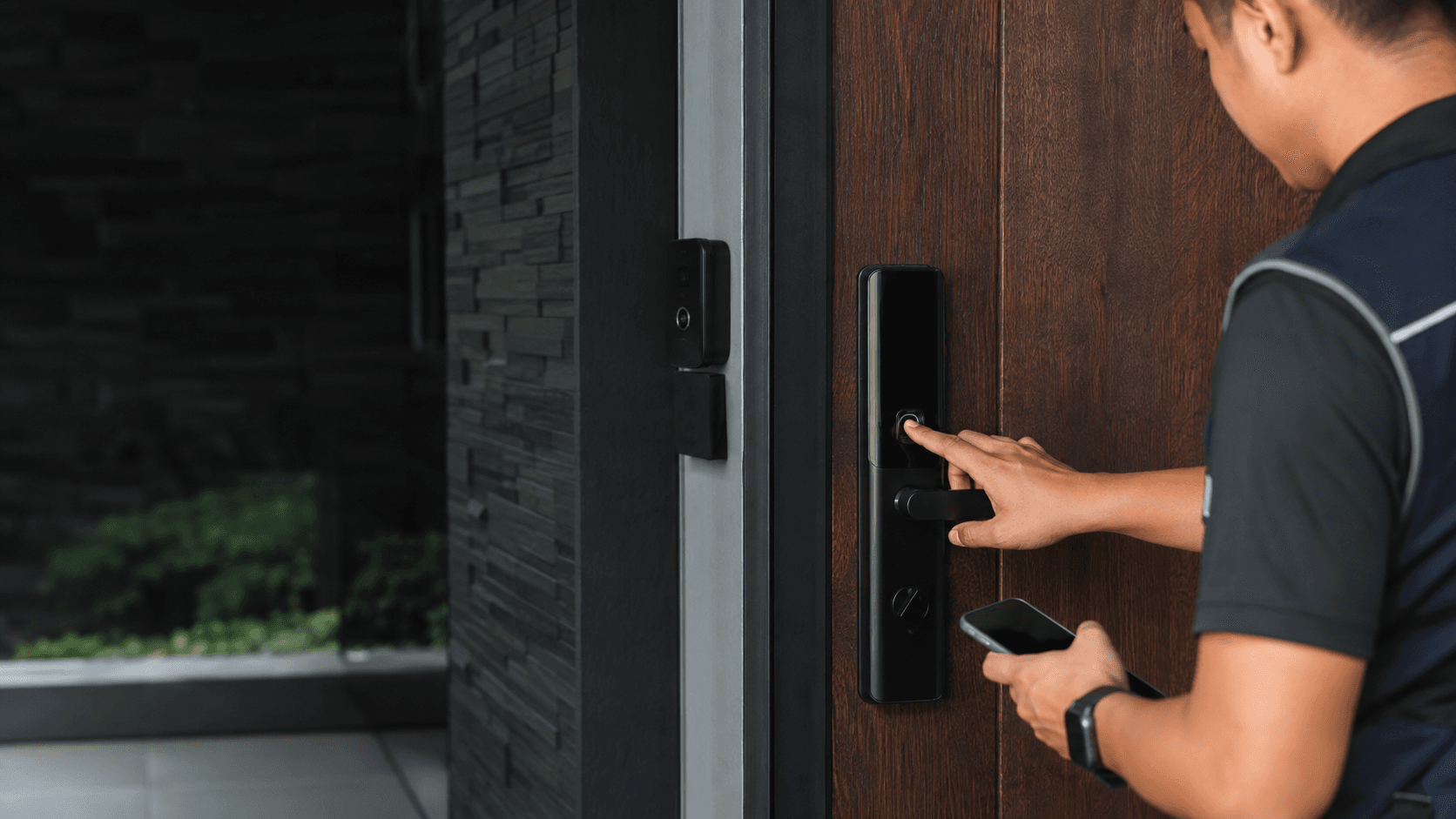
The term bluetooth door describes a door that opens through a wireless credential instead of a physical key. In practice it covers two different products: a standalone smart lock fitted to an existing door, and a panel-based access control system that manages several doors and many users from one place.
Malaysian readers researching this topic are usually weighing convenience against control. A home owner wants to stop carrying keys. A shop owner wants staff to enter without sharing a key that can be copied. An office manager wants a record of who entered and when. Those are three different problems, and they do not all point to the same hardware.
Bluetooth Door. What the Term Covers
A bluetooth door setup is not one product category. It is a way of granting entry, and the hardware behind it varies with the door and the number of people who need access.
The two common shapes are a standalone smart lock and an access control panel. A standalone smart lock replaces or fits over the existing lock on a single door. An access control panel sits between the credential and the door hardware, and it can manage several doors, several user groups and several schedules at once.
Eyonic's own product review notes that smart locks work best when door condition, user roles and backup method are reviewed before installation, and that for business use the choice between a standalone smart lock and an access-control panel is usually the first decision. That framing matters because the two options fail in different ways. A standalone lock fails on a single door. A panel-based system fails across every door it controls, which makes the pre-installation review more important, not less.
Both shapes share the same vocabulary: keyless entry, user permissions, backup entry and handover. Those four words describe most of what determines whether the system works six months after installation.
How Bluetooth Door Access Works in Daily Use
A user approaches the door, presents a credential, and the lock releases. The credential is usually a phone, a card, a code or a fingerprint, depending on the hardware. The lock then re-secures itself after a set interval.
What separates a good installation from a frustrating one is what happens around that moment. Three things matter most in daily operation.
User permissions decide who can open which door and when. A home needs one or two permission levels. A shop with shift staff needs permissions that can be added and removed as people join and leave. An office with visitors needs a permission level that expires.
Backup entry decides what happens when the primary credential fails. A dead phone battery, a forgotten code or a flat lock battery should not strand anyone outside. Every bluetooth door plan needs a second way in that does not depend on the same failure point as the first.
Handover decides whether the people using the door understand it. Eyonic's CCTV installation process runs through site survey, system proposal, installation and handover, and the same sequence applies to door access work. A system that is installed but not explained tends to get bypassed, propped open or left unlocked.
Eyonic's Kuching Immigration Office project focused on arrival flow, staff areas, visitor movement and dependable daily operation. That is the same set of concerns a bluetooth door decision raises in a public-facing building: how people arrive, where staff move, how visitors are handled, and whether the system holds up on an ordinary working day.
Bluetooth Door Checks Before Installation
Most failed installations trace back to something that was visible before the work started. Working through these checks in order prevents the common problems.
- Check the door condition. The door leaf, frame, existing lock cut-out and closing action all affect what hardware will fit and whether it will align reliably.
- Map the user roles. List every person or group who needs entry, what they need to reach, and when. This decides whether a standalone lock is enough or whether a panel is required.
- Agree the backup entry method. Decide how someone gets in when the phone is dead, the code is forgotten or the primary credential fails.
- Confirm the power or battery arrangement. Establish where power comes from, or how the lock is powered, and who is responsible for replacing it.
- Confirm the network and app requirements. Establish what the phone app needs to reach the lock, and what happens when that connection is unavailable.
The door condition check is the one most often skipped. A door that does not close cleanly will not hold a lock reliably, no matter how good the lock is. Eyonic applies the same principle to camera work, checking actual conditions on site before confirming placement rather than assuming from a plan.
Door condition and hardware fit
A solid timber door, a metal-framed glass door and a lightweight interior door each accept different hardware. The existing lock cut-out may or may not suit a replacement. The frame may or may not carry the weight. None of this can be settled from a photograph alone.
User roles and permissions
A single household needs one permission level. A shop with part-time staff needs permissions that can be revoked the day someone leaves. An office with contractors and visitors needs time-limited access. The number of distinct permission levels is usually the deciding factor between a standalone lock and a panel.
Backup entry and edge cases
Backup entry is not a formality. It is the part of the plan that gets tested on the worst day. A mechanical key override, a second credential type, or a staffed reception point all work as backup, but each has a different cost and a different failure mode.
Compared With Other Entry Options
The comparison that matters most is between a standalone smart lock and a panel-based access control approach. Both can be described as a bluetooth door solution, but they suit different buildings.
| Consideration | Standalone smart lock | Panel-based access control |
|---|---|---|
| Door condition | Suits a single door in reasonable condition | Suits multiple doors, including mixed hardware |
| User roles | Best for a small number of users and simple permissions | Handles many users, groups and schedules |
| Backup entry | Usually a mechanical override or second credential | Planned across the system, often with a staffed point |
| Typical fit | Homes, small shops, single offices | Offices, public buildings, multi-door sites |
Eyonic's product review states that for business use the usual check is whether a standalone smart lock or an access-control panel is more appropriate. That check is about user roles and door count more than about the wireless method itself.
Other entry options sit alongside these two. A conventional keyed lock remains the simplest and needs no power. An intercom and keyphone system handles visitor screening at a gate or lobby. An autogate handles vehicle entry. These are not replacements for door access, and they are not automatically integrated with it. Eyonic supplies intercom, autogate, alarm and CCTV systems, but no supplied evidence confirms compatibility between those systems and any specific bluetooth door lock, so integration should be confirmed on site rather than assumed.
Costs and Project Scope in Malaysia
No supplied evidence gives a Bluetooth door installation price, package price or labour rate, so no figure is quoted here. What can be described is the shape of the project and the published Eyonic package pricing for adjacent systems.
Eyonic publishes three packages at RM 1,599 each: a Hikvision CCTV package covering camera supply and setup, basic recording configuration and mobile viewing handover; a Hikvision alarm system covering control panel and sensors, siren and zone setup, and user testing and handover; and an autogate package covering motor recommendation, remote-control setup, and safety testing and handover.
Those packages show the pattern a door access project follows: supply, configuration, user testing and handover. Door access work is scoped the same way, with the addition of the door condition review.
For larger sites, Eyonic's published project budgets give a sense of scale. The Kuching Immigration Office project carried an approximate budget of RM 12,000 to RM 28,000. The KTA Sarawak Sdn Bhd project, an engineering consultancy office in Kuching, carried an approximate budget of RM 8,000 to RM 18,000. Both covered practical office setups supporting staff movement, visitor handling and clearer daily site control.
Scope for a bluetooth door project usually includes the door condition review, the choice between standalone and panel-based hardware, user permission setup, backup entry planning, installation, user testing and handover. Anything beyond that, such as integration with existing CCTV, alarm or intercom systems, needs to be confirmed against the actual equipment on site.
Planning With Eyonic
Eyonic Sdn Bhd is a security system supplier in Sarawak, Malaysia, working on CCTV and ELV systems for homes, offices, shops and industrial sites. The company plans, supplies and installs monitoring systems with camera placement, recording and remote viewing, and its published service list includes site survey, camera placement, NVR setup and remote viewing.
Eric Yong founded Eyonic Security Systems and has worked in the industry for more than ten years, with experience in technical installation of digital security solutions for commercial businesses in Sarawak.
The practical sequence for a door access project follows the same path as the published CCTV process: site survey, system proposal, installation and handover. The site survey is where door condition, user roles and backup entry get settled. The proposal turns those findings into a specific hardware recommendation. Installation and handover close the loop by testing the system with the people who will actually use it.
Two named projects show how that works in practice. The Kuching Immigration Office project supported arrival flow, staff areas, visitor movement and dependable daily operation in a public building. The KTA Sarawak Sdn Bhd project supported staff movement, visitor handling, tidy cabling and clearer daily site control in an engineering consultancy office. Both are office environments where door access decisions sit alongside visitor management and staff movement rather than standing alone.
For a Malaysian home, shop or office weighing a bluetooth door setup, the useful starting point is not a product list. It is a clear description of the door, the people who need to pass through it, and the way in when the primary credential fails. Share the location, property type and required system with Eyonic on WhatsApp at +60 11-5111 7959 for the next practical step.