
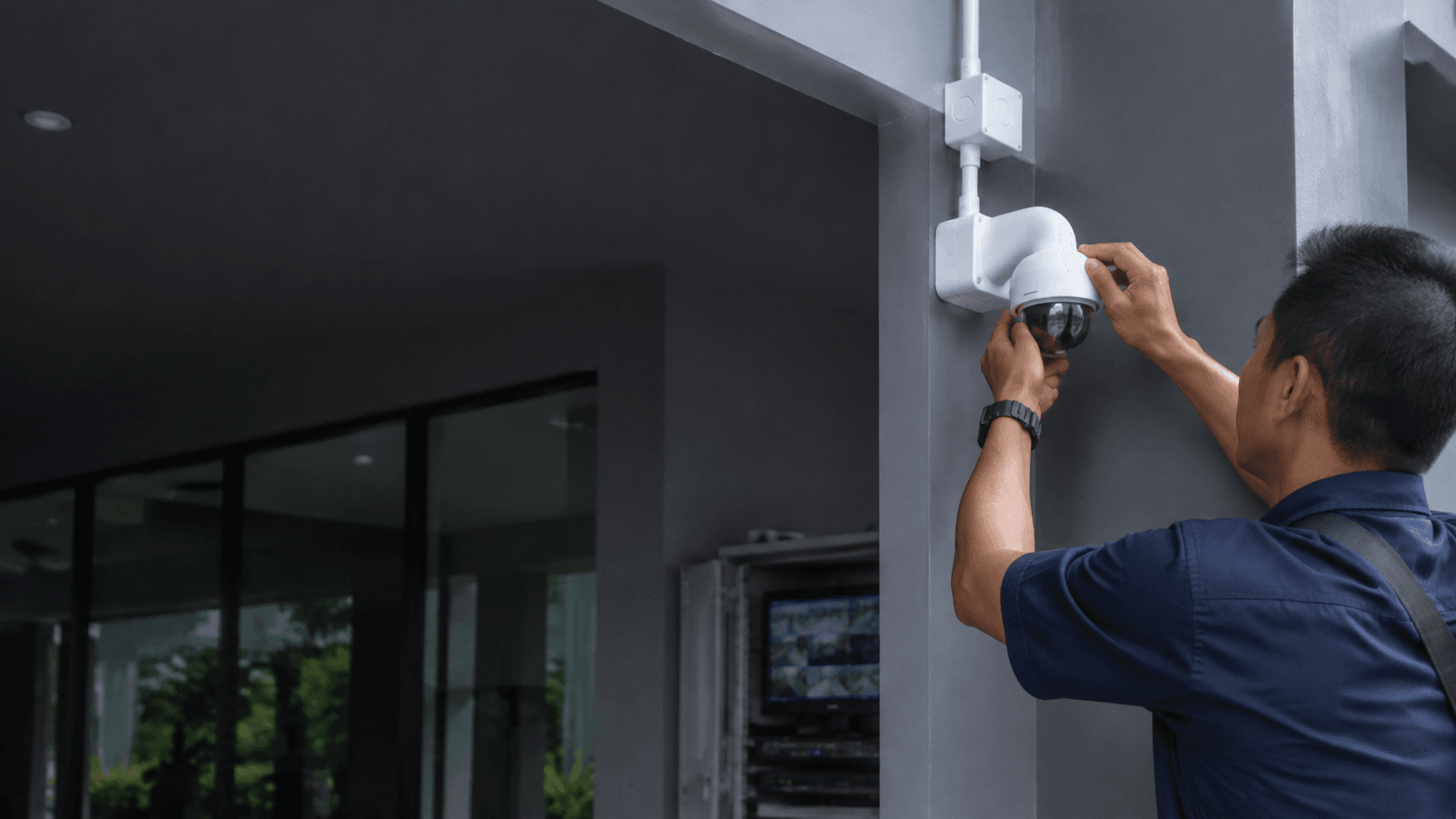
The exact phrase verisure cctv is searched in Malaysia, yet the pages that actually rank for it are Verisure's own UK and corporate properties, app store listings and a YouTube video. None of the eight pages analysed used the phrase once. That gap matters, because a reader searching verisure cctv in Malaysia is usually trying to work out two separate things: what a Verisure-branded monitored camera setup actually is, and whether anything like it can be bought, installed and supported locally.
This article answers the first question from Verisure's own published material, then handles the second honestly. Where the evidence does not confirm Malaysian availability, pricing or monitoring arrangements, that limit is stated rather than filled in with guesswork. The practical comparison that follows uses a Sarawak security supplier's documented process and project work as the local reference point.
What Verisure Cctv means in a monitored alarm setup
In Verisure's own published material, cameras are not sold as a standalone CCTV kit. They sit inside a monitored alarm system, alongside alarm sensors, a control panel and an alarm receiving centre that handles alerts. The camera's job is to add visual confirmation to an alarm event, not to run as an independent recording device.
Verisure's UK camera page describes outdoor cameras with spotlight and infrared night vision, indoor cameras with privacy controls, and wireless video doorbells, all presented as part of a monitored system rather than a self-installed kit. The same page frames the distinction directly: monitored cameras against DIY cameras. Verisure's app page describes remote monitoring, live video footage and real-time alerts delivered through a smartphone app, with alarm events routed to an alarm receiving centre.
That structure is the defining feature of verisure cctv as a category. The camera is one component in a chain that runs from detection, to verification, to a human response. A standalone recorder has no equivalent link in that chain.
What the brand's own material confirms
Verisure's corporate site states the company operates in 18 countries across Europe and Latin America. Its UK pages describe professionally monitored alarm systems, an alarm receiving centre, and camera products including Arlo-branded outdoor cameras and a GuardVision photo detector. App listings for Verisure Cameras describe streaming, recording, motion detection, audio detection, infrared night mode and wide dynamic range settings.
What that material does not contain is any Malaysian market listing, Malaysian pricing, Malaysian warranty terms or a Malaysian alarm receiving centre. The corporate market list covers Europe and Latin America. On the evidence available, Verisure CCTV should be treated as a brand and system concept rather than a product line confirmed as purchasable in Malaysia.
How monitored cameras differ from standalone recording
The difference is what happens after motion is detected. A standalone recorder writes video to a local drive or memory card and stops there. A monitored camera system passes the event to a monitoring centre, where a person can review it and act.
Verisure's UK material describes this as the split between monitored and DIY cameras, and its app page describes alarm events reaching an alarm receiving centre. The trade-offs run in both directions.
Monitored systems typically involve a recurring subscription, a contract term and installation by the provider, because the monitoring service is the product being sold. Standalone systems involve a one-off hardware and installation cost, with the property owner responsible for reviewing footage and deciding what to do about it. A monitored system suits a site where nobody is present to watch footage in real time. A standalone system suits a site where recording for later review is the actual requirement.
For most Malaysian homes, shops and offices, the practical question is not which category is better in the abstract. It is whether a recurring monitoring fee is justified by the response it buys, and whether the response is available at the property's location.
What Malaysian property owners should compare before choosing
Four things separate a workable camera system from an expensive one, and none of them are camera resolution.
Who responds, and how fast. A monitored system is only worth its subscription if a real person acts on an alert. Verisure's UK pages describe alarm receiving centre handling and guard response, but no equivalent Malaysian arrangement is confirmed in the available evidence. Any local buyer should establish, in writing, who receives an alert and what they do with it.
Where footage is stored and for how long. Verisure's app listings describe streaming and recording from a smart camera system. Local systems typically record to an NVR on site. The two carry different risks. cloud storage depends on the internet connection and a subscription staying active, while on-site recording depends on the recorder surviving the incident.
Whether the property's internet and power can carry the system. Remote viewing depends on upload bandwidth, not download. A connection that streams video comfortably to the property may still struggle to send it out.
What the installation actually includes. Camera supply, cabling, recorder configuration, mobile viewing setup and user handover are separate line items in most quotations. A price that covers only hardware leaves the rest to be arranged separately.
Eyonic, a security system supplier based in Sarawak, publishes package pricing that makes this structure visible: a Hikvision CCTV package, a Hikvision alarm system and an autogate package are each listed at RM 1,599, covering camera or panel supply, basic configuration and mobile viewing or user handover. That is a one-off structure rather than a subscription model, which is the main commercial difference from a monitored service.
Where a local supplier fits
Eyonic plans, supplies and installs monitoring systems with camera placement, recording and remote viewing for homes, offices, shops and industrial sites. Its documented project work includes the Kuching Immigration Office, where the requirement centred on arrival flow, staff areas, visitor movement and dependable daily operation, and KTA Sarawak Sdn Bhd, an engineering consultancy office needing support for staff movement, visitor handling, tidy cabling and clearer daily site control.
Those projects describe the kind of requirement a monitored system is often bought for: coverage of movement through a site, reviewed after the fact, with the installation expected to keep working without attention. They do not describe a monitoring centre, and no such claim is made here.
Camera placement and lighting checks that change results
Placement decides whether a camera produces usable footage. Two failures account for most disappointing installations: the camera is pointed at the wrong area, or the light at that area is not what it appeared to be during the site visit.
Eyonic's published guidance on ColorVu-style cameras recommends checking actual lighting conditions before confirming placement. The reason is mechanical. Cameras that produce colour images in low light depend on available light reaching the sensor, and a position that looks adequately lit in the afternoon can be effectively dark at the hours that matter. A daytime site visit can therefore confirm a position that fails at night.
Three checks reduce that risk.
- Walk the site at the hours the system needs to perform, not only during the working day.
- Identify what the camera must actually capture — a face, a plate, or simply that someone crossed a line — because the required detail changes the lens and the position.
- Confirm the mounting height and angle against the light sources that will be present at night, including any that will be switched off.
Coverage of entrances, arrival routes and staff or visitor movement areas tends to matter more than wide coverage of empty space. The Kuching Immigration Office project focused on arrival flow, staff areas and visitor movement rather than blanket coverage, which reflects the same principle.
Installation sequence from site survey to handover
Eyonic's documented CCTV installation process runs through four stages. The sequence matters because each stage constrains the next: a placement decision made before the survey limits what the proposal can offer, and a handover that skips user testing leaves the system unverified.
- Site survey. The property is assessed for camera positions, cabling routes, recorder location, lighting conditions and power availability.
- System proposal. The survey findings become a specification covering camera types, placement, recording and remote viewing, with the associated cost.
- Installation. Cameras, cabling and the recorder are installed and configured, including NVR setup and remote viewing access.
- Handover. The system is tested with the user, mobile viewing is set up on the devices that will actually be used, and operation is explained.
The handover stage is where most value is lost. A system that records correctly but cannot be reviewed by the person who needs it is not doing its job. Confirming mobile viewing on the actual phones and tablets in use, and testing playback rather than only live view, closes that gap.
What to settle before installation begins
Three items are worth confirming in writing before work starts: which areas are covered and which are deliberately not, where footage is stored and for how long, and who to contact if the system stops recording. For a monitored service, a fourth applies — what triggers a response and what that response is.
For readers weighing a monitored service against a locally installed system, the deciding factor is usually the response arrangement rather than the camera. A locally installed system with clear recording, reliable remote viewing and a defined maintenance contact covers the majority of Malaysian home, shop and office requirements. A monitored service adds a human response layer, and that layer is only valuable where it is actually available.
Where the requirement is a practical local installation, Eyonic's process starts with a site survey and a written proposal. Sharing the property location, property type and required system with Eyonic on WhatsApp at +60 11-5111 7959 is the next practical step.