
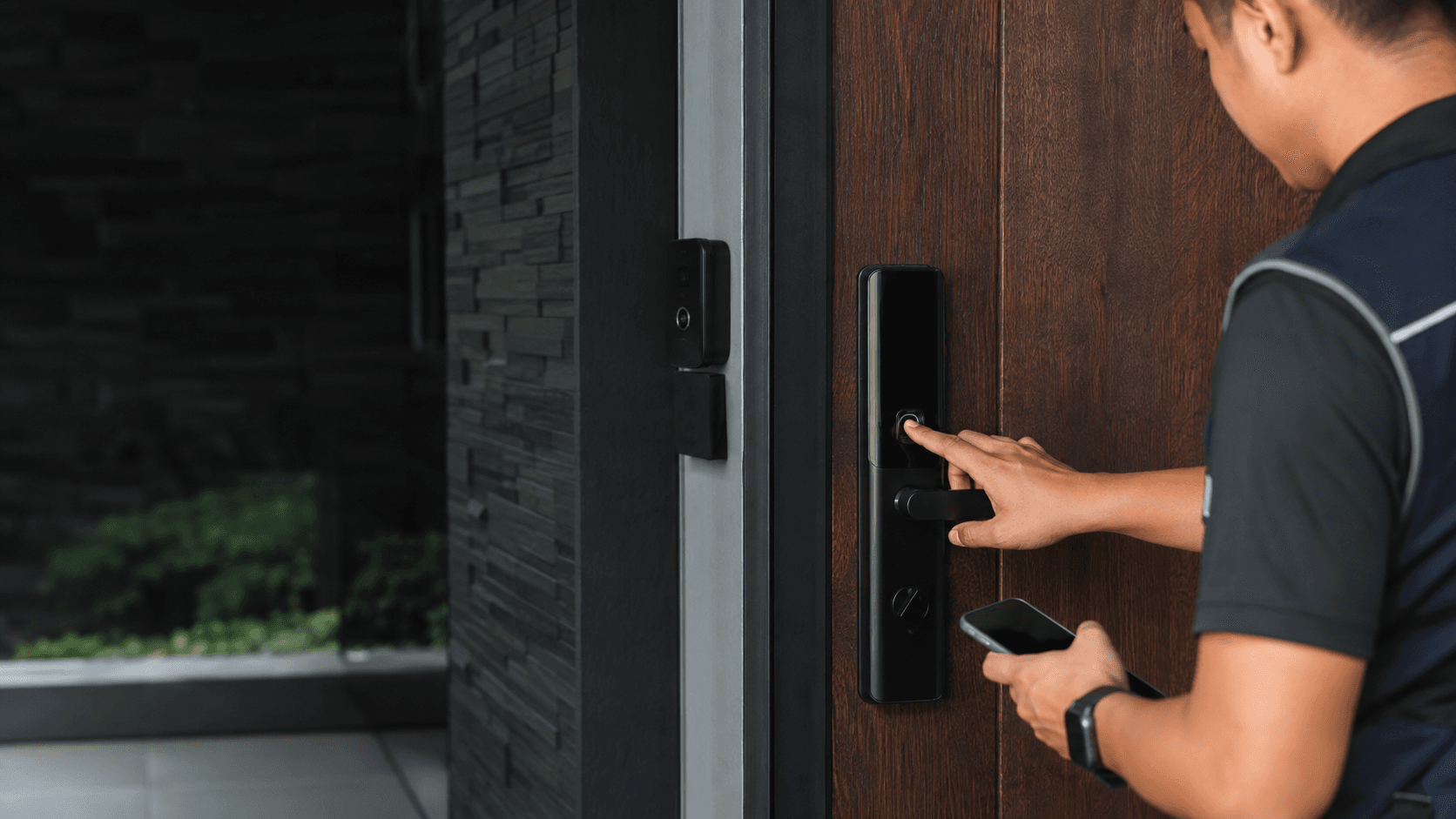
The exact-match query bosch smart lock covers a family of electronic door locks rather than one product. Bosch smart lock models appear in distributor catalogues under names such as ID60, EL600F and EL800VF, and Bosch Smart Home has partnered with Yale on smart lock integration. What those listings rarely explain is whether a specific door can carry the lock, who needs daily entry, and what happens when the battery or network fails.
Eyonic Sdn Bhd, a security system supplier in Sarawak, reviews smart locks the same way it reviews cameras and alarms: the hardware only works when the site conditions match it. The checks below follow that order.
What to check before choosing a Bosch Smart Lock
- Confirm the door condition, including how the existing lock body sits in the door and whether the door closes squarely.
- Map who needs entry, separating residents or staff from visitors, contractors and delivery access.
- Decide the backup entry method before installation, so a dead battery or failed reader does not lock out the people who need in.
- Confirm whether a standalone smart lock or an access-control panel suits the site, especially where multiple doors or staff permissions are involved.
Each check removes a category of failure. A lock that fits the door but ignores user roles creates shared PINs and no record of who entered. A lock with clean user roles but no backup method becomes a liability the first time it loses power.
What a Bosch Smart Lock does in daily use
A smart lock replaces the keyed cylinder with an electronic reader and a motorised or assisted deadbolt. Entry happens through a credential: fingerprint, PIN code, card, app command or a mechanical key where the model provides one. The lock then re-locks on a timer or on door close, depending on the model.
That changes daily routine in three ways. People stop carrying keys for the main door. Temporary access becomes possible without cutting a new key. And entry events can be reviewed rather than guessed at, provided the model and setup record them.
The trade-off is dependency. A mechanical lock fails only when its parts break. An electronic lock also depends on battery state, reader condition and, for app or remote features, a working network. Bosch smart lock listings from distributors describe fingerprint, PIN, card and mechanical key access across different models, which means the access methods available depend on which model is chosen rather than being uniform across the range.
Door condition and entry roles decide the fit
Door condition is the first filter because a smart lock body must sit where the old lock sat. Distributor listings for Bosch smart lock models reference mortise lock bodies and applicable door thickness, which indicates that fit is model-specific rather than universal. A door that has been trimmed, patched or fitted with a non-standard lock body may need preparation before any electronic lock goes on.
Entry roles are the second filter. A home with two or three regular users needs far less structure than a shop with rotating staff, a clinic with visiting contractors, or an office where visitor movement must stay separate from staff areas. Eyonic handled a project for the Kuching Immigration Office that focused on arrival flow, staff areas, visitor movement and dependable daily operation, and that separation of movement is the same question a smart lock raises at a single door.
Where several people need different levels of access, a standalone lock can become the wrong tool. Eyonic usually checks whether a standalone smart lock or an access-control panel is more appropriate for business use, because a panel manages permissions centrally while a standalone lock manages them at the door.
When a standalone lock is enough
A single entrance with a small, stable group of users suits a standalone lock. The credential list stays short, the backup method is simple, and there is no need to coordinate access across doors.
When an access-control panel fits better
Multiple doors, staff who join and leave, or a need to review entry by person point toward a panel. The lock becomes one device on a managed system rather than the whole system.
Bosch Smart Lock models and access methods
Model names matter because access methods differ between them. Distributor catalogues list Bosch smart lock models including the ID60, ID450, EL600, EL600B, EL600F, EL600VF, EL800A and EL800VF, with access described across fingerprint, PIN code, RFID card and mechanical key. A Bosch Malaysia site lists product families including ID40, ID60, ID60C, EL600, EL600F, EL600VF, EL800VF, FU6 Plus, FU8 Plus, T15 and T15 Plus, alongside warranty registration and product authentication pages.
Those listings are a starting point for model names, not a specification source. Verified Bosch Smart Lock dimensions, battery life, IP ratings and Malaysian pricing are not available in the evidence behind this article, so no figures are quoted here. Anyone comparing models should confirm the current specification sheet and the local support route before committing.
Two practical questions cut through the model list. First, which access methods are needed at that door: fingerprint alone, or fingerprint plus PIN plus card for people who cannot or will not use biometrics. Second, whether the lock must work with anything else on site, such as an existing alarm or intercom. Bosch Smart Home and Yale announced a partnership covering smart lock integration, which shows ecosystem thinking exists at brand level, but it does not confirm what is supported on any specific model sold in Malaysia.
Installation and backup entry planning
Installation is where door condition, model choice and backup method meet. The sequence Eyonic follows on security work is site survey, system proposal, installation and handover, and a smart lock benefits from the same order because the survey is what confirms the door can take the lock.
Backup entry deserves its own decision rather than being left to the installer. Options include a mechanical key where the model provides one, a second credential held securely off site, or a documented process for what happens when the lock fails. The failure case is not hypothetical: batteries discharge, readers stop responding, and a lock that only opens by fingerprint leaves everyone outside until it is resolved.
For sites with staff or tenants, the handover step matters as much as the install. Someone on site should know how to add and remove a user, how to check battery state, and who to contact when the lock misbehaves. Without that, a manageable lock becomes a recurring call-out.
Questions Malaysian buyers ask before choosing
Does a Bosch Smart Lock suit a Malaysian door? Fit depends on the door and the model, not on the brand alone. Distributor listings reference mortise lock bodies and applicable door thickness, so the door must be measured against the chosen model before purchase. No verified compatibility data for Malaysian door types or door thicknesses is available in the evidence behind this article.
Is a smart lock suitable for a business entrance? It can be, when user roles and backup entry are planned properly. Where several staff need different access levels, or where entry needs to be reviewed by person, an access-control panel is usually the better fit.
What should be confirmed before buying? The door measurement, the access methods required, the backup entry method, and the local support and warranty route. Verified Bosch Smart Lock pricing for Malaysia and warranty terms are not available in the evidence behind this article, so those must be confirmed with the seller.
Who should install it? A lock that must align with an existing mortise cut is not a drop-in part. Installation should follow a survey that confirms the door can take the lock, which is the same survey-first approach Eyonic applies to CCTV, alarm and autogate work across Sarawak.
For a site in Sarawak that needs the door, user roles and backup method reviewed together, Eyonic can be reached on WhatsApp at +60 11-5111 7959 with the location, property type and required system.