
The category exists for one reason: some sites have no practical way to reach a router or a power point. A farm gate, a construction compound, a store room at the back of a shophouse, or a temporary site office may sit well inside mobile coverage while sitting far outside cabling reach. A 4g solar camera closes that gap by treating the mobile network as the transport layer and sunlight as the power source.
That convenience carries conditions. Cellular data is a recurring cost, solar charging depends on how much direct light a panel actually receives, and battery capacity sets a ceiling on how much the camera can record and transmit each day. The sections below work through those conditions in the order that matters when a system is being planned.
4g Solar Camera: What Matters Before You Choose
Four variables decide whether a 4g solar camera performs as expected on a given site: mobile signal strength at the mounting point, daily direct sunlight on the panel, how often the camera wakes and transmits, and whether recordings are stored locally or in the cloud. Each one can be checked before purchase, and each one can quietly undermine the others if it is skipped.
- Confirm usable mobile signal at the exact mounting height and direction, not at ground level near the gate.
- Estimate direct sunlight hours on the panel across the year, including monsoon months and any new shading from trees or neighbouring buildings.
- Decide the recording pattern. motion-triggered clips, scheduled snapshots, or continuous recording, because each draws a different amount of power and data.
- Choose where footage lives. a microSD card inside the camera, a cloud plan, or both.
- Match the camera's field of view and pan-and-tilt range to the area that genuinely needs coverage.
- Plan the data plan and its renewal before installation, so the camera does not go dark after the first month.
Signal testing is the step most often treated as a formality. A phone showing four bars at the gate does not guarantee the same at a pole three metres higher, and metal structures, reinforced walls, and dense foliage all change the result. Testing at the final position, with the camera's own antenna orientation, removes most of the guesswork.
Choosing the Right 4g Solar Camera
Selection usually comes down to how the site is used rather than which specification looks strongest on paper. A camera watching a quiet storeyard needs far less power and data than one watching an active construction entrance where vehicles and workers move all day.
Match the camera to the site, not the brochure
Fixed-lens models suit a single doorway, gate, or corridor where the camera can be aimed once and left alone. Pan-and-tilt models cover a wider area and allow the view to be repositioned remotely, which helps when the area of interest changes through the day, but the motors draw additional power each time the camera moves.
Resolution matters less than people expect in this category. A 4MP or similar sensor is generally enough to identify a person or vehicle at a gate, and pushing resolution higher increases both storage use and the data consumed per clip. Night performance deserves more attention than pixel count, because a camera that produces unusable footage after dark has not solved the problem it was installed for.
Power budget and battery behaviour
Solar panels on these cameras are small, so the panel is a maintenance charger rather than a generator. In strong daily sun, a modest panel can keep a battery topped up while the camera records motion events. Under heavy cloud, the battery carries the load alone, and its capacity determines how many days of reduced activity the site can absorb.
Continuous recording is the fastest way to exhaust a solar-powered battery. Motion-triggered recording with a short pre-record buffer is the usual compromise, capturing the moments that matter while leaving the panel time to recover. Sites that genuinely need 24/7 recording are usually better served by a wired system with a recorder, even if that means running cable.
Data plans and running costs
A 4g solar camera needs an active SIM and a data plan. Consumption scales with how often the camera uploads, the length of each clip, and whether live view is opened frequently. Motion-only uploads with local storage on a microSD card keep data use low, while cloud storage of every event pushes it up.
Carrier compatibility is worth verifying before purchase. Some cameras are locked to specific networks or ship with a bundled SIM, and a camera that cannot accept a local SIM may be impractical depending on where it is deployed. Checking which networks operate well at the site, and whether the camera supports them, prevents a working camera from becoming an unusable one.
What Is a 4g Solar Camera?
A 4g solar camera is an outdoor security camera that sends video over a 4G LTE mobile network and draws power from a solar panel paired with a rechargeable battery. It needs no Wi-Fi router and no mains wiring at the camera position, which is what separates it from a conventional IP camera.
The three subsystems work together. The solar panel charges the battery during daylight. The battery runs the camera, the image sensor, and the cellular modem. The modem connects to the mobile network and carries video to an app or cloud service, and often carries commands back to the camera for live view or pan-and-tilt control.
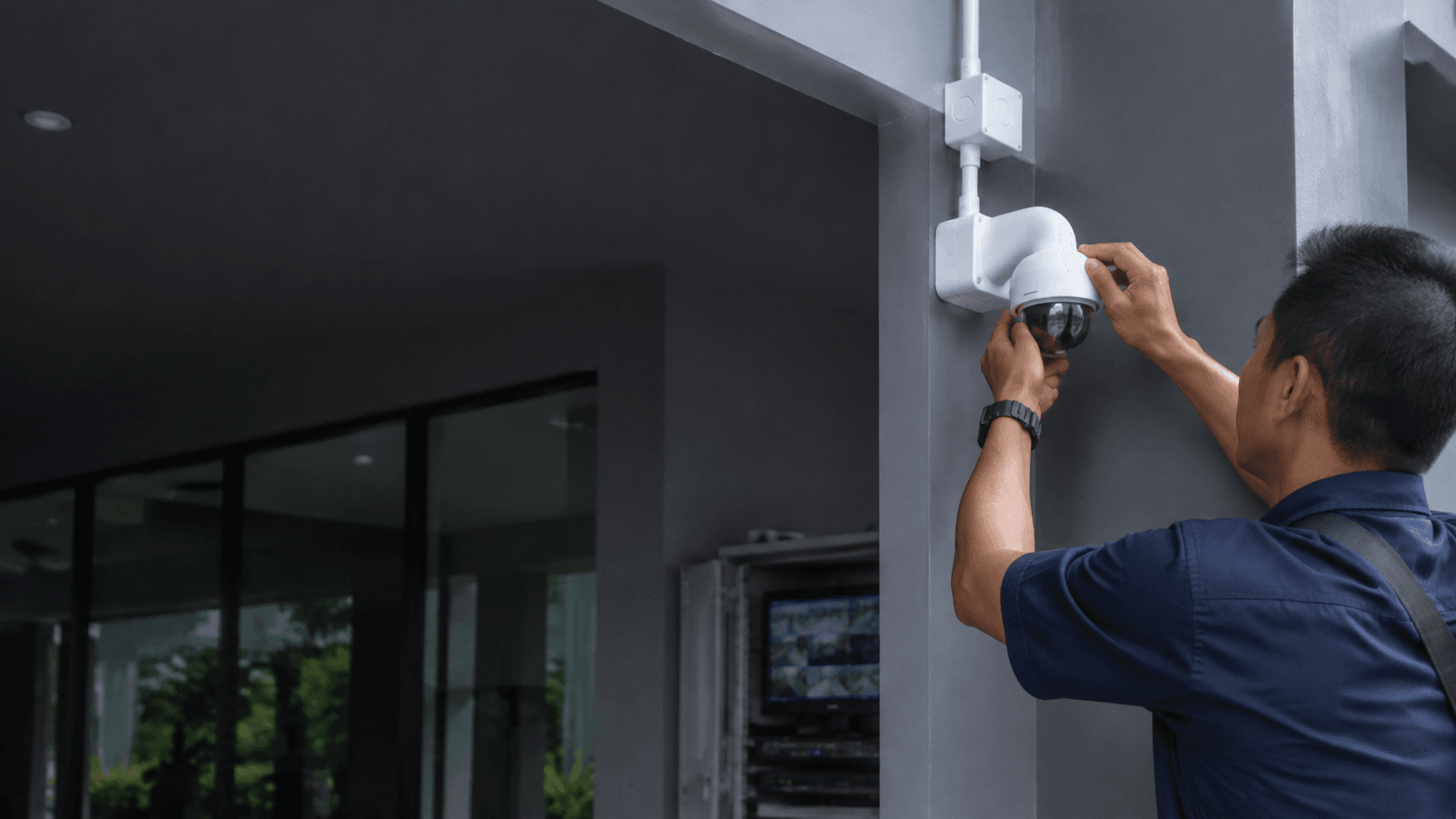
Because the camera is effectively a small self-contained unit, installation usually involves mounting a bracket and inserting a SIM rather than pulling cable. That is also why placement decisions carry more weight than they do on a wired system: the panel angle, the antenna position, and the camera's line of sight all have to be right at the same time.
Practical Considerations for Deployment
Deployment questions tend to cluster around the same handful of issues, and most of them can be answered before a unit is ordered.
Where these cameras genuinely fit
Remote or semi-remote sites are the natural fit: agricultural land, isolated storeyards, temporary construction compounds, and buildings awaiting renovation where power and network services are not yet connected. Rental properties and sites where drilling or cabling is not permitted also suit the format, because the installation is largely reversible.
Urban and suburban premises with reliable power and Wi-Fi are usually better served by a wired camera. A 4g solar camera in that setting adds a recurring data cost and a battery to maintain without removing any cabling work that a wired camera would have required anyway.
Storage retention and evidence value
Local storage on a microSD card keeps footage on the camera and avoids ongoing cloud fees, but a camera that is stolen or damaged takes its recordings with it. Cloud storage protects against that, at the cost of a subscription and higher data use. Many deployments use both. continuous or event recording to the card, with selected events uploaded.
Retention periods matter for anyone who may need footage later. A card that holds two weeks of motion events is adequate for reviewing an incident reported promptly, and inadequate for one discovered a month afterwards. The recording pattern and card capacity together determine how far back the footage reaches.
Maintenance and edge cases
Panels accumulate dust, and in some regions bird droppings, which reduce charging without any visible fault. Lenses need occasional cleaning for the same reason. Batteries age, and a battery that held several days of standby when new will hold less after a few years of cycling.
Weather exposure is the other long-term factor. Housings and seals degrade, and a camera mounted where water pools or where wind drives rain directly at the lens will not last as long as one sheltered by an eave. Mounting position is a durability decision as much as a coverage decision.
How a professional installation is scoped
Eyonic's CCTV installation process runs through site survey, system proposal, installation, and handover, which is the sequence that surfaces signal, sunlight, and coverage questions before equipment is committed. The same discipline applies to solar and cellular units, where a survey at the mounting point answers questions that no product listing can.
Eyonic has completed work for the Kuching Immigration Office, covering arrival flow, staff areas, visitor movement, and dependable daily operation, and for KTA Sarawak Sdn Bhd, where the requirement centred on staff movement, visitor handling, tidy cabling, and clearer daily site control. Both projects illustrate the same principle: camera placement follows how a site is actually used.
For lighting-sensitive cameras, Eyonic recommends checking actual lighting conditions before confirming placement, since a position that looks adequate in daylight can behave very differently after dark. That check is inexpensive during a survey and awkward to correct afterwards.
Making an Informed Choice About Systems
The decision usually resolves into a short set of trade-offs. A 4g solar camera buys independence from cabling and Wi-Fi, and pays for it with a data plan, a battery that ages, and a power budget that limits continuous recording. A wired camera buys unlimited recording and stable power, and pays for it with installation work and a fixed position.
Where mains power and a network connection already exist at the camera position, the wired option is normally the stronger choice. Where they do not, and where mobile coverage is usable, the cellular solar option is often the only practical way to get coverage at all.
Two checks are worth completing before committing. First, confirm mobile signal at the exact mounting point rather than nearby. Second, confirm how much direct sun the panel will receive across the year, including the wettest months. If both hold up, the remaining decisions concern resolution, storage, and data plan size, and those are easier to adjust later than a bad mounting position.
For sites in Sarawak, sharing the location, property type, and the system required with Eyonic on WhatsApp at +60 11-5111 7959 is a practical way to move from general questions to a specific recommendation.