
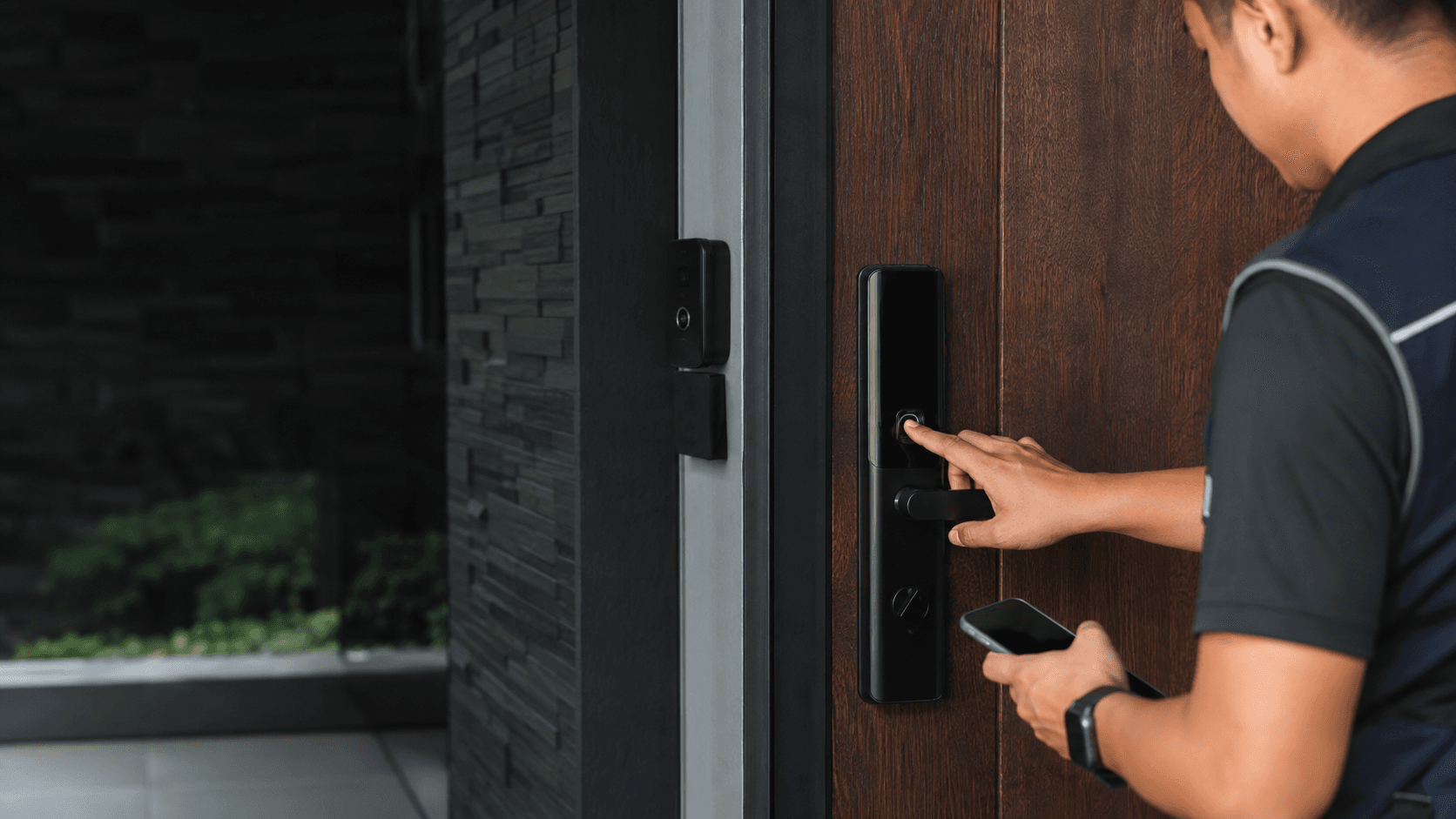
The Kwikset Smart Deadbolt category sits between two older options: a mechanical deadbolt that always needs a key, and a full access-control panel that manages many doors and users. Kwikset's own product pages describe electronic keyless entry deadbolts with digital keypads, and they separate models that work with smart home systems from models that only remove the key.
- Confirm the door already has a deadbolt bore and that the door thickness and backset match the lock being considered.
- Decide whether the door needs keyless entry alone or keyless entry plus remote locking and unlocking through a smart home hub.
- Check which wireless protocol the home system uses, because Kwikset's connected models are described with Z-Wave and Zigbee options.
- Plan a backup entry method before installation, since a keypad lock still depends on power and on working electronics.
- Review who needs access and whether a standalone smart lock or a managed access-control panel fits better.
What is kwikset smart deadbolt
A Kwikset Smart Deadbolt is a deadbolt whose exterior side carries a keypad or touchscreen instead of a keyway, so the door is opened with a code rather than a key. Kwikset's electronic deadbolt pages describe these as keyless entry deadbolt door locks with digital keypads, sold under the SmartCode Signature Series name.
The category splits into two practical groups. One group is electronic but not connected: the code opens the door, and nothing else changes. The other group adds Home Connect Technology, which Kwikset describes with Z-Wave and Zigbee options so the lock can communicate wirelessly with other devices and be controlled from a phone, tablet, or another internet-connected device.
Kwikset also documents a touchscreen security feature called SecureScreen Technology, which is intended to address fingerprint detection on touchscreen keypads. That detail matters mainly for shared or street-facing doors where a visible smudge pattern could hint at a code.
Kwikset Smart Deadbolt features that change daily use
Three features do most of the work in everyday use, and each one has a limit worth knowing before purchase.
Keyless entry removes the key from routine entry. The trade-off is that the code becomes the secret, so code sharing and code changes need a plan. Kwikset's own support material covers re-keying procedures for its SmartKey cylinders, which is relevant for the mechanical side of a lock rather than the keypad.
Access control means different people can be given different codes or permissions. On a standalone lock this is usually a small number of user codes managed at the keypad or in an app. On a managed system, permissions live in a panel or platform instead. Eyonic, a Sarawak security system supplier, notes that smart locks work best when door condition, user roles, and backup method are reviewed before installation, and that for business use it usually checks whether a standalone smart lock or an access-control panel is more appropriate.
Remote locking and unlocking depends entirely on the connection. A lock without Home Connect Technology cannot be operated from a phone when away from the door. A connected lock needs a compatible hub or system, and Kwikset's comparison material exists precisely because compatibility varies between models.
Choosing the right Kwikset Smart Deadbolt
The decision usually comes down to whether the door is residential or commercial, and whether anyone needs to open it remotely.
For a home where the goal is simply to stop carrying a key, an electronic deadbolt without smart home integration covers the need and removes an entire category of compatibility problems. For a home that already runs a smart home hub, a Home Connect model adds remote control and status, provided the hub speaks the same protocol.
For a business door, the calculation changes. A standalone smart lock gives controlled convenience, but it does not produce an audit trail of who entered and when, and it does not scale to many doors. Where staff movement, visitor handling, and clearer daily site control matter, a managed access-control approach is the more appropriate structure. Eyonic's own project work in Kuching has centred on exactly those concerns: arrival flow, staff areas, visitor movement, and dependable daily operation.
Door condition is the constraint that gets overlooked most often. A deadbolt needs a properly prepared bore, correct backset, and a door that closes squarely enough for the bolt to throw without binding. A lock that fits the box may still not fit the door.
Practical considerations before installation
Power and backup come first. An electronic deadbolt depends on batteries, and a depleted lock on a main entrance is a real inconvenience. A backup entry method should be decided before the lock is fitted, not after the first low-battery warning.
Second is the wireless environment. Z-Wave and Zigbee are not interchangeable, and a lock that supports one will not join a hub that only speaks the other. Kwikset's own site directs readers to check which devices and systems are compatible with its smart deadbolts, which is the right step before buying rather than after.
Third is the difference between a lock and a system. A smart deadbolt controls one door. If the requirement is multiple doors, shared permissions, or integration with cameras and alarms, the lock becomes one component in a wider setup. In Sarawak, Eyonic plans, supplies, and installs CCTV and ELV systems for homes, offices, shops, and industrial sites, and its installation process runs through site survey, system proposal, installation, and handover. A door lock decision made alongside that kind of survey tends to fit better than one made in isolation.
Fourth is the physical security question that keyless entry does not answer. A keypad changes how the door is opened; it does not change the door frame, the strike plate, or the wall around it. Those remain the parts an intruder attacks first.
Making an informed choice about Kwikset Smart Deadbolt
The useful sequence is to confirm the door will accept the lock, decide whether remote access is genuinely needed, verify protocol compatibility if it is, and settle the backup entry method. A Kwikset Smart Deadbolt that meets those four conditions will behave predictably. One that fails any of them will still install, and will still cause friction later.
Where the door is part of a larger property with staff, visitors, and multiple entry points, the lock decision is better made as part of a wider security plan than on its own. Eyonic can be reached on WhatsApp at +60 11-5111 7959 with the location, property type, and required system.