
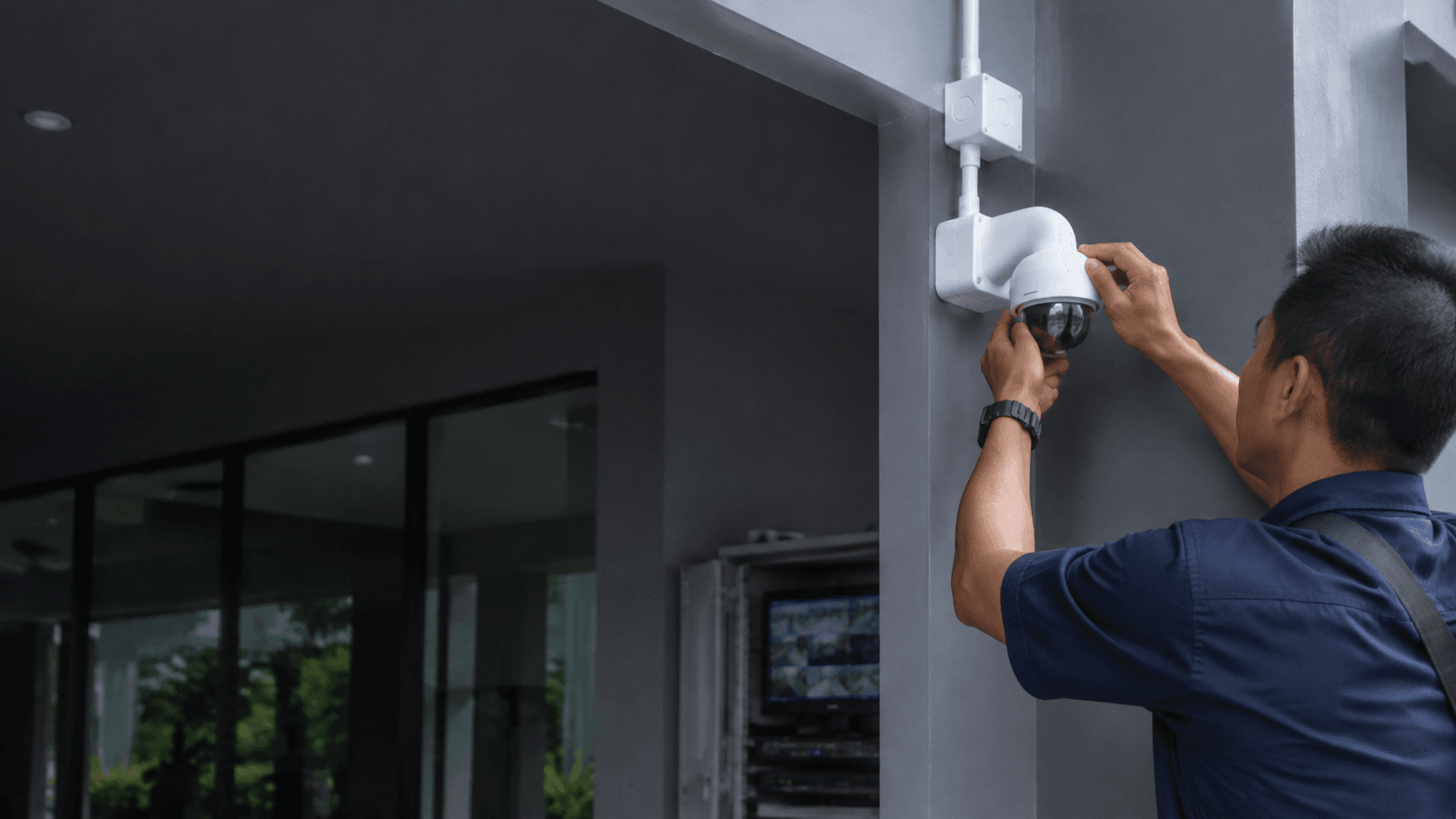
The decision that matters most is not the brand on the box. It is whether the position chosen can see the area that needs watching once the light drops, and whether the cabling and recording behind it still work in the wet season. In Sarawak, that usually means a survey first, a proposal second, and installation only after both are settled.
Backyard camera placement starts with the light at the site
Eyonic recommends checking actual lighting conditions before confirming placement for ColorVu-style cameras. That is a practical instruction rather than a product claim: a position that looks clear at midday can sit in a pool of shadow at 8pm, or face directly into a neighbour's security light and wash out the frame.
Three lighting situations decide most placements:
- Mixed light. A yard lit by one corner lamp and otherwise dark produces a bright patch and a black patch in the same frame. The camera has to be aimed at the boundary that matters, not at the brightest surface.
- Backlight. A camera facing a street lamp, a lit shopfront, or a rising sun loses detail in the foreground. Turning the unit to shoot along the wall rather than across it usually helps.
- Full dark. A back lane with no lighting at all is the hardest case, and it is the one where placement and supplementary lighting matter more than any specification on a box.
Height is the other half of the same decision. Mounting high enough to be out of easy reach also flattens the angle, so faces at a gate arrive from above. Mounting low enough to catch a face puts the unit within reach. The survey exists to find the compromise for the specific yard rather than to apply one rule everywhere.
What a backyard camera has to cover in a Malaysian yard
Coverage is a list of boundaries, not a single view. A typical terrace house, shophouse, or small property has four or five separate things worth watching, and they rarely sit in one line of sight.
- Site survey. Eyonic's CCTV installation process begins with a site survey, which is where the actual lighting, the cable route, and the boundaries to be covered are recorded on site rather than assumed from a description.
- System proposal. The survey findings become a proposal covering camera placement, recording, and remote viewing, so the number of units and their positions are agreed before work starts.
- Installation. Cabling, mounting, and NVR setup follow the agreed plan, with the recording position and power arrangement settled as part of the same job.
- Handover. The final stage covers mobile viewing and basic recording configuration, so the person responsible for the property can actually check the yard without calling anyone.
The boundaries that usually need separate attention are the gate and its approach, the back lane or rear access point, any side path between properties, a parked vehicle, and a storage or utility area. A single wide view covering all of them at once tends to produce a frame in which nothing is large enough to identify.
Malaysian conditions add two constraints. Rain and direct sun age outdoor housings and connectors, so the cable entry and the joint quality matter as much as the camera body. And mixed lighting at dusk, when a yard moves from daylight to lamps, is the period where a poorly placed unit produces its least useful images.
How Eyonic plans a backyard camera installation
Eyonic Sdn Bhd is a security system supplier in Sarawak that plans, supplies, and installs monitoring systems with camera placement, recording, and remote viewing for homes, offices, shops, and industrial sites. The founder, Eric Yong, has worked in the industry for more than ten years, with a focus on technical installation of digital security solutions for commercial businesses in Sarawak.
The company's completed work includes the Kuching Immigration Office, where the requirement was practical support for a public office focused on arrival flow, staff areas, visitor movement, and dependable daily operation. A second project, for KTA Sarawak Sdn Bhd, covered a practical office setup in Kuching supporting staff movement, visitor handling, tidy cabling, and clearer daily site control. Both are useful reference points for a backyard camera job because they show the same sequence applied to a site where the boundaries and the daily routine had to be understood first.
The trade-off in a domestic yard is between coverage and cost. More units cover more boundaries, but each one needs a cable route, a mounting point, and a share of the recorder's capacity. A survey that identifies which two or three boundaries actually matter usually produces a better result than spreading the same budget across six positions that each see very little.
Backyard camera choices. wired, wireless, and recording
The choice between wired and wireless is mostly a choice about power and reliability, not about image quality. A wired unit draws power continuously and does not depend on a battery or a signal reaching a distant corner of the property. A wireless unit avoids running cable through a finished wall, which matters in a shophouse or a rented property where drilling is restricted.
Recording is the second decision. A recorder on site keeps footage locally and does not depend on the internet connection staying up, while remote viewing lets the yard be checked from elsewhere. Eyonic's service scope covers NVR setup and remote viewing alongside camera placement, so the recording position and the viewing setup are part of the same plan rather than separate purchases.
Two edge cases are worth settling before installation. First, a yard with no convenient power point and no route back to the recorder limits what can be installed without additional work. Second, a property where the internet connection is unreliable changes how much the remote viewing feature can be relied on, even though local recording continues.
What a backyard camera project costs in Sarawak
Eyonic's published package pricing starts at RM 1,599 for a Hikvision CCTV package covering camera supply and setup, basic recording configuration, and mobile viewing handover. The same RM 1,599 figure applies to the Hikvision alarm system package and the autogate package, which are separate systems rather than part of a camera installation.
Larger projects sit in a different range. The Kuching Immigration Office project carried an approximate budget of RM 12,000 to RM 28,000, and the KTA Sarawak Sdn Bhd project an approximate budget of RM 8,000 to RM 18,000. Those figures describe office-scale work with multiple areas and tidy cabling requirements, not a single backyard camera, and they are useful mainly as an indication of how quickly scope changes the number.
What moves a backyard camera job between those points is the number of positions, the difficulty of the cable route, and whether recording and remote viewing are included. A straightforward single-position installation on an accessible wall is a different job from a multi-boundary setup across a shophouse with a rear lane.
Backyard camera questions before confirming a placement
Does the camera need to work at night without extra lighting? That depends on the light actually present at the position, which is why the survey checks it on site. A position with some ambient light behaves differently from a fully dark back lane, and the answer changes the placement rather than the brand.
Can the yard be checked from a phone? Remote viewing is part of Eyonic's service scope and is covered in the handover stage, so the viewing setup is configured as part of the installation rather than added afterwards.
What happens if the internet goes down? Local recording and remote viewing are separate functions. A recorder on site continues to record; the ability to view from elsewhere depends on the connection.
Who decides where the camera goes? The placement is agreed during the survey and proposal stages, before installation. That ordering exists so the position is based on the actual light and the actual boundaries rather than on a description given over the phone.
For a property in Sarawak, the practical next step is to share the location, the property type, and the system required with Eyonic on WhatsApp at +60 11-5111 7959, so the survey can be arranged against the real site conditions.