
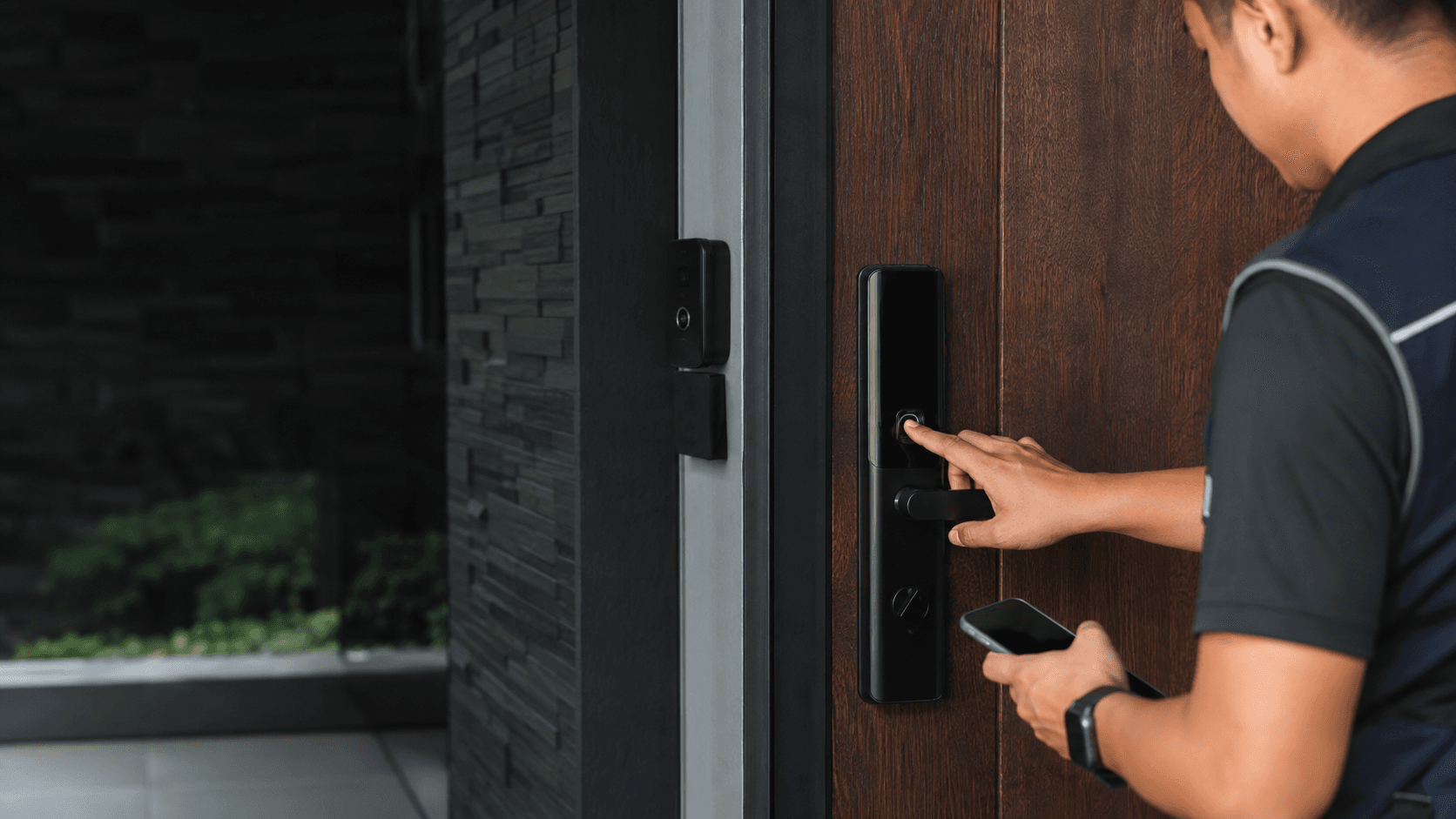
The exact-match query kwikset interconnected lock describes a lockset family rather than one fixed product. Kwikset builds interconnect hardware around a deadbolt positioned above a lever, with the two mechanisms linked inside the door so the handle and the bolt move together. That linkage is the whole point of the design, and it is also the reason the hardware cannot be judged from a photograph alone.
Readers in Malaysia usually arrive at this topic while comparing door hardware for a house, a shoplot, or a small office. The questions that matter are practical: what the lockset actually does, whether the door can accept it, who holds stock locally, and who installs it. The sections below work through those points in order.
What a Kwikset Interconnected Lock combines on a single door
An interconnected lockset pairs two separate locking points into one operating unit. The upper position holds a deadbolt. The lower position holds a lever handle with its own latch. Inside the door, a connecting mechanism ties the two together so that turning the interior lever or the interior thumbturn releases the deadbolt at the same time as the latch.
The practical result is a door that can be secured with one action and opened with one action. That matters most on an entrance used by several people through the day, where a separate deadbolt and knob would otherwise mean two movements every time someone enters or leaves.
Kwikset's interconnect range is documented around lever handles rather than knobs, and the manufacturer's own product pages describe the combination as a keyed-entry deadbolt paired with a passage lever. Some variants in the range carry SmartKey re-key technology, which allows the cylinder to be re-keyed without removing the lock from the door. Model numbers, finishes, cylinder options, and keyway choices vary across the range, so those details need to be confirmed against the specific product listing rather than assumed from the category name.
Two features are worth separating clearly. The deadbolt provides the security layer. The lever provides the everyday entry and exit layer. Interconnection does not change what either component does on its own; it changes how they are operated together.
Where an interconnected deadbolt and handle set fits in Malaysian properties
The fit depends on how the door is used, not on the property type alone. An interconnected deadbolt and handle set suits a door that needs to be locked and unlocked frequently by people who should not have to think about two separate mechanisms.
Three scenarios tend to justify the design:
- Main entrances on homes where family members come and go through the same door and a single motion is easier to repeat consistently.
- Shop offices and small commercial units where staff open and close the premises daily and a fast, predictable exit matters during busy periods.
- Rental or multi-unit properties where the same door hardware pattern repeats across several units and re-keying between tenants is a recurring task.
The exit-without-a-key behaviour is the strongest argument for the design in a commercial setting. When the interior lever releases both the latch and the deadbolt, anyone inside can leave through the door without locating a key first. That is a meaningful difference from a setup where the deadbolt must be unlocked separately before the door will open.
Where the design fits less well is on doors that are rarely used, or on doors where the hardware is expected to integrate with an electronic access-control system. A standalone interconnected lockset is mechanical. It does not by itself provide user permissions, audit trails, or remote release. Eyonic's own product guidance notes that smart locks work best when door condition, user roles, and a backup entry method are reviewed before installation, and that for business use the choice between a standalone lock and an access-control panel should be checked first. The same logic applies when weighing a mechanical interconnect against an electronic alternative.
What to confirm before ordering a Kwikset Interconnected Lock
Ordering is where most of the risk sits, because the hardware has to match the door that already exists. The checks below are the ones that decide whether a purchase works out.
- Confirm the door thickness and the existing bore and backset measurements against the manufacturer's requirements for the specific model.
- Confirm the handing of the door, since lever hardware is supplied for a particular swing direction.
- Confirm which cylinder and keyway option applies, and whether the model supports re-keying.
- Confirm the finish against the rest of the door furniture, because finishes are model-specific rather than universal.
- Confirm local availability, lead time, and warranty terms with the supplier rather than assuming regional stock.
- Confirm who will install the lockset and who handles adjustment if the door does not close cleanly afterwards.
Door preparation is the item most often skipped. An interconnected lockset needs the deadbolt and the lever to align correctly on the same door edge, and a door that has been previously bored for a different configuration may not accept the new hardware without additional work. Measurements should be taken from the actual door, not from a similar door elsewhere in the building.
Availability is the second item to settle early. Kwikset interconnect hardware is widely listed by overseas retailers, and several of the pages ranking for this topic are product listings built around shipping and ordering. That tells you the hardware is sold internationally, but it does not tell you what is held locally in Malaysia, what the lead time looks like, or what warranty support is available after purchase. Those are questions for a supplier, and they are worth asking before payment rather than after delivery.
Installation and handover steps for door hardware
Installation follows a sequence that applies to door hardware generally, and the sequence matters because each step depends on the one before it.
- Survey the door and frame, checking condition, alignment, thickness, and existing preparation.
- Confirm the hardware selection against the survey findings before any cutting or adjustment begins.
- Fit the deadbolt and lever assembly, aligning both components on the door edge.
- Test the linkage so that the interior lever releases the latch and the deadbolt together.
- Check the strike alignment and adjust until the door closes without force.
- Test the exterior key operation and confirm the cylinder turns smoothly in both directions.
- Walk the people who will use the door through normal operation, exit behaviour, and what to do if a key is lost.
- Hand over the keys, any re-keying tools supplied with the model, and the contact for follow-up adjustment.
Eyonic's installation work follows a comparable shape: site survey, system proposal, installation, and handover. The survey stage exists because door condition and alignment problems are cheaper to find before hardware is fitted than after. The handover stage exists because a lockset that nobody has been shown how to operate correctly tends to be reported as faulty when it is simply misaligned or misunderstood.
Adjustment after fitting is normal rather than a sign of a defective product. Doors move with humidity and with use, and a strike plate that lined up on the day of installation may need a small adjustment later. Knowing who to call for that adjustment is part of the purchase decision.
Questions to settle before choosing door hardware
Several follow-up questions come up repeatedly once the basic function is understood, and they are worth answering directly.
Is an interconnected lockset the same as a handleset? No. A handleset is a decorative entry assembly, typically with a thumb-latch grip and a separate deadbolt above it. An interconnected lockset links the deadbolt and the lever mechanically so they operate together. The two look similar from the outside but behave differently at the door.
Can the lockset be re-keyed later? Some Kwikset interconnect models support re-keying at the cylinder, which is useful when tenants or staff change. Whether a specific model supports it depends on the product, so it should be confirmed against the model listing rather than assumed across the range.
Does it replace an existing lock, or does the door need new preparation? It depends entirely on what is already fitted. A door previously prepared for a compatible configuration may accept the new hardware with minimal work. A door prepared for a different layout may need additional preparation, and that should be assessed before ordering.
Is it suitable for a business entrance? It is suitable where the requirement is a mechanical lock that can be operated quickly from inside. It is not a substitute for an access-control system where the requirement includes user-level permissions, entry records, or remote management. Those are different problems, and mixing them up leads to hardware that does not do what was expected.
What happens if the door does not close properly after installation? This is usually an alignment issue rather than a lock fault. Strike adjustment, hinge tightening, or minor door adjustment normally resolves it. It is worth confirming in advance who carries out that work.
Kwikset Interconnected Lock. what to do next
The decision comes down to three things: whether the door can accept the hardware, whether the mechanical behaviour matches how the door is actually used, and whether local supply and installation support exist. A Kwikset Interconnected Lock answers the second question well for frequently used entrances where a single action to lock and a key-free exit from inside are the priorities.
The first and third questions need local answers. Door measurements have to come from the actual door. Availability, lead time, and warranty support have to come from a supplier who can be reached after the sale. Installation and any later adjustment have to be handled by someone who will return to the site.
For properties in Sarawak, Eyonic handles security and door-related hardware work alongside CCTV, alarm, autogate, and intercom systems, with projects including the Kuching Immigration Office and KTA Sarawak Sdn Bhd. Share the location, property type, and required system on WhatsApp at +60 11-5111 7959 to move the enquiry forward.