
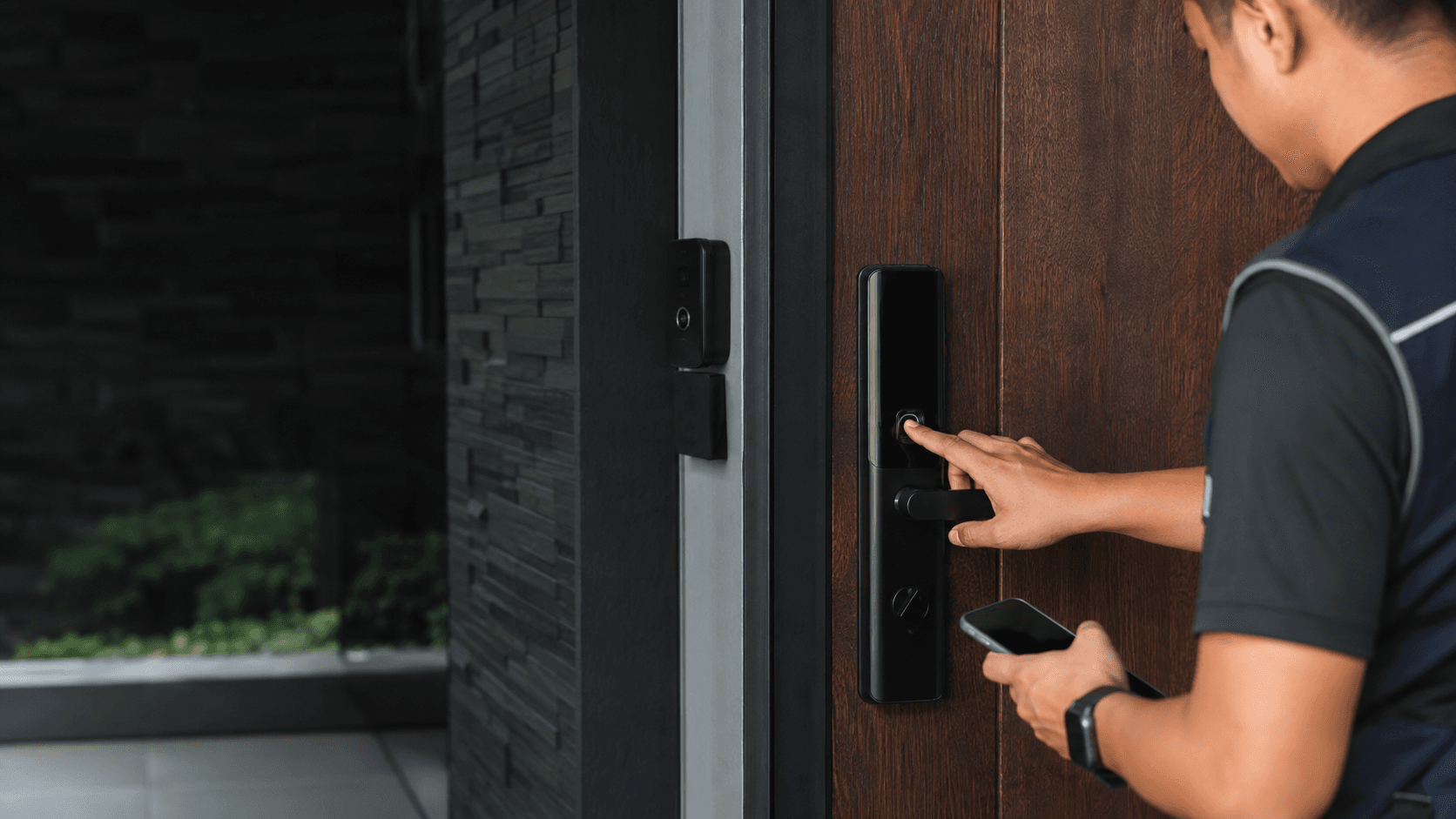
The keyed override is the part of the lock that does not depend on power. It sits alongside the keypad, fingerprint reader, or app, and it works on the same deadbolt or latch. Eyonic treats backup entry as a planning item rather than an add-on, because the lock is only as useful as the way it opens on its worst day.
Smart Lock With Key Backup. What The Keyed Override Actually Does
A keyed override is a physical cylinder turned by a cut key. On most deadbolt-replacement locks, the cylinder sits on the exterior face and drives the same bolt the motor drives. Turning the key retracts the bolt without waking the electronics.
That separation matters. A keypad code, a phone app, and a fingerprint template all pass through the lock's controller and its power source. The cylinder does not. When the controller is unresponsive, the cylinder is still a working lock.
Three failure paths are worth naming, because each one behaves differently:
- Battery drain. The lock stops responding to codes and app commands. A key still turns the cylinder.
- Network or hub outage. Remote unlock and access logs stop updating. Local codes and the key keep working.
- Electronics or motor fault. The keypad may light up while the bolt does not move. The key bypasses the motor entirely.
Not every product sold as a smart lock includes a cylinder. Some retrofit models keep the existing exterior keyway and add smart control behind it. Others replace the whole deadbolt and ship with a key. A few offer no key at all. The difference is a specification question, not a marketing one, and it should be confirmed against the actual model before purchase.
Why A Physical Key Still Matters When Power Or Network Drops
Battery failure is the most common lockout cause, and it is also the most predictable. Most locks warn before the cell dies, but warnings are easy to miss on a door that is used by several people. A key removes the deadline.
Network outage is a different problem. A lock that depends on a hub or cloud service for remote unlock can still accept local codes, but scheduled access, temporary guest codes, and audit logs may stop. The key does not restore those functions. It only guarantees that the door opens for whoever holds it.
There is a trade-off worth stating plainly. A key cylinder is a mechanical pick point and a key can be copied. A lock with no keyway removes that exposure but also removes the fallback. For a home, the fallback usually wins. For a controlled commercial door, the answer depends on who is allowed to hold a key and how that key is tracked.
Key storage is part of the plan. A key kept inside the building is useless during a lockout. A key kept off-site needs to reach the door quickly. Where a key is stored, and who can retrieve it, should be decided before installation rather than after the first dead battery.
Door Condition, User Roles And Backup Method Before Installation
Eyonic's smart lock review guidance is direct: smart locks work best when the door condition, user roles and backup method are reviewed before installation. Those three checks decide whether a standalone lock is enough or whether the door needs a wider access-control setup.
Door condition covers the frame, the strike plate, the door thickness, and whether the existing bore matches the new lock body. A misaligned frame can make a motor strain against the bolt, which drains batteries faster and shortens the lock's working life. This is a physical check, not a settings change.
User roles decide how many credentials exist and who can issue them. A household with four regular users needs far less structure than an office where staff turn over, visitors need temporary access, and someone has to review who entered and when.
Backup method is the third decision, and it should be chosen deliberately. A mechanical key cylinder, a secondary keypad code held by a manager, and an external power contact are different answers with different failure coverage. The right choice depends on who is on site when the lock fails.
Eyonic applies the same sequence to smart lock work that it applies to its CCTV installation process: site survey, system proposal, installation, and handover. The survey is where door condition and user roles get settled, before any hardware is ordered.
Smart Lock With Key Backup Compared With Keypad And App Entry
Keypad entry is convenient and shareable. A code can be issued, changed, and revoked without cutting a key. It also depends on the keypad working, the battery holding, and someone remembering the code under pressure.
App entry adds remote control and a record of events. It depends on the lock's radio, the hub or bridge, the home network, and the vendor's service staying available. Each layer is another place the chain can break.
A smart lock with key backup does not replace either method. It sits underneath them as the last layer, and it is the only layer that survives a dead battery and a dead network at the same time.
The practical ranking is straightforward. Use the app for daily convenience and remote access. Use codes for regular users and temporary visitors. Keep the key for the day the first two stop working. A lock that offers all three gives the widest coverage, and a lock that offers only the first two leaves the door dependent on power and connectivity.
Standalone Smart Lock Or Access-Control Panel For Business Use
For business use, Eyonic usually checks whether a standalone smart lock or an access-control panel is more appropriate. The deciding factors are the number of doors, the number of users, and how much reporting the site needs.
A standalone smart lock suits a single door with a small, stable user group. It is simpler to install, simpler to manage, and easier to replace. Its limits appear when several doors need consistent permissions, when staff turnover is high, or when someone needs a record of every entry.
An access-control panel suits sites where doors, users, and schedules have to be managed together. It costs more and takes more planning, but it centralises permissions and produces a usable log. The Kuching Immigration Office project is an example of the wider approach: the work focused on arrival flow, staff areas, visitor movement, and dependable daily operation rather than a single door.
The KTA Sarawak Sdn Bhd project followed a similar pattern for an engineering consultancy, supporting staff movement, visitor handling, tidy cabling, and clearer daily site control. In both cases the door hardware was one part of a larger access plan, not the whole answer.
Budget expectations differ by scope. Eyonic's published packages for CCTV, alarm, and autogate systems are each RM 1,599, and completed project budgets have ranged from RM 8,000 to RM 18,000 for an office setup and RM 12,000 to RM 28,000 for a public office. Smart lock supply and installation is not covered by those figures, so scope should be confirmed before any commitment.
Smart Lock With Key Backup. Practical Checks Before Handover
Handover is where a smart lock with key backup either proves itself or exposes a gap. The checks are short, and they are worth repeating with the people who will actually use the door.
Test the key first, with the lock powered and again with the battery removed. A cylinder that only turns when the motor is alive is not a backup. Confirm the key turns smoothly without forcing it, because a stiff cylinder becomes unusable in a hurry.
Test each credential separately. every code, every fingerprint, every app user. Then test the failure cases. Pull the battery and confirm the key still opens the door. Disconnect the network and confirm local codes still work. Confirm that whoever holds the backup key knows where it is and how to use it.
Confirm the audit trail. If the site needs a record of entries, check that the log survives a network outage and that someone knows how to read it. If the lock depends on a hub, confirm what still works when the hub is offline.
Finally, confirm the maintenance path. Battery type and replacement interval should be known, and the person responsible for changing it should be named. A lock with a key backup still needs its battery changed; the key is a fallback, not a substitute for maintenance.
Eyonic Sdn Bhd plans, supplies, and installs security and ELV systems in Sarawak, and the founder, Eric Yong, has worked in technical installation of digital security solutions for commercial businesses in Sarawak for more than 10 years. Share the location, property type, and required system with Eyonic on WhatsApp at +60 11-5111 7959 for the next practical step.