
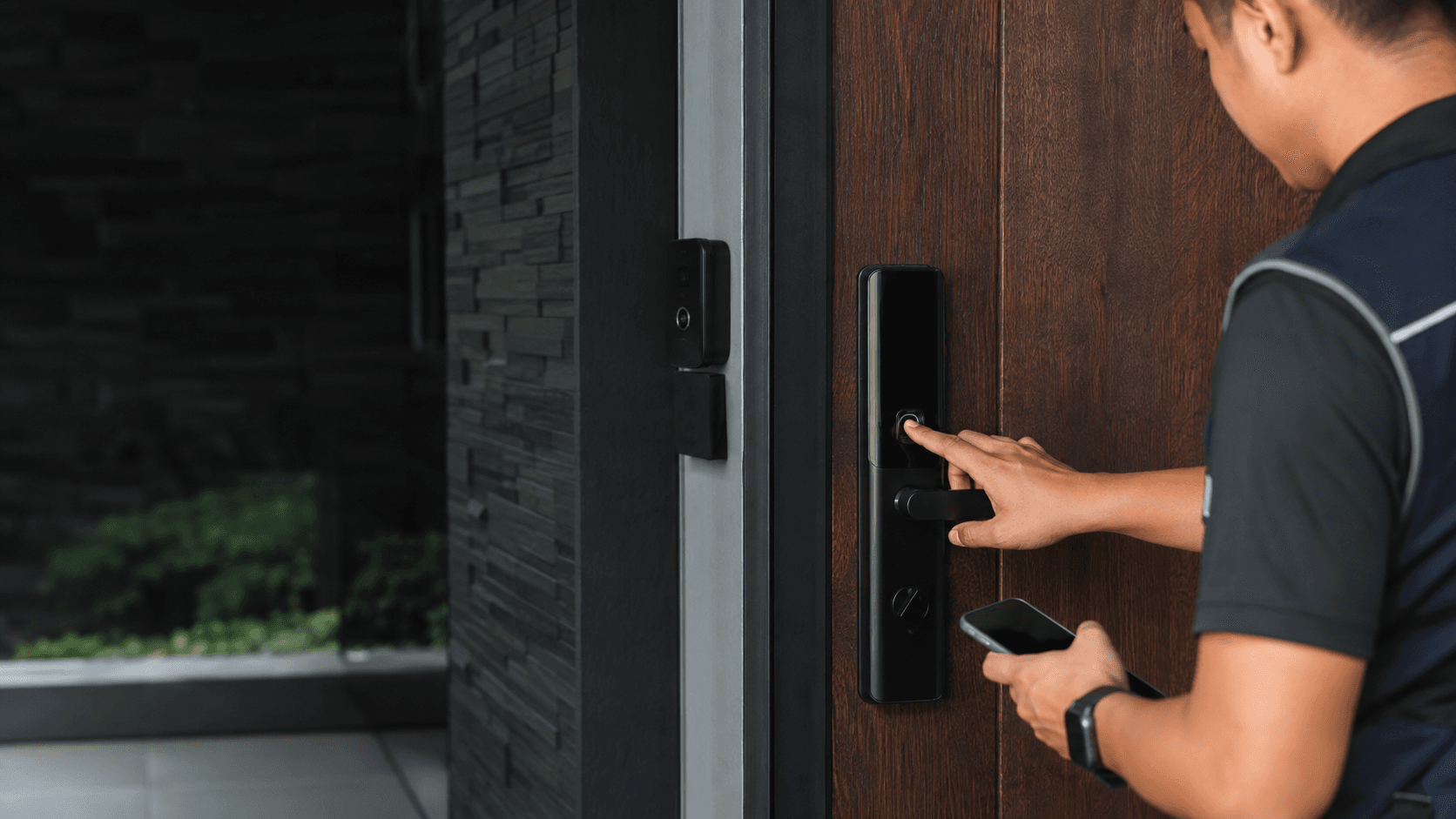
The exact-match query control4 locks describes a category of hardware rather than a single product. Control4 is a home and building automation platform, and locks join it as one device type among cameras, sensors, and gates. The practical question is not whether locks can be added, but which door, which users, and which fallback method the installation must support.
What Control4 Locks control in a real installation
Control4 Locks sit inside a broader security and automation layer. Control4's own user documentation groups locks and sensors on one screen, which tells the reader something useful: lock control is treated as part of a security view, not as a standalone app.
That grouping matters because a lock is rarely the only device on a door. A door may carry a lock, a contact sensor, and a camera covering the same approach. When those three report into one interface, an event on that door can be read as a single story instead of three separate logs.
Control4's published material also places locks next to surveillance, door stations, and video doorbells. The pattern is consistent across the vendor's own pages: locks are one element of an entry and monitoring setup, and they are expected to work with the rest of it.
Lock, gate, and sensor control from one screen
Control4 documentation describes a Locks & Sensors screen where locks, gates, and other relay-controlled devices appear together. From that screen, a user can operate a device, favourite it to a room, and change its settings.
Gate control belongs in the same conversation as lock control because both are entry points. A gate motor and a door lock may be different hardware, but a user who can open one from a screen will expect the other to behave the same way. Eyonic supplies and installs autogate packages in Sarawak, which is a separate product line from locks but sits in the same entry-control category.
Sensors complete the picture. A lock tells the system whether a door was unlocked; a contact sensor tells it whether the door is open. Reading only one of the two leaves a gap, particularly on a door that is meant to stay closed.
Managing door lock users and access history
Control4 documentation covers user management and access history as distinct functions. Door lock users are added and edited in a dedicated screen, and access history is viewed in a separate tab.
This split is worth understanding before committing. User management answers who can open a door. Access history answers who did open it, and when. A site that needs the second function but only plans for the first will end up with a lock that works and a record that does not.
For a household, user management is usually the whole requirement. For an office, a shop, or a site with staff and visitors moving through different areas, access history is often the reason the lock is being installed at all. The Kuching Immigration Office project that Eyonic completed focused on arrival flow, staff areas, and visitor movement, which is the kind of environment where entry records carry operational weight rather than convenience value.
Door condition, user roles, and backup entry
Eyonic's own product review guidance states that smart locks work best when the door condition, user roles, and backup method are reviewed before installation. That is a short list, and each item can stop a project.
Door condition covers the physical facts. A door that does not close squarely, a frame that has moved, or existing hardware that cannot be reused will affect what can be fitted. This is checked on site, not from a photograph.
User roles cover permissions. A home may need one or two roles. A business may need staff, cleaners, contractors, and visitors separated, with different access at different hours. Eyonic's guidance notes that for business use, the choice between a standalone smart lock and an access-control panel is usually reviewed, because the two suit different user counts and different levels of control.
Backup entry covers the failure case. A lock that depends on a network, a hub, or a battery will eventually face a condition where the normal path is unavailable. A mechanical key, a keypad with its own power, or a second door is the answer, and it needs to be agreed before installation rather than after.
What to confirm before committing
- Confirm the door condition on site, including how the door closes, the frame, and whether existing hardware can be reused.
- Define user roles and permissions, including who needs access, at what hours, and whether access history is required.
- Agree the backup entry method, such as a mechanical key or an independently powered keypad, before installation.
- Confirm the control interface and handover, including which screen or app will be used and who will be shown how to manage users.
These four checks are the difference between a lock that is convenient and a lock that becomes a daily problem. None of them require a technical background, and all of them are easier to settle before hardware is ordered.
Planning a Control4 Locks installation in Malaysia
Malaysian properties vary widely in door construction, and that variation affects what can be fitted. A solid timber door, a metal grille door, and a glass door present different constraints. A site survey is the point where those constraints become visible.
Eyonic's installation process for its security work follows site survey, system proposal, installation, and handover. The same sequence applies to entry hardware, because the survey is what confirms whether the door can take the hardware and whether the user roles match the plan.
Network and power availability also belong in the survey. A lock that reports into an automation system depends on the system being reachable, and a door with no nearby power or network path may need a different approach. This is a site-specific finding, not a general rule.
For readers comparing options, the honest position is that Control4 Locks are one route into managed entry, and a standalone smart lock is another. Eyonic's guidance frames the choice around user roles and door condition rather than around brand preference. A single home door with two users is a different problem from an office entrance with rotating staff and a visitor log.
What cannot be confirmed without a site visit
Several details depend on the specific door and the specific system, and they should be verified locally rather than assumed. These include which lock hardware suits the door, how the lock connects to the wider system, and what the ongoing requirements are.
Cost is also site-specific. Eyonic publishes package pricing for its Hikvision CCTV package, Hikvision alarm system, and autogate package at RM 1,599 each, which gives a reference point for entry and monitoring work. Lock hardware and integration costs are quoted per project because they depend on the door and the user requirement.
Availability and support terms are best confirmed directly, since they can change and vary by location. A reader in Sarawak has a different support path from a reader in another state, and that difference is worth knowing before committing.
Frequently asked questions about
Can a Control4 system control a gate as well as a lock
Control4 documentation places locks, gates, and other relay-controlled devices on the same Locks & Sensors screen, so gate control and lock control are handled in the same part of the interface.
Is access history available for door lock users
Control4 documentation describes a History tab alongside a Users tab, which indicates that access history and user management are separate functions within the lock interface.
What happens if the lock loses power or network
The backup entry method is the answer, and it should be agreed before installation. A mechanical key or an independently powered keypad keeps the door usable when the normal path is unavailable.
Does a smart lock suit a business entrance
Eyonic's guidance notes that for business use, the choice between a standalone smart lock and an access-control panel is usually reviewed, because user count and control requirements differ between the two.
Next steps for a decision
The decision comes down to the door, the users, and the fallback. A reader who can answer those three questions has most of what an installer needs to give a useful response.
Share your location, property type and required system with Eyonic on WhatsApp at +60 11-5111 7959 for the next practical step.