
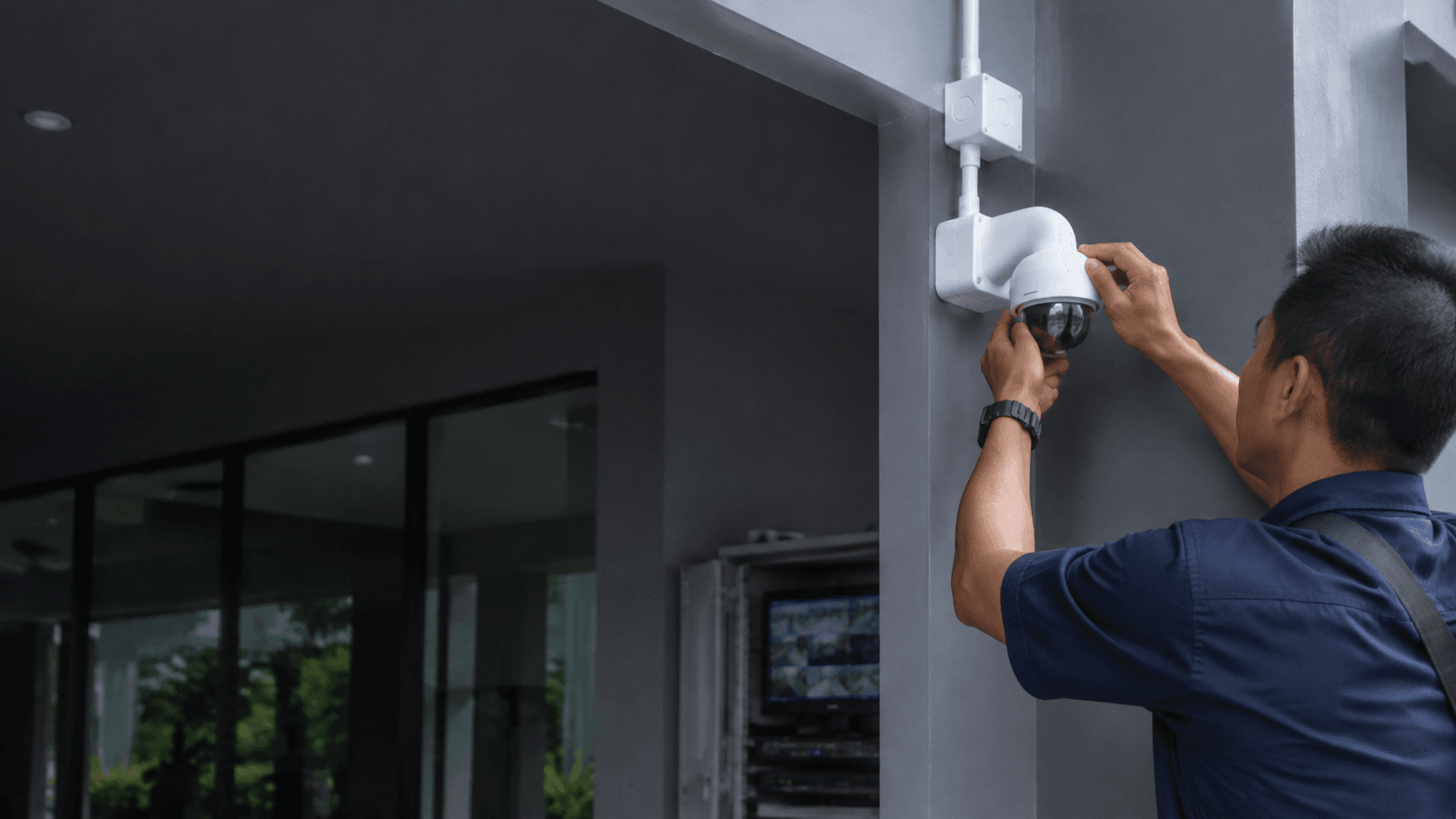
Two product families carry that specification: the DS-2CE16H0T-ITF 5 MP bullet camera and the Hikvision 5MP PoC TVI CCTV camera with 40m night vision. Both are analogue-over-coax designs, so they record into a DVR rather than an NVR, and both rely on infrared rather than colour light to see in the dark.
That distinction matters more than the megapixel count. A 40 m infrared rating describes how far the camera's own IR illuminator reaches in darkness, not how far a face remains identifiable. Resolution, lens choice, mounting height and the recorder all shape what the footage is actually worth.
Hikvision 5mp Cctv Camera With 40m Night Vision: What Matters Before Choosing
The specification is a starting point, not a purchase decision. Four variables decide whether this camera suits a given site.
- Confirm the recorder type. These are analogue 4-in-1 cameras, so they need a DVR with HD-TVI, CVI, AHD or CVBS support rather than an IP NVR.
- Match the lens to the distance being covered. A wider lens covers more area but spreads the same 5 MP across more space, so distant detail shrinks.
- Check the real lighting at the mounting point. Infrared performance depends on what the scene reflects back, and Eyonic recommends checking actual lighting conditions before confirming placement.
- Plan the cable run. Power-over-coax models draw power from a PoC-compatible Hikvision recorder over an RG59 cable, which removes a separate local power feed at the camera.
- Decide the mounting height and angle before drilling. Height reduces tampering risk but steepens the angle, which flattens facial detail.
Working through those five points in order avoids the most common outcome: a camera that meets its datasheet and still misses the detail the site actually needed.
What the 5 MP and 40 m Figures Actually Mean
5 MP on an analogue camera means a 2560 x 1440 image, which is roughly 2.5 times the pixel count of a 1080p unit. More pixels help when the subject occupies a small part of the frame, because there is more detail left after cropping into the image.
The 40 m figure is an infrared illumination distance. It describes the reach of the camera's IR array in zero light, and it assumes a scene that reflects infrared back toward the lens. Open ground, foliage and dark clothing absorb or scatter IR, so effective range shortens in practice. A wall or gate at 30 m may read clearly while a person on open tarmac at the same distance does not.
Two further specifications shape outdoor use. The DS-2CE16H0T-ITF is a bullet body, and the eBay UK listing for the 4-in-1 bullet variant records IP67 water and dust resistance with a 380 g plastic main body. IP67 covers rain and hose spray, not submersion, and it says nothing about image quality.
Hikvision 5MP PoC TVI CCTV Camera With 40m Night Vision: Variants and Fit
The same core specification appears in several body styles, and the differences are practical rather than cosmetic.
| Variant | Distinguishing feature | Where it fits |
|---|---|---|
| Bullet, 4-in-1 | Fixed lens, IP67 body, 40 m EXIR | Long straight runs such as a driveway, perimeter wall or gate line |
| PoC TVI | Power drawn from a PoC-compatible Hikvision recorder over RG59 | Sites where a local power point at the camera is difficult or costly |
| Turret with motorised zoom | Motorised zoom and wider viewing angles, IP67 | Positions where the exact field of view is uncertain until the camera is live |
| Turret with audio over coax | Integrated microphone using the video cable for audio | Entries and counters where sound adds context to the picture |
Motorised zoom is the variant most often underestimated. It allows the field of view to be adjusted after installation rather than committing to a fixed lens angle at the survey stage, which reduces the risk of a camera that covers the wrong area.
Audio over coax is a different trade-off. It captures sound on the same cable as video, but it also captures conversations, so placement near a public footpath or a neighbour's boundary raises privacy questions that a video-only camera does not.
Practical Considerations for Hikvision 5mp Cctv Camera With 40m Night Vision
Installation quality decides more outcomes than the model number. Eyonic's CCTV installation process runs through site survey, system proposal, installation and handover, and the survey stage is where most of the value sits.
Camera placement is the first constraint. A camera mounted under a deep eave may have its IR reflection bounce back off the soffit and wash out the image. A camera aimed along a wall gets a strong IR return from the wall and a dark far field. Both problems are visible at survey and invisible on a datasheet.
Cabling is the second. PoC models need an RG59 cable run back to a compatible recorder, and the recorder must actually support power over coax. A standard DVR will carry video but not power, which turns a one-cable installation into a two-cable one after the walls are closed.
Recording and remote viewing are the third. The camera supplies the image; the DVR supplies retention, search and mobile access. Storage sizing depends on channel count, resolution and how many days of footage the site needs to keep, and that decision belongs at proposal stage rather than after handover.
For sites with mixed requirements, Eyonic's project work shows how the pieces combine. The Kuching Immigration Office project focused on arrival flow, staff areas, visitor movement and dependable daily operation, while the KTA Sarawak Sdn Bhd project covered staff movement, visitor handling, tidy cabling and clearer daily site control. Both are public-facing environments where camera placement had to serve several different viewing needs at once.
Comparing Options and Making an Informed Choice
Resolution is the first comparison. A 2 MP camera at 1080p costs less and produces smaller files, and it remains adequate where the subject fills a good part of the frame at close range. A 5 MP camera earns its place when the subject is small in frame or when footage may need to be cropped later.
Night vision technology is the second. Infrared produces monochrome images in darkness and depends on IR reflection. Colour-capable low-light cameras behave differently, and Eyonic recommends checking actual lighting conditions before confirming placement for ColorVu-style cameras, because the two approaches suit different scenes.
Body style is the third. Bullets are easier to aim along a boundary; turrets are less prone to IR reflection from nearby surfaces and are less intimidating at eye level. Neither is universally better.
Budget is the fourth. Eyonic's Hikvision CCTV package is listed at RM 1,599 and covers camera supply and setup, basic recording configuration and mobile viewing handover. Larger multi-camera projects sit in a different range: the Kuching Immigration Office project carried an approximate budget of RM 12,000 to RM 28,000, and the KTA Sarawak Sdn Bhd project an approximate RM 8,000 to RM 18,000. Those figures reflect scope, channel count and site conditions rather than the camera alone.
One edge case deserves attention. A single 5 MP camera with 40 m night vision is not a complete system. It needs a compatible recorder, a cable run, storage and a viewing method. Buyers who already own a compatible HD-TVI DVR can add a camera; buyers starting from nothing are choosing a system, not a component.
Another is the 40 m claim itself. Sites that need identification at 40 m in darkness generally need more than one camera, or a camera positioned closer to the point that matters. Treating the IR rating as an identification range rather than an illumination range is the most common planning error.
Eric Yong, founder of Eyonic Security Systems, has worked in the industry for more than ten years and is experienced in technical installation of digital security solutions for commercial businesses in Sarawak. That installation experience is where the specification meets the site.
Share your location, property type and required system with Eyonic on WhatsApp at +60 11-5111 7959 for the next practical step.