
Prama India builds its own surveillance hardware rather than rebadging another factory's stock, and its published catalogue groups products into network cameras, recorders and accessories. That matters for a Malaysian buyer because the brand's public material is written for the Indian security market, so the practical questions shift from "what is it" to "who can supply it, install it and support it here."
This page covers what a Prama CCTV camera is, how cameras and recorders connect, what to verify before committing, and how lighting and placement decisions affect the result. It does not quote Prama specifications, model numbers or prices, because no verified Malaysian source for those figures was available at the time of writing.
What a Prama CCTV camera is and where it fits
Prama is a video security brand that manufactures cameras, recorders and related accessories. Its own product pages describe network cameras in three broad shapes: bullet cameras for long-distance outdoor coverage, dome cameras for indoor and outdoor mounting, and Wi-Fi or IP cameras that connect over a network. The same catalogue lists network video recorders and digital video recorders as the recording end of the system.
The distinction that matters most is analog versus IP. An analog camera sends a signal over coax cable to a DVR, which converts and stores the footage. An IP camera sends data over a network link to an NVR. Prama's catalogue covers both paths, which means a Prama CCTV camera could sit on either side of that divide depending on the model. Confirming which side a specific unit belongs to is the first check, because it determines what recorder the camera can talk to.
For a Malaysian property, the brand's origin is less important than the support chain behind it. A camera is a long-lived fixture, and the practical risk is not the hardware itself but whether replacement units, firmware help and installation labour remain available years after purchase.
Camera types, recorders and how the pieces connect
A working system has four parts. cameras, a recorder, storage, and a viewing method. Each part constrains the others.
Cameras capture. The recorder receives the streams and writes them to a hard disk. Storage determines how far back the footage goes. Viewing is how the footage is actually used, whether on a monitor in a back office or on a phone from another location.
Recorder compatibility is the hinge. An IP camera needs an NVR that speaks the same protocol, and an analog camera needs a DVR with matching inputs. Mixing brands is sometimes possible and sometimes not, and the only reliable answer comes from the manufacturer's own compatibility documentation for the specific models involved. A supplier who cannot produce that documentation is guessing.
Channel count is the other constraint. A recorder with a fixed number of channels caps how many cameras the system can ever hold, so a property that might expand later should size the recorder for the eventual camera count rather than the current one. Adding cameras to a full recorder means replacing the recorder, not just buying another camera.
Remote viewing depends on the recorder's software and on the network at the property. A stable internet connection and a sensible router configuration matter more than the camera brand in most cases.
What to compare before choosing a Prama CCTV camera
Comparison should start with the property, not the product list. The checks below are the ones that change the outcome most often.
- Confirm recorder compatibility. Establish whether the camera is analog or IP, and match it to a DVR or NVR that supports that signal type and the required channel count.
- Confirm the lens and housing suit the location. A bullet camera and a dome camera solve different problems, and an indoor-rated unit mounted outdoors will fail early.
- Confirm the lighting at the actual mounting point. Check conditions at night, not in daylight, because that is when identification matters.
- Confirm the cabling route. Coax, network cable and power all need a path that is protected, serviceable and tidy.
- Confirm who handles installation and handover. Establish who configures recording, sets up remote viewing and explains the system to the people who will use it.
Two of these deserve more detail. On lighting, Eyonic's own product guidance for low-light cameras recommends checking actual lighting conditions before confirming placement, because a position that looks adequate during a site visit in the afternoon can be unusable at 2am. On handover, a system that records but that nobody can review is not doing its job. Handover should include a walkthrough of playback and remote access, not just a working installation.
Where a property already has a recorder, the sensible sequence is to identify that recorder first and then look for cameras that fit it. Replacing a functioning recorder to accommodate a preferred camera brand is usually the more expensive path.
Lighting, placement and daily operating conditions
Placement decides what a camera can prove. A camera aimed at a gate records that someone approached; a camera positioned to capture a face or a plate records who. Those are different mounting decisions, and they are made before purchase, not after.
Malaysian conditions add specific pressures. Heavy rain, direct afternoon sun and high humidity all affect housing choice and mounting angle. Cameras under an eave last longer than cameras fully exposed. Cable runs should avoid standing water and direct sun where possible.
Lighting is the most common source of disappointment. Entrances with a single weak bulb, covered car parks and back lanes at night are the positions where footage most often fails to identify anyone. Adding a light at the mounting point is frequently more effective than upgrading the camera.
Daily operation matters too. Recording schedules, motion zones and retention periods all affect how useful the system is six months in. A recorder full of motion-triggered clips from a swaying tree branch is worse than one with sensible zones set at installation.
Practical next step for a Malaysian property
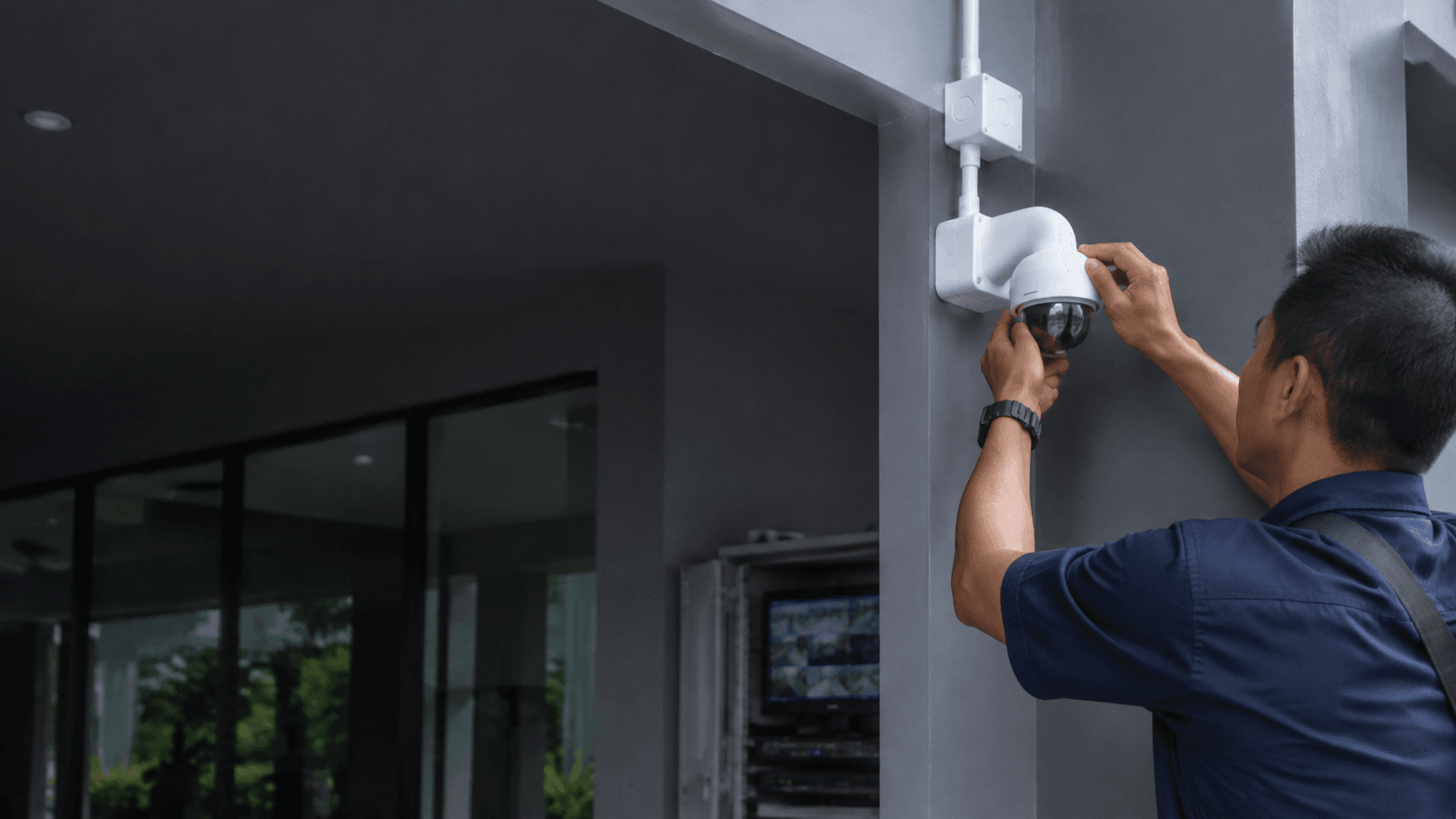
The workable sequence is a site survey, a system proposal, installation, and handover. Eyonic's published installation process follows those four stages, and the survey is where camera placement, recorder compatibility and cabling routes get settled before anything is ordered.
Eyonic is a security system supplier based in Sarawak that plans, supplies and installs monitoring systems with camera placement, recording and remote viewing for homes, offices, shops and industrial sites. Completed work includes the Kuching Immigration Office, where the focus was arrival flow, staff areas, visitor movement and dependable daily operation, and KTA Sarawak Sdn Bhd, an engineering consultancy office in Kuching that needed support for staff movement, visitor handling and tidy cabling.
On the question of whether Eyonic supplies or installs Prama products specifically, that has not been confirmed, and it should be asked directly rather than assumed. A supplier who works with multiple camera brands can usually advise on compatibility with an existing recorder regardless of which brand is finally chosen.
For a property in Malaysia weighing a Prama CCTV camera against alternatives, the deciding factors are usually local: whether the model can be sourced, whether it fits the existing recorder, and who will service it. Share the location, property type and required system with Eyonic on WhatsApp at +60 11-5111 7959 for the next practical step.