
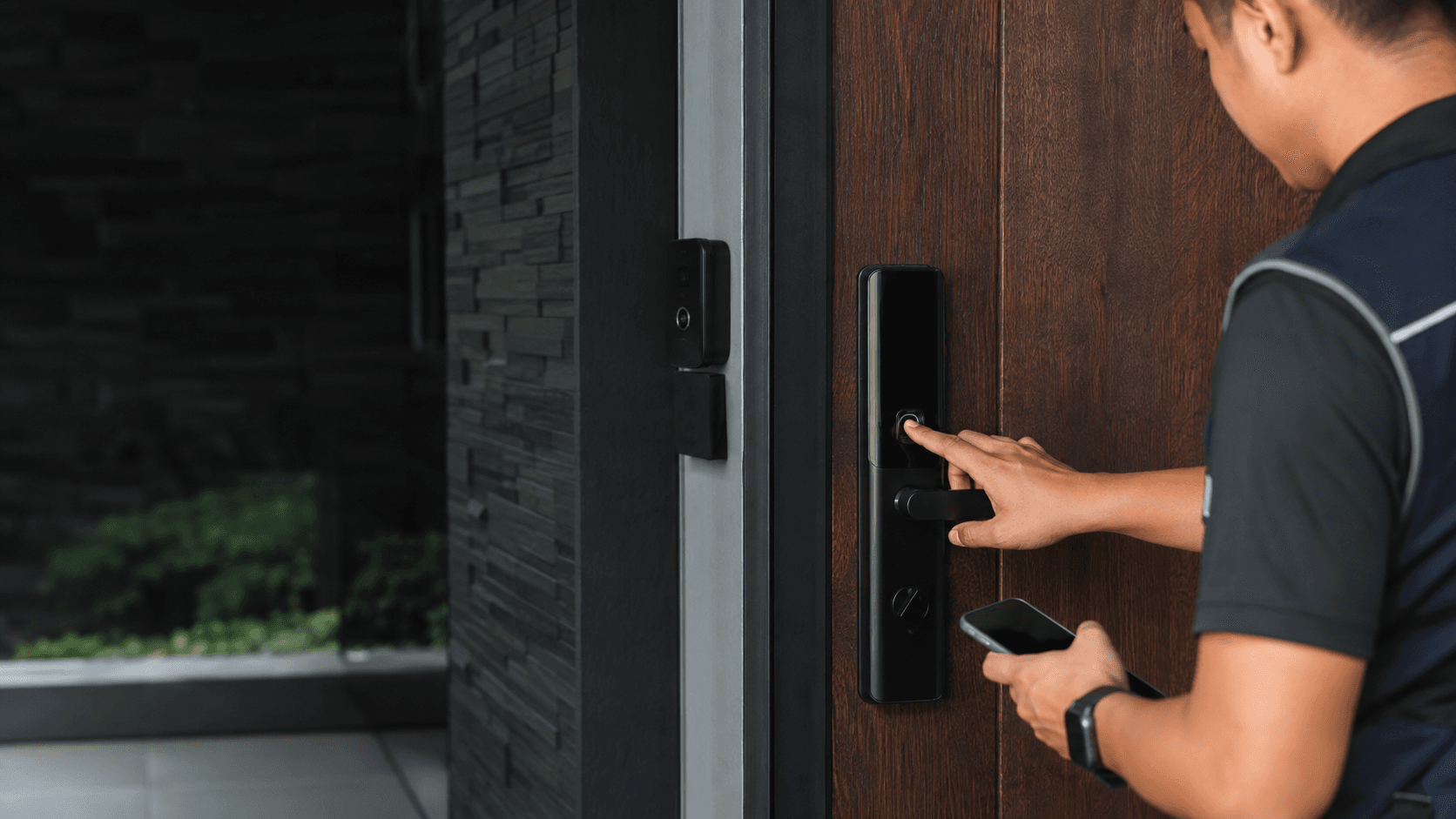
The exact-match query digital electronic lock describes a broad family of door hardware rather than a single product. Buyers in Malaysia comparing keyless entry options usually need to know what the lock controls, which credential types exist, what the door must support, and how people get in when power or batteries fail. Those four questions decide most of the practical outcome.
Digital Electronic Lock. What It Controls and Where It Fits
A digital electronic lock replaces or augments a mechanical key with an electronic decision about who may pass. The lock holds a list of credentials, checks a presented credential against that list, and releases a latch, deadbolt or motorised mechanism when the check passes. The door itself still does the physical work; the lock only decides when the door may open.
That distinction matters because a digital electronic lock is not the same as a full access-control system. A standalone lock makes its own decisions at the door. An access-control panel centralises decisions across many doors, which suits sites where administrators need one place to add, remove or audit users. Eyonic's own product review notes that smart locks work best when door condition, user roles and backup method are reviewed before installation, and that for business use the usual check is whether a standalone smart lock or an access-control panel is more appropriate.
Where a digital electronic lock fits well:
- A single entrance where the number of regular users is small and changes slowly.
- A door that already closes cleanly and has sound framing, so the lock is not fighting a misaligned leaf.
- Sites that want keyless entry without running new cabling to every opening.
- Rooms where a record of who entered is useful but a full panel is more than the site needs.
Where it fits poorly. multi-door sites with frequent staff turnover, doors on escape routes where release behaviour must be defined, and openings exposed to weather or heavy physical abuse. Those cases usually point toward a wider access-control design rather than a single lock.
Keypad, Card and Mobile Entry Options Compared
Credential choice is the most visible decision, and each option trades convenience against administration effort.
Keypad access uses a numeric code. It needs no card, no phone and no app, so it survives a dead phone battery and works for visitors who receive a temporary code. The weakness is sharing. a code passed to one person is hard to withdraw from that person alone, and codes get observed. Keypad access suits doors with a stable, small user group.
Card or fob entry issues a physical credential per person. Removing access means collecting or disabling that credential, which is cleaner than changing a shared code. The cost is that cards get lost, and lost cards must be disabled promptly.
Mobile entry puts the credential on a phone. It removes the lost-card problem and allows remote changes, but it depends on the phone being charged, the app working, and the user being comfortable with it. For staff who are not issued phones, mobile-only entry creates a daily dependency that a keypad or card avoids.
Many sites combine two methods. a keypad for everyday entry and cards or mobile credentials for staff who need individual accountability. The right mix follows from how often the user list changes, not from which technology looks newest.
Door Condition and User Roles Before Installation
Door condition is the constraint that most often decides whether a digital electronic lock works reliably. A lock cannot compensate for a door that binds, a frame that has moved, or a latch that needs force to close. Before any hardware is chosen, the door should be checked for alignment, closing force, frame soundness and whether the existing cut-outs can accept the new lock body.
User roles come next. A useful review separates three groups:
- Regular users who enter daily and need fast, low-friction access.
- Occasional users such as contractors or cleaners who need time-limited access.
- Administrators who add, remove and audit credentials, and who need to know how that is done.
If the administrator role is unclear, the lock will be managed by whoever happens to hold the manual, and credentials accumulate. For business use, that is the point at which a standalone lock becomes the wrong shape for the site and an access-control panel becomes the better fit.
Backup Entry and Daily Operation Planning
Backup entry is the question that separates a workable installation from a recurring problem. Every electronic lock depends on power, whether from batteries or mains, and every electronic lock can fail. The site needs a defined answer for three situations: a flat battery, a lock fault, and a lost or revoked credential.
A mechanical override key is the common answer, but it only helps if the key is stored somewhere reachable and controlled. A key locked inside the room it opens is not a backup. A second entrance with independent access is another answer, provided that entrance is genuinely independent and not on the same failure path.
Daily operation planning covers the small routines that decide whether the lock stays useful: who replaces batteries and how often they are checked, who removes credentials when a person leaves, and what happens during a power interruption. These are administrative tasks, not hardware features, and they are the usual reason an installed lock stops being trusted.
Digital Electronic Lock in Malaysian Homes, Shops and Offices
In Malaysia, the same digital electronic lock category serves very different sites, and the differences are practical rather than technical.
A home usually has one main entrance, a small and stable user group, and a preference for keyless entry that removes the need to carry a key. The main risks are battery failure and family members who are not issued credentials.
A shop has a changing cast of staff, deliveries and after-hours access. The user list changes often, so credential removal matters more than credential issuance. A shop also needs a clear answer for how the premises are opened when the first person arrives and locked when the last person leaves.
An office sits between the two. Staff movement and visitor handling are the daily concerns, and the door often needs to distinguish between people who belong there and people who are visiting. Eyonic's work for the Kuching Immigration Office focused on arrival flow, staff areas, visitor movement and dependable daily operation, which is the same set of concerns an office door raises in miniature. Eyonic's work for KTA Sarawak Sdn Bhd addressed staff movement, visitor handling, tidy cabling and clearer daily site control in a Kuching office.
Industrial sites raise the stakes further. Doors are used harder, users are more numerous, and a single standalone lock rarely covers the requirement. Those sites generally need a wider access-control design rather than one lock on one door.
Installation Steps from Site Survey to Handover
Eyonic's installation process follows a defined sequence, and the same sequence applies to door access work. The steps below describe the order in which decisions are made, not a fixed timeline.
- Site survey. The door, frame, closing behaviour, existing hardware and available power are inspected on site. This is where door condition is confirmed rather than assumed.
- System proposal. The survey findings are turned into a recommendation covering credential type, whether a standalone lock or an access-control panel suits the site, and how backup entry will work.
- Installation. The lock is fitted, wired or powered as required, and configured with the agreed credentials and user roles.
- Handover. Users and administrators are shown how to operate the lock, how to add or remove credentials, and what to do when the lock fails or the battery runs flat.
The survey step is the one most often skipped when a lock is bought first and fitted later. A lock chosen before the door is inspected may not fit the existing cut-outs, may not suit the door's closing behaviour, and may leave no sensible backup path. Checking the door first is cheaper than discovering the mismatch after installation.
Eyonic's founder, Eric Yong, has worked in technical installation of digital security solutions for commercial businesses in Sarawak for more than 10 years, and the survey-first sequence reflects that installation background rather than a product preference.
What to Confirm Before Choosing
Four confirmations decide whether a digital electronic lock is the right choice for a given door.
First, confirm the door is sound. Alignment, closing force and frame condition are prerequisites, not details.
Second, confirm the user list and how often it changes. A stable, small list suits a standalone lock. A large or fast-changing list points toward an access-control panel.
Third, confirm the backup entry method and where the override is stored. If no workable backup exists, the installation is not finished.
Fourth, confirm who administers the lock and how credentials are removed. Without a named administrator, access accumulates and the lock stops reflecting who should be on site.
Where those four confirmations hold, a standalone digital electronic lock delivers controlled convenience. Where any of them fails, the site usually needs a wider access-control design, and the honest answer is to plan that instead of fitting a lock that will be worked around.
Share your location, property type and required system with Eyonic on WhatsApp at +60 11-5111 7959 for the next practical step.