
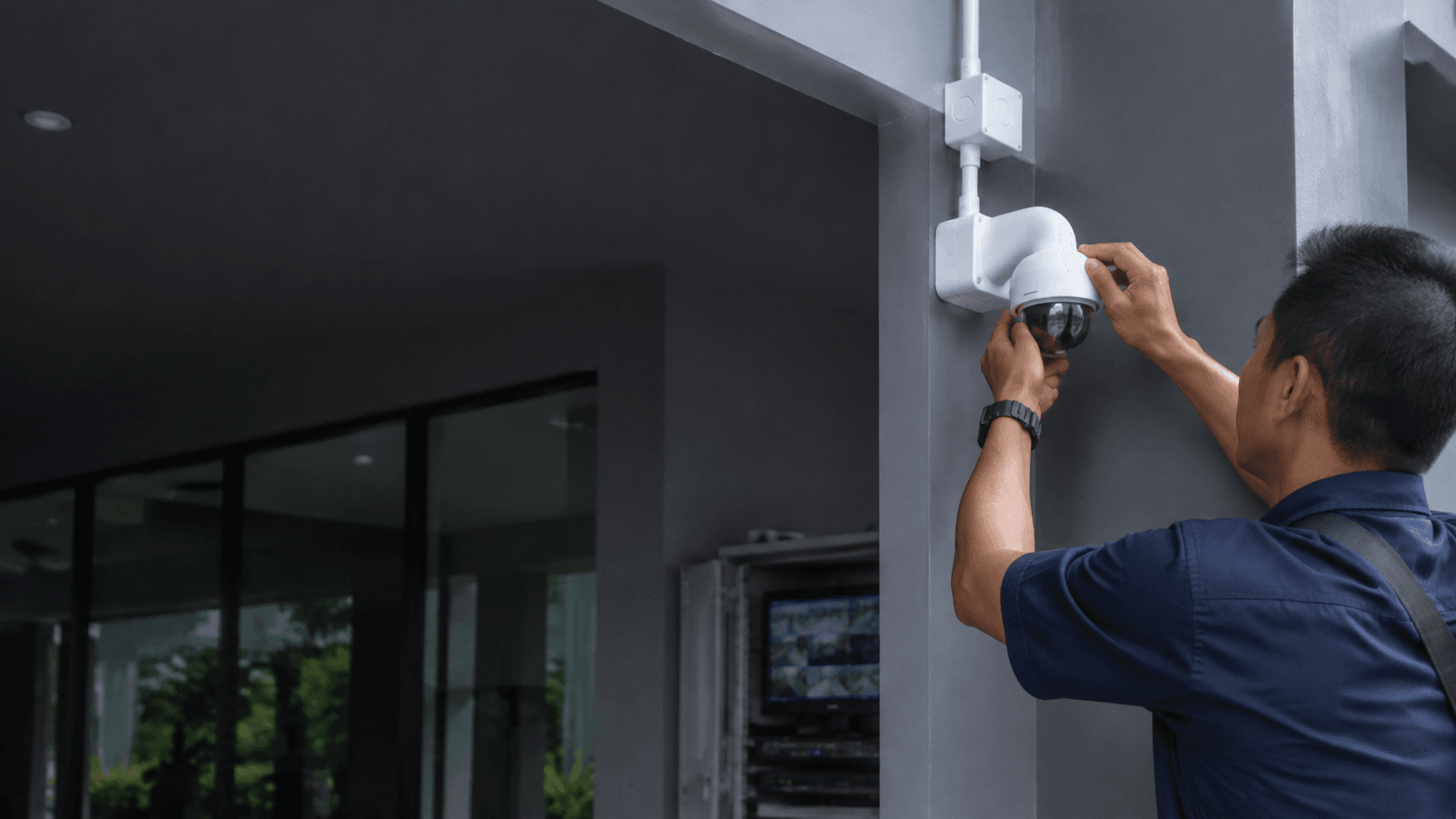
Eyonic Sdn Bhd plans, supplies and installs monitoring systems for homes, offices, shops and industrial sites, covering camera placement, recording and remote viewing. The company is based in Sarawak and works on residential and commercial security work, including a completed project for the Kuching Immigration Office that focused on arrival flow, staff areas, visitor movement and dependable daily operation.
Most buyers arrive with the same three questions: what the system actually contains, how the cameras get positioned, and what the work costs. The sections below answer those in order, then set out the limits of what can be confirmed before a site visit.
Residential Surveillance Cameras: What Matters Before You Choose
A home camera system is not a single product. It is a small set of parts that have to work together, and the mix changes with the property.
The core components are cameras, a recorder, storage, cabling or wireless links, and a viewing method. Eyonic lists camera placement, NVR setup and remote viewing as part of its CCTV work, which maps onto that list: the cameras capture, the network video recorder stores and manages the footage, and remote viewing is how the homeowner checks in from a phone.
Two practical choices sit underneath all of this.
The first is wired versus wireless. Wired cameras draw power and send video over a cable, which usually means a more permanent installation and a tidier result over time. Wireless cameras are easier to place but depend on signal quality and, in most consumer designs, on battery or local power. Neither is automatically better; the deciding factor is usually whether the property can take cabling to the points that matter.
The second is local versus cloud storage. Local recording keeps footage on a recorder inside the property. Cloud storage moves it off-site but normally ties the system to a subscription. Eyonic's residential work is built around local recording with remote viewing, which keeps the system usable without a recurring storage fee.
What a home system does not include by default is monitoring. A camera system records and lets the owner look in. It does not dispatch anyone. Buyers who want an alarm response are looking at a different product, and Eyonic sells a separate Hikvision Alarm System package for that purpose.
How camera placement is decided
Placement is the decision that determines whether a system is useful or decorative, and it is made on site rather than from a floor plan.
The starting point is coverage of the routes a person actually uses: the gate, the car porch, the front door, the side passage, and any rear access. A camera that watches a wall tells the owner nothing. A camera that watches the approach to a door captures who arrived and when.
Lighting is the second input. Eyonic advises checking actual lighting conditions before confirming placement for ColorVu-style cameras, because a position that looks adequate in daylight can behave differently after dark. This is why the survey happens at the property rather than over the phone.
Three constraints shape the final positions.
- Site survey — the property is walked to identify entry routes, existing cabling, power points and lighting conditions at each candidate position.
- System proposal — the survey findings are turned into a written scope covering camera positions, recorder location, storage and viewing setup.
- Installation — cameras, cabling and the recorder are installed and configured to the agreed scope.
- Handover — the system is tested and the owner is shown how to view footage and manage the setup.
That sequence is Eyonic's stated CCTV installation process, and it applies to residential work in the same way it applies to commercial sites.
Two edge cases are worth naming. Rental properties limit both drilling and cabling, so placement often has to favour fewer, better-positioned cameras over full perimeter coverage. Older shophouse-style or long-lot homes can have a rear area that is hard to reach with cable, which pushes the decision toward a different camera type or a different recorder position.
Choosing between coverage and detail
A fixed budget forces a choice between watching more of the property and seeing any one part of it clearly. Wide coverage with too few cameras produces footage where faces and plates are not readable. Tight coverage on the main entry produces usable evidence but leaves the perimeter unwatched.
Most homes resolve this by prioritising the entry route and the vehicle area, then adding coverage elsewhere if the budget allows. The right balance depends on the property, which is why the survey comes before the proposal rather than after.
What installation involves
Installation is the part buyers underestimate. The cameras are the visible element; the cabling, recorder position and configuration determine how well the system holds up.
Eyonic's process runs from site survey through system proposal to installation and handover. In practice that means the installer needs access to the points where cameras will sit, a route for cable back to the recorder, and a power source for the recorder itself. A recorder is usually placed somewhere secure and ventilated rather than in a living area.
Configuration covers recording settings, storage, and remote viewing. Remote viewing is the step most homeowners care about most, because it is how the system gets used day to day. It also depends on the home network, so the handover includes confirming that the phone app connects and that footage plays back.
Handover is not a formality. It is where the owner learns which camera covers which area, how to find a past recording, and what to do when something needs attention. A system that is installed but not understood tends to go unused.
For buyers comparing residential surveillance cameras, the useful question is not how many cameras a package contains but whether the installer will walk the property first. A quote given without a survey is a guess about placement, and placement is where most of the value sits.
Costs and package ranges
Eyonic publishes three basic packages at RM 1,599 each: a Hikvision CCTV Package covering camera supply and setup, basic recording configuration and mobile viewing handover; a Hikvision Alarm System covering control panel and sensors, siren and zone setup, and user testing and handover; and an Autogate Package covering motor recommendation, remote-control setup, and safety testing and handover.
Those figures are the published starting packages. They are not a quotation for a specific home, because the final scope depends on the number of cameras, the cabling distance and the recorder and storage chosen. Larger projects carry larger budgets: Eyonic's Kuching Immigration Office project sits in an approximate range of RM 12,000 to RM 28,000, and the KTA Sarawak Sdn Bhd office project sits in an approximate range of RM 8,000 to RM 18,000. Both are non-residential projects, so neither figure should be read as a residential price.
What can be said honestly is that a basic residential package starts at RM 1,599, and that a larger property with more cameras and longer cable runs will cost more. The gap between those two points is closed by the survey and proposal, not by a published price list.
Coverage limits and what cannot be confirmed yet
Several things buyers reasonably want to know cannot be stated here without a verified source, and it is better to say so than to guess.
There is no verified resolution, sensor, lens, storage-capacity or night-vision specification for any specific residential camera model in this material. There is no verified number of cameras required per property type or per square foot. There is no verified warranty length, response time or after-sales service term. There is no verified Malaysian regulatory, licensing or data-protection requirement for home camera recording, and no verified statement about how long footage is retained or how storage is sized for a home. Whether internet is required for local recording in an Eyonic installation is also unconfirmed here.
Those gaps matter because they are exactly the points where a generic product roundup would fill space with assumptions. A property-specific answer needs a property-specific survey.
What is confirmed is narrower but more useful. Eyonic plans, supplies and installs monitoring systems with camera placement, recording and remote viewing for homes, offices, shops and industrial sites. The installation process runs through site survey, system proposal, installation and handover. The company has completed work for a public office in Kuching and for an engineering consultancy, and it advises checking real lighting conditions before locking in camera positions.
For a homeowner in Sarawak working through residential surveillance cameras for the first time, the practical next step is to share the property location, the property type and the system required with Eyonic on WhatsApp at +60 11-5111 7959, so the survey can be scoped against the actual building rather than a package description.