
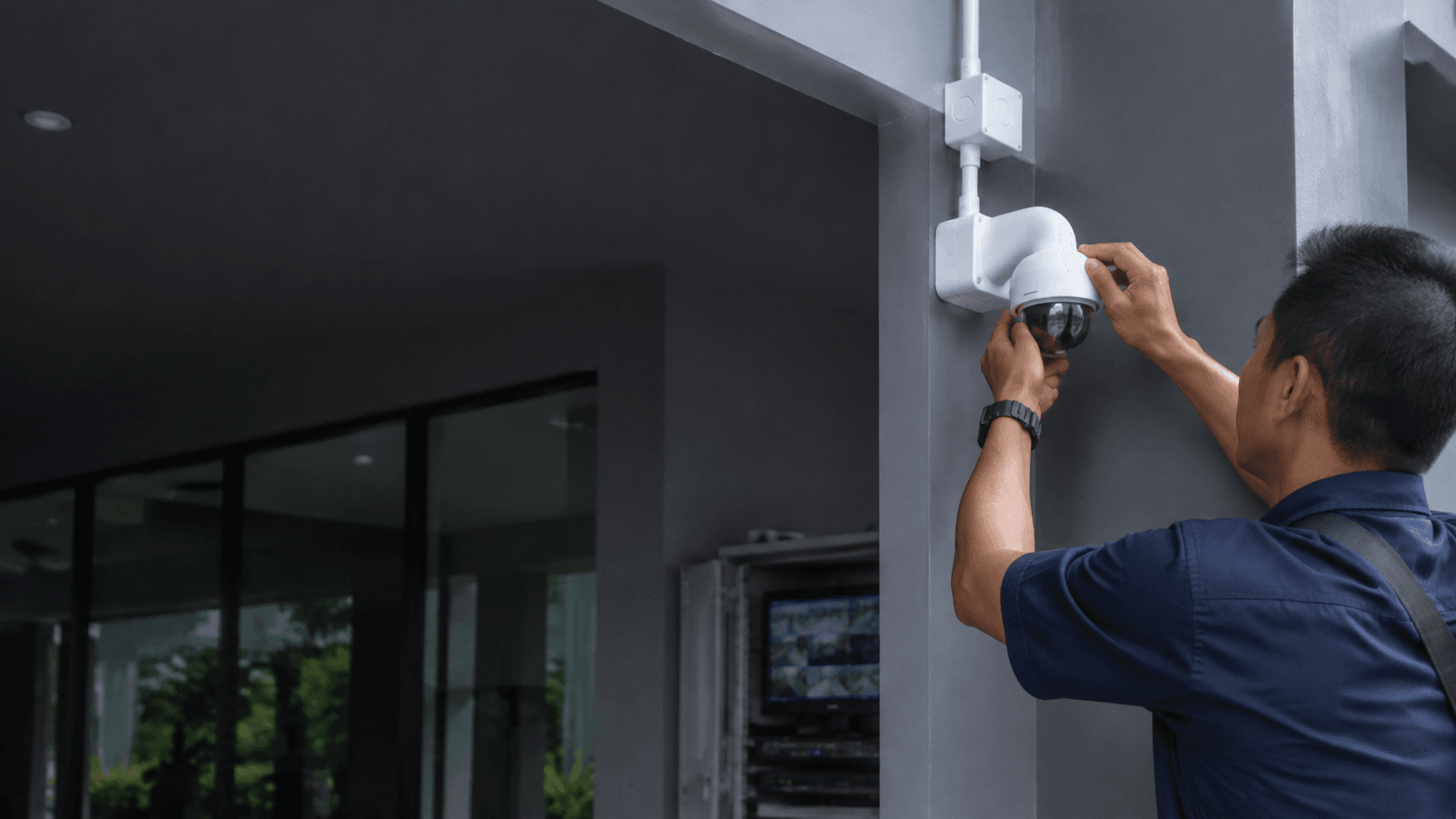
Coverage is decided on the ground, not on a catalogue page. Two sites of the same size can need different camera positions because one has a bright open approach and the other has a shaded corridor with a pillar in the middle of the view.
What area CCTV coverage actually means on site
Area CCTV is the practice of covering a defined zone — an entrance, a counter, a yard, a corridor — rather than buying a fixed number of cameras and pointing them somewhere useful. The zone comes first. The hardware follows.
That order matters because coverage is a chain of decisions. Each one narrows the next.
- Site survey. walk the space, note entry and exit points, staff-only areas, visitor routes and existing lighting.
- System proposal. match camera positions, recording and remote viewing to what the survey found.
- Installation. mount, cable and configure the system on site.
- Handover. confirm recording, mobile viewing and day-to-day operation with the people who will use it.
Eyonic's CCTV installation process follows those four stages, and the survey is the stage that decides everything after it.
Coverage is not the same as camera count
A single well-placed camera can cover an entrance, a counter and the walkway between them if the angle and height are right. Two cameras pointed at the same doorway from similar angles add cost without adding information.
The useful question is what needs to be identifiable in the recorded view, and from which direction a person or vehicle would approach it. That answer sets the position. The number of cameras falls out of the positions, not the other way round.
What the survey is actually looking for
A survey records the physical facts that change camera placement: where people enter, where they queue, which doors staff use, where deliveries arrive, which surfaces reflect light at night, and which structures block a line of sight. It also records how the space is used at different times of day, because a corridor that is empty at noon may be the busiest route at shift change.
Those observations become the proposal. Without them, a quote is a guess with a price attached.
How Eyonic plans area CCTV coverage
Eyonic Sdn Bhd is a security system supplier in Sarawak that plans, supplies and installs monitoring systems with camera placement, recording and remote viewing for homes, offices, shops and industrial sites. The planning stage is where area coverage is settled.
Eric Yong, founder of Eyonic Security Systems, has worked in the industry for more than ten years and is experienced in technical installation of digital security solutions for commercial businesses in Sarawak. That experience shows up most clearly in the survey, where the difference between a workable layout and an awkward one is usually visible before anything is mounted.
Zones come before equipment
A public office, a shop and a warehouse do not share the same coverage priorities. A public office needs arrival flow, staff areas and visitor movement covered so daily operation stays dependable. A shop needs the counter, the stockroom door and the till. A warehouse needs the loading point and the yard perimeter.
Eyonic's work for the Kuching Immigration Office focused on arrival flow, staff areas, visitor movement and dependable daily operation. That is a coverage brief, not a camera list — and it is the kind of brief a survey produces.
Recording and remote viewing are part of coverage
Coverage that nobody can review is not coverage. NVR setup and remote viewing are part of the same plan, because the position of the recorder, the network path and the way footage is accessed all affect whether the system is useful after an incident.
Remote viewing also changes what counts as a good camera position. A view that is clear on a large monitor may be unreadable on a phone screen, so the survey should consider where the footage will actually be watched.
placement decisions that change the result
Placement is where most coverage problems are created or avoided. The decisions below are the ones that most often change the outcome.
Height and angle
Mounting a camera too high produces a view of the tops of heads and the tops of vehicles. Mounting it too low invites tampering and obstruction. The workable height is the one that keeps faces and number plates visible at the distance that matters, while staying out of easy reach.
Angle matters just as much. A camera aimed along a wall covers a long strip but loses depth. A camera aimed across a doorway covers the approach but may miss the interior. Most areas need the approach covered, because that is where a person or vehicle is identifiable before entering.
Overlap and blind spots
Two cameras with a small overlap close the gap between them. Two cameras with no overlap leave a strip that neither records. Overlap is cheap insurance, but it should be deliberate rather than accidental.
Blind spots are usually created by the building itself: a pillar, a staircase, a signboard, a parked vehicle. The survey is the point at which those are found, because a blind spot discovered after installation is expensive to correct.
Entry points and internal routes
Entry points carry the most value per camera because they capture people and vehicles at a predictable moment. Internal routes — corridors, stairwells, the path between a counter and a back office — carry the next most value, because they connect the entry to everything else.
Perimeter coverage is a different problem. A long boundary needs either several cameras or a smaller number positioned where the boundary is easiest to cross, since that is where an approach is most likely.
Where the recorder and network sit
NVR setup is not a separate task from coverage planning. The recorder needs a secure, ventilated position with a network path to each camera, and the cabling route affects where cameras can practically be mounted. Tidy cabling is also a coverage decision, because a cable run that crosses a view or hangs within reach undermines the installation.
Lighting obstructions and daily conditions
Lighting is the single most common reason a planned view fails in practice. A camera that performs well in daylight can produce an unusable image at night if the area is lit unevenly or not at all.
Eyonic recommends checking actual lighting conditions before confirming placement for ColorVu-style cameras. That check belongs in the survey, not after installation, because it can move a camera by a metre or change which side of a doorway it is mounted on.
What to check after dark
Walk the area at night and look for the light sources that will actually be present: street lighting, corridor lighting, signage, vehicle headlights, and any light that is switched off after hours. A camera facing a bright light source will struggle with the area behind it. A camera facing a dark corner will record movement without detail.
Reflective surfaces — glass, polished floors, wet tarmac — can also throw light back into the lens. These are physical facts about the site, and they are only visible on site.
Obstructions that change over time
Trees grow, signage is added, stock is stacked, and vehicles park in different places. A view that is clear on survey day may not stay clear. Where an obstruction is likely to change, a slightly different angle or a second position is usually worth the small extra cost.
Weather matters too. In Sarawak, heavy rain reduces visibility and can affect outdoor camera positions that face directly into prevailing weather. A mounting position under an eave or overhang is often more durable than an exposed one.
Daily operation and who uses the system
Coverage should match how the site is actually run. If staff need to check a counter during a dispute, the camera covering that counter needs to record clearly at the distance where people stand. If a manager checks the yard from a phone, the yard view needs to be readable on a small screen.
Handover is where these expectations are tested. Recording, mobile viewing and basic operation should be confirmed with the people who will use the system daily, not just with whoever signed off the installation.
What a completed project looks like
A finished project is not a pile of equipment. It is a system where each camera has a stated job, the recorder captures what those cameras see, and the people on site can review footage without calling for help.
Eyonic's project work shows the pattern. The Kuching Immigration Office project provided practical support for a public office in Kuching, focused on arrival flow, staff areas, visitor movement and dependable daily operation. The approximate budget for that type of work is RM 12,000 to RM 28,000.
A second example is the KTA Sarawak Sdn Bhd project, which needed a practical office setup in Kuching to support staff movement, visitor handling, tidy cabling and clearer daily site control. The approximate budget for that type of work is RM 8,000 to RM 18,000.
Both briefs describe coverage outcomes rather than camera specifications, which is the useful way to judge whether a proposal will actually work.
Smaller scopes and package pricing
Not every site needs a project-scale installation. Eyonic's Hikvision CCTV Package is RM 1,599 and covers camera supply and setup, basic recording configuration and mobile viewing handover. That scope suits a smaller area where the survey confirms a straightforward layout.
The gap between a package and a project is usually the number of zones, the complexity of the cable routes, and how much the lighting and obstructions complicate placement. A survey is what separates the two.
Questions that come up during planning
How many cameras does an area need? There is no fixed number per square metre. The count follows the number of zones that need separate coverage and the positions that can see them clearly. A survey is the only reliable way to answer it for a specific site.
Can existing cameras be reused? Sometimes, if they are in working order and their positions still suit the coverage plan. The survey should assess what is already installed before proposing replacements.
What if the area is shared with neighbouring units? Coverage should be limited to the area under the owner's control. Pointing cameras at a neighbour's entrance or a shared corridor beyond the property's boundary creates problems that are easier to avoid at the planning stage than to resolve later.
Does recording need to be continuous? That depends on what the footage is for. Continuous recording captures everything but fills storage faster. Motion-based recording saves space but can miss the moments before movement is detected. The choice belongs in the proposal, alongside the coverage plan.
What happens after handover? Handover confirms recording, mobile viewing and day-to-day operation. Beyond that, the practical questions are who holds the account details, who can review footage, and who to contact if a camera stops working.
What to prepare before a survey
A survey is more productive when the site owner can describe the problem rather than the product. Useful things to have ready. the areas that matter most, the incidents or concerns that prompted the enquiry, the times of day the site is busiest, and any existing cameras or cabling.
It also helps to know who will review footage and from where, because that shapes both the camera positions and the remote viewing setup.
Share the location, property type and required system with Eyonic on WhatsApp at +60 11-5111 7959 to move from a general idea of area CCTV to a coverage plan for a specific site.