
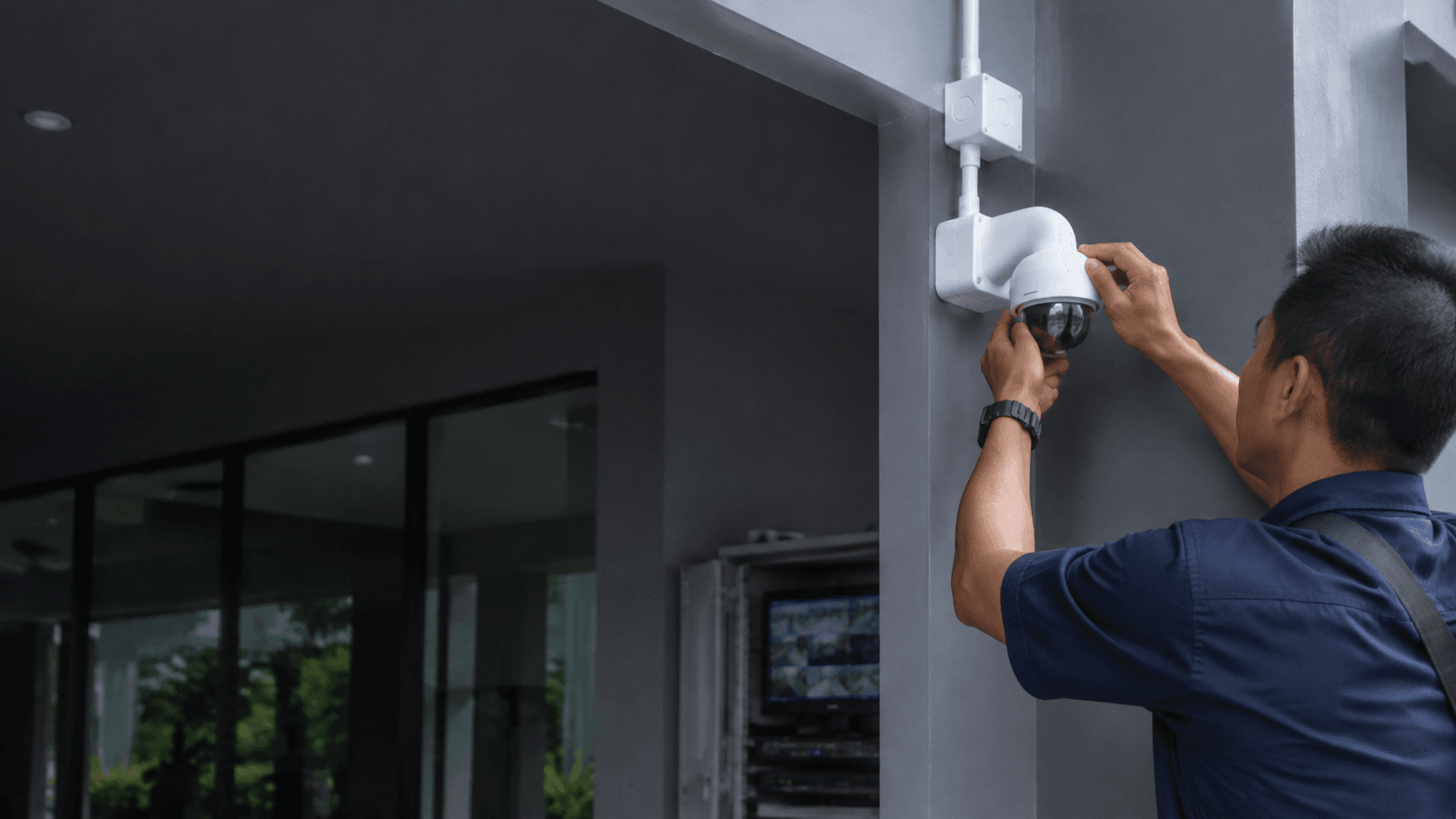
The exact figure a buyer pays rarely matches a single sticker. A surveillance camera price is built from the camera units, the recorder, the storage drive, the cabling, and the labour that puts it all in place. Two properties with the same number of cameras can land on very different totals once cable runs, lighting conditions, and recording retention are counted.
Eyonic Sdn Bhd, a security system supplier in Sarawak, publishes a Hikvision CCTV package at RM 1,599 that covers camera supply and setup, basic recording configuration, and mobile viewing handover. That package sits at the entry point. Completed office work in Kuching has carried approximate budgets of RM 8,000 to RM 18,000 for an engineering consultancy site and RM 12,000 to RM 28,000 for a public office.
What Shapes a Surveillance Camera Price
Four cost blocks decide most quotes: cameras, recording and storage, installation labour, and any recurring service. Each block scales differently, so a cheap camera count can still produce an expensive total.
- Count the cameras and match each one to a real field of view, not a hopeful one.
- Size the recorder and storage so retention days match what the site actually needs.
- Walk the cable routes and confirm power, conduit, and access before pricing labour.
- Check lighting at each position, because low-light performance changes the camera model required.
- Confirm who configures remote viewing, user accounts, and handover training.
Camera count is the most visible driver, but it is not the largest. A four-camera home setup and a sixteen-camera office setup differ far more in cabling and recorder capacity than in the cameras themselves. Storage is the quiet cost. longer retention means a larger hard drive, and continuous recording fills it faster than motion-triggered recording.
Camera Units and Resolution
Resolution tiers move the unit price. Higher-resolution cameras cost more per unit and also produce larger files, which pushes storage requirements upward. That second effect is easy to miss when comparing camera prices alone.
Recording, Storage, and Retention
An NVR setup with a hard drive is the common local arrangement. Retention length, frame rate, and resolution together determine drive size. A site that wants thirty days of continuous footage needs a materially larger drive than one that keeps seven days of motion events.
Installation Labour and Cabling
Labour is where site conditions show up. Tidy cabling through an office ceiling, conduit on an exterior wall, and long runs between camera and recorder all add time. Eyonic's CCTV installation process runs through site survey, system proposal, installation, and handover, which is the sequence that turns a rough camera count into a fixed scope.
Surveillance Camera Price Benchmarks in Malaysia
Published package pricing gives a starting anchor. Eyonic lists three packages at RM 1,599 each: a Hikvision CCTV package, a Hikvision alarm system, and an autogate package. The CCTV package includes camera supply and setup, basic recording configuration, and mobile viewing handover.
Project-scale work sits well above that. The Kuching Immigration Office project, focused on arrival flow, staff areas, visitor movement, and dependable daily operation, carried an approximate budget of RM 12,000 to RM 28,000. The KTA Sarawak Sdn Bhd office setup in Kuching, covering staff movement, visitor handling, tidy cabling, and clearer daily site control, carried an approximate budget of RM 8,000 to RM 18,000.
| Scope | Approximate budget | What drives the figure |
|---|---|---|
| Entry package | RM 1,599 | Camera supply and setup, basic recording configuration, mobile viewing handover |
| Small office or consultancy site | RM 8,000 - RM 18,000 | Staff movement coverage, visitor handling, tidy cabling, daily site control |
| Public office with public flow | RM 12,000 - RM 28,000 | Arrival flow, staff areas, visitor movement, dependable daily operation |
These are approximate budgets for completed work, not fixed retail prices. They show the gap between a packaged home or small-shop installation and a multi-zone office deployment.
Choosing the Right Surveillance Camera
Selection follows the site, not the catalogue order. The practical sequence is to define what needs to be seen, then pick the camera that sees it under real conditions, then size everything behind the camera.
Lighting is the most common mismatch. Eyonic recommends checking actual lighting conditions before confirming placement for ColorVu-style cameras, because a position that looks adequately lit during a daytime survey can behave differently after dark. A camera chosen for low-light colour performance is wasted if the position is genuinely dark, and a standard camera is wasted where colour detail at night matters.
Coverage intent matters too. A camera aimed at an entrance answers a different question than one covering a long corridor or a loading area. Wide views trade detail for breadth, and narrow views do the reverse. Matching the lens to the job avoids paying for resolution that never gets used.
Home Shop and Office Fit
A home or small shop usually needs a small camera count, one recorder, and remote viewing on a phone. An office adds staff areas, visitor movement, and often a requirement that cabling stays tidy and out of the way. Industrial sites add distance, weather exposure, and power routing concerns.
Wired Wireless and Power Choices
Wired cameras generally suit fixed positions where cable can be routed cleanly. Wireless cameras reduce cabling but still need power or a battery plan, and battery life depends on how often the camera records. The choice affects both the surveillance camera price and the maintenance routine afterward.
Practical Considerations Before Committing
Several constraints change the number on the quote after the first walkthrough. Knowing them in advance keeps the comparison honest.
Retention policy is the first. Continuous recording, motion-only recording, and scheduled recording produce very different storage needs. A site that only needs event clips can often stay on a smaller drive than one that wants a full timeline.
Remote viewing and user accounts are the second. Handover includes configuring mobile viewing, and the number of people who need access affects how accounts are set up. This is a configuration task, not a hardware cost, but it belongs in the scope.
Future expansion is the third. A recorder with spare channels costs more upfront and less later. A site that expects to add cameras should size the recorder once rather than replace it.
Maintenance is the fourth. Cameras on exterior walls collect dust, insects, and water exposure. Cleaning schedules and occasional lens adjustment are part of ownership, and hard-to-reach positions make that work harder.
Questions Buyers Ask About Cost
Does a higher camera count always cost more? Usually, but the increase is not linear. Recorder channels, storage, and cabling often jump at specific thresholds, so moving from four to eight cameras can cost more than the camera units alone suggest.
Is installation included in package pricing? Eyonic's RM 1,599 Hikvision CCTV package lists camera supply and setup, basic recording configuration, and mobile viewing handover. Larger project scopes are quoted separately after a site survey.
What makes an office project cost several times a home setup? Coverage of staff areas, visitor movement, arrival flow, and tidy cabling across a larger building. The Kuching Immigration Office and KTA Sarawak projects show the range that office-scale work reaches.
Can a system be added to later? Yes, if the recorder has spare channels and the cabling plan leaves room. Sizing for expected growth at the start is usually cheaper than replacing the recorder later.
Making an Informed Choice About
The useful comparison is scope against scope, not camera against camera. A quote that names the camera count, the recorder, the storage, the cable route, and the handover steps can be checked against another quote on equal terms. A quote that lists only cameras cannot.
For a single property, the entry package figure gives a realistic floor. For an office or public-facing site, the completed-project budgets in the RM 8,000 to RM 28,000 range show what multi-zone coverage with tidy cabling and dependable daily operation actually costs.
Eric Yong, founder of Eyonic Security Systems, has worked in the industry for more than ten years and specialises in technical installation of digital security solutions for commercial businesses in Sarawak. That installation background is the reason the process starts with a site survey rather than a product list.
Share your location, property type and required system with Eyonic on WhatsApp at +60 11-5111 7959 for the next practical step.