
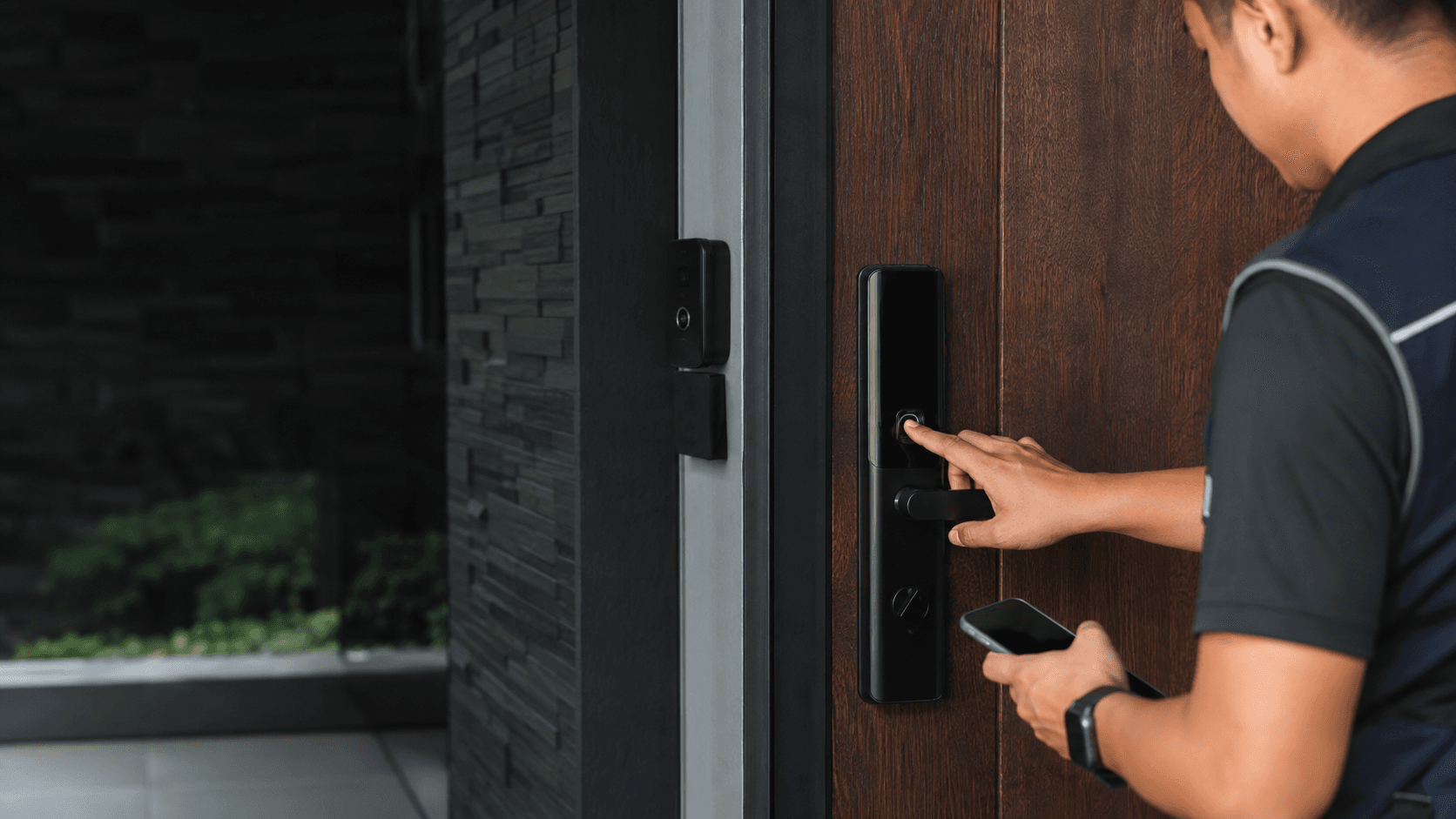
The exact-match query "z wave lever lock" describes a narrow piece of hardware: a lever-handle lock with a Z-Wave radio inside. Most pages that rank for it are product listings with almost no explanation. The median word count across eight analyzed pages was 47 words, and the median heading count was zero. That leaves room for a page that explains what the hardware does, what it connects to, and what has to be confirmed at the door before anyone commits.
What a Z Wave Lever Lock changes at the door
A Z Wave Lever Lock changes two things at once. It changes how the door is opened, because entry moves from a key to a keypad code, an app command, or an automation rule. It also changes how the door is monitored, because the lock can report its state to a hub or alarm panel rather than sitting silently as mechanical hardware.
The lever format matters because it replaces an existing lever handle rather than adding a deadbolt above it. That keeps the door's appearance closer to what was there before and avoids a second piece of hardware on the same leaf. It also means the lock inherits whatever condition the existing lever preparation is in.
Eyonic's own product review notes that smart locks work best when the door condition, user roles and backup method are reviewed before installation. For business use, the same review says Eyonic usually checks whether a standalone smart lock or an access-control panel is more appropriate. That distinction is the practical fork in the road: a single lever door with a handful of users behaves very differently from a staff entrance with shift changes and audit needs.
Lever locks versus deadbolt smart locks
A deadbolt smart lock secures the main locking point of a door. A lever lock secures the handle and latch. On many residential doors both exist, and only one of them is smart. On some doors, particularly interior or lighter-duty leaves, the lever is the only locking hardware present.
The trade-off is straightforward. A lever lock is easier to retrofit where a lever already exists, and it keeps the door looking unchanged. A deadbolt generally sits on the primary security point that a forced entry would target. Choosing between them is not a quality question; it is a question of which locking point the door actually has and which one needs to be controlled.
There is also a handling question. Lever locks are commonly built to work on either a left-hand or right-hand door, but the lock still has to be set to match the door it is going on. Getting that wrong produces a lock that installs cleanly and then operates backwards.
Hub and alarm compatibility to confirm first
A Z Wave Lever Lock is only as useful as the system it joins. Z-Wave is a radio protocol, and the lock needs a controller that speaks it. That controller is usually a smart home hub or an alarm panel, and it is the piece that turns a keypad lock into something that can be scheduled, monitored, or tied to other events.
Compatibility has to be confirmed against the specific hub or panel already in place, not against Z-Wave in general. A hub that supports Z-Wave door locks may still need the lock added through a pairing process, and the features available afterwards depend on what the platform exposes. Remote locking, code management, and lock-state reporting are platform features as much as lock features.
Where no hub exists yet, the decision changes shape. Adding a hub purely to support one lever lock is a different proposition from adding a lock to a hub that already runs lighting, cameras, or an alarm. The lock is the cheap part of that decision; the controller and its configuration are the part that takes planning.
Eyonic's project work at the Kuching Immigration Office focused on arrival flow, staff areas, visitor movement and dependable daily operation. That is the same lens a lever lock gets judged through in a workplace: not whether it is clever, but whether it holds up across a normal working day with different people passing through.
Door preparation and handing checks
Before any purchase decision, the door itself has to be measured and inspected. A lever lock is not a universal fit, and the checks below are the ones that decide whether a specific lock can go on a specific door.
- Confirm the door currently uses a lever handle and that the preparation is a single-hole fit rather than a combined handle-and-deadbolt arrangement.
- Confirm the door handing, so the lock is configured for a left-hand or right-hand swing before installation begins.
- Confirm the backset and bore dimensions against the lock's requirements, since a mismatch cannot be corrected by configuration.
- Confirm the hub or alarm panel supports Z-Wave and can pair with a door lock, including whether the platform exposes code management and lock-state reporting.
- Confirm user roles and the code plan, so each person or group gets an entry method that can be changed or removed later.
- Confirm a backup entry method exists for the day the batteries run down or the hub goes offline.
- Confirm the handover test, covering lock, unlock, code entry, remote command and reporting from the hub.
Door condition is the check most often skipped. A door that has swollen, dropped on its hinges, or has a strike that no longer lines up will fight any new lock, no matter how well the lock is made. Fixing the door first is usually cheaper than replacing a lock that was never the problem.
Installation and handover sequence
Installation follows the same shape as other access hardware work. Eyonic's CCTV installation process runs through site survey, system proposal, installation and handover, and the same sequence applies to a lever lock: understand the door and the users first, propose hardware that matches, install, then test with the people who will actually use it.
Handover is where most of the value sits. A lever lock that has been fitted but never tested against real codes, real users and a real hub command is an untested system. The handover test should confirm that every issued code works, that the hub sees the lock, that remote commands land, and that the backup entry method is known to whoever needs it.
For a business door, the code plan deserves the same attention as the hardware. Codes tied to individuals can be revoked when someone leaves. Codes shared across a group cannot. Eyonic's smart lock review notes that user permissions and backup entry are what make controlled convenience work, which is why the plan is settled before installation rather than after.
Where a site has multiple doors, staff movement and visitor handling, the question of standalone locks versus a managed access-control panel comes up early. Eyonic's work for KTA Sarawak Sdn Bhd centred on supporting staff movement, visitor handling, tidy cabling and clearer daily site control, which is the kind of brief where a single lever lock is one part of a wider arrangement rather than the whole answer.
Readers comparing hardware should also expect regional variation. Z-Wave radios operate on different frequencies in different markets, and a lock bought for one region may not pair with a hub sold for another. That detail belongs in the compatibility check, not in the assumption that any Z-Wave lock will work with any Z-Wave hub.
For a property in Sarawak, the practical next step is to establish what the door is, what controller already exists, and who needs entry. Eyonic can be reached on WhatsApp at +60 11-5111 7959 with the location, property type and required system.