
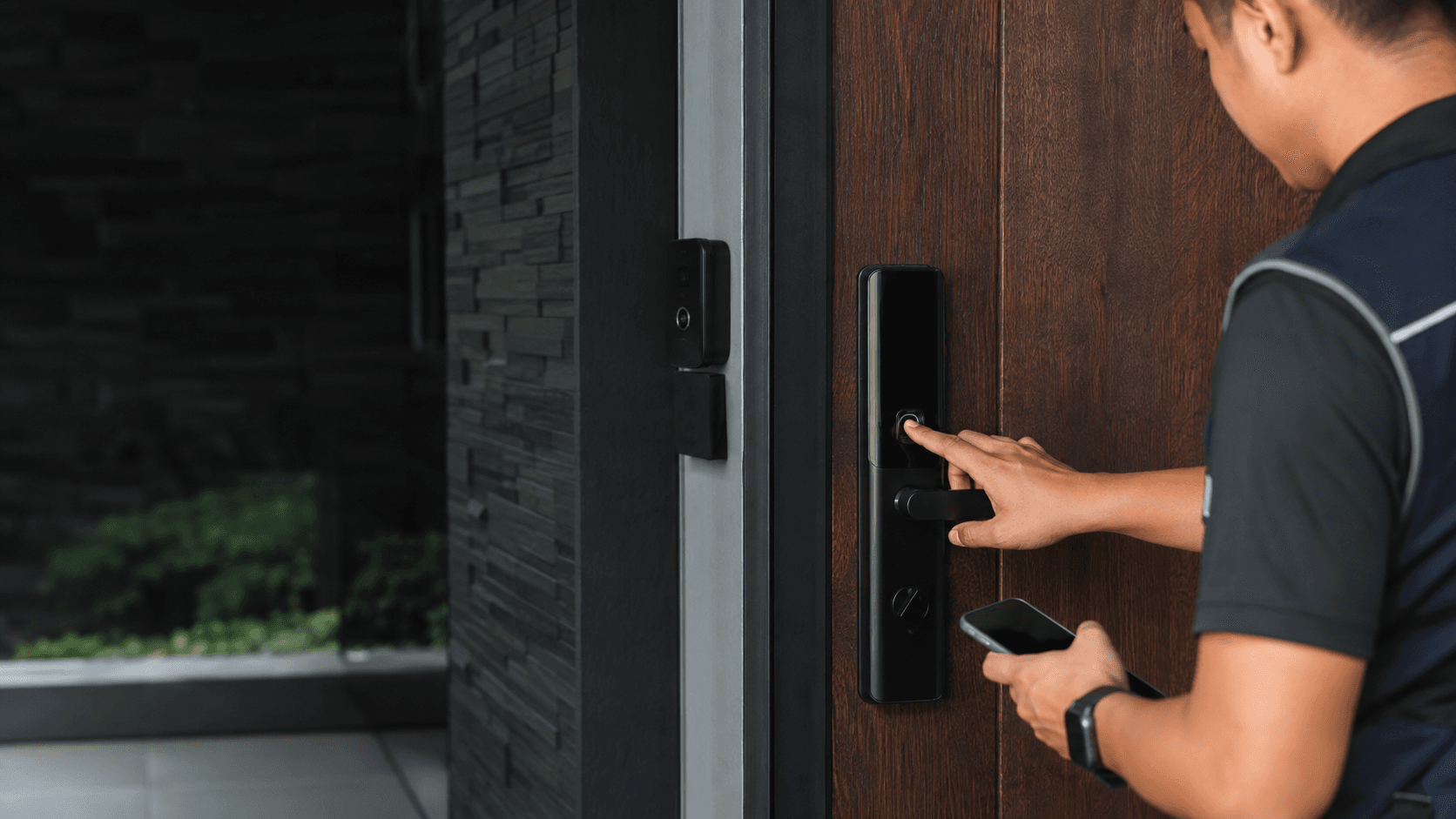
The term covers a broad family of hardware rather than one product. Some units replace the existing deadbolt; others sit over the thumb-turn as a retrofit; others are full lock bodies built into a door frame. What they share is that the locking action can be triggered without a physical key turned by hand, and that at least one trigger is a remote control, a phone app, or a wireless fob.
For Malaysian homes and business premises, the practical questions are narrower than the category name suggests. A remote is only useful if the door can accept the hardware, if the people who need entry are given the right permissions, and if there is a workable answer for the moment the battery or the mains supply fails. Eyonic Sdn Bhd, a security system supplier in Sarawak, treats smart lock door access as suitable for controlled convenience when user permissions and backup entry are planned properly.
Automatic Door Lock With Remote. What the Term Covers
An automatic door lock with remote is best understood by separating the two halves of the phrase. The lock is the mechanical and electronic assembly that secures the door. The remote is one of several possible ways to command it.
Remote control in this category usually means one of three things: a dedicated handheld fob that pairs with the lock, a mobile app that reaches the lock over a network, or a wireless command sent from a wall-mounted panel or intercom. These are not interchangeable. A fob works at short range without any network. An app depends on the lock being reachable, which in turn depends on how the lock connects. A panel or intercom command is typically part of a wider access-control arrangement rather than a standalone lock.
The automatic part refers to behaviour rather than to the remote. Auto-lock means the lock secures itself after a set interval or once the door closes. Auto-unlock means the lock releases when a recognised user approaches or when a schedule triggers. Both behaviours can exist on a lock that also accepts a remote command, and both change how the door feels day to day.
Because the category spans retrofit adapters, full deadbolt replacements and lever-handle units, two buyers can use the same phrase and mean very different hardware. That is why the door itself, not the product name, is the first thing to check.
How Remote Control Fits With Auto-Lock and Auto-Unlock
Remote control, auto-lock and auto-unlock solve different problems, and combining them badly creates friction.
Auto-lock is the feature that removes the habit of checking whether the door is secured. It is most useful on a door that is used constantly and left unattended, such as a side entrance or a staff door. The trade-off is that an auto-locking door can shut out someone who stepped outside without a fob, so the backup method matters more, not less, once auto-lock is switched on.
Auto-unlock is the convenience feature. It releases the door when the system recognises an approaching authorised user. It depends on the lock knowing who is nearby, which is why it is sensitive to how the lock detects presence and how reliably that detection works at the specific door.
Remote control sits between the two. It lets a person open the door deliberately from a distance, which suits a gate-adjacent entrance, a delivery point, or a door that a receptionist controls for visitors. It does not replace auto-lock, and it does not replace a keypad or a key for the people who arrive without a fob.
A workable setup usually assigns one job to each method. Auto-lock handles routine securing. A keypad or fingerprint reader handles everyday entry for regular users. The remote handles the exceptions, such as letting a contractor in or releasing the door for a visitor. When one method is asked to do all three jobs, the door becomes either inconvenient or insecure.
Door, Power and Backup Checks Before Choosing
Most disappointing installations trace back to a door or power condition that was never checked. The checks below are worth running in order, because each one can rule out options before the next is considered.
- Confirm the door type and condition, including whether the existing lock is a deadbolt, a lever handle or a mortise body, and whether the door and frame are sound enough to carry new hardware.
- Confirm who needs entry and with what permission, separating regular users, occasional visitors and anyone who needs temporary access.
- Confirm the remote and access methods required, and decide which method is the primary one rather than assuming every method is needed.
- Confirm power and backup behaviour, including what the lock runs on and how the door is opened when that power source is depleted.
- Confirm installation and handover arrangements, including who supplies the hardware, who fits it, and what the user is shown at completion.
Door condition deserves more attention than it usually gets. A retrofit adapter depends on the existing deadbolt turning freely. A full replacement depends on the door preparation matching the new lock body. A lever-handle unit depends on the existing bore and latch. If the door has swollen, dropped, or been repaired around the lock area, the hardware may fit and still not operate cleanly.
Power and backup is the second common failure point. Locks in this category typically run on batteries, on mains power, or on a combination. Whatever the source, the door needs a method of opening that does not depend on that source. A physical key cylinder, a mechanical override, or a second power path all serve that purpose. The specific backup method varies by product, so it should be confirmed for the exact unit rather than assumed from the category.
Eyonic's own guidance on smart lock door access is that locks work best when door condition, user roles and backup method are reviewed before installation. For business use, the same guidance notes that the choice between a standalone smart lock and an access-control panel is usually settled during that review.
Access Methods and Who Needs Entry
Access methods are where a lock either fits a building or fights it. The table below sets out what each common method requires and where it tends to fail. It describes the method, not any specific product.
| Access method | What it requires | Where it tends to fail |
|---|---|---|
| Remote fob or remote control | A paired handheld unit carried by the user | Lost or unpaired fobs, and users who arrive without one |
| Keypad code | A shared or individual code entered at the door | Codes shared beyond the intended group and not changed |
| Fingerprint | Enrolled fingerprints for each authorised user | Enrolment that is never updated when people leave |
| Mobile app | A lock that is reachable over a network, plus a configured account | Network or account problems that leave the door unreachable |
| Physical key or mechanical override | A key cylinder or override that works without power | Being treated as an afterthought rather than a planned backup |
The permission question is separate from the method question. A household may only need to decide who holds a fob and who knows the code. A business needs to decide who can add and remove users, who can see when the door was opened, and what happens when a staff member leaves. Those are administrative decisions, and they determine whether a standalone lock is sufficient or whether an access-control panel is the better fit.
Eyonic's project work in Sarawak has centred on movement through a building rather than on locks alone. The Kuching Immigration Office project focused on arrival flow, staff areas, visitor movement and dependable daily operation. The KTA Sarawak Sdn Bhd project supported staff movement, visitor handling, tidy cabling and clearer daily site control. Both illustrate the same principle: the door hardware is one part of how people move through a site, and the access rules around it matter as much as the lock.
Installation and Handover in Sarawak and Malaysia
Installation is where the earlier checks either pay off or get exposed. Eyonic's installation process for its security systems follows a sequence of site survey, system proposal, installation and handover, and the same sequence applies sensibly to door access work.
The site survey establishes the door type, the frame condition, the power available at the door, and how the door is used through the day. The proposal sets out which access methods are being provided and which is primary. Installation fits the hardware and confirms that the door closes, latches and releases cleanly. Handover is where the user is shown how to add and remove access, how to open the door when the primary method is unavailable, and what to do when the lock reports a problem.
Handover is the step most often skipped, and it is the step that determines whether the lock is used as designed. A door with four access methods and no clear primary method tends to be operated inconsistently, and inconsistent operation is what makes an automatic lock feel unreliable.
For readers in Sarawak, the practical constraint is less about product availability and more about who will attend the door when something needs adjusting. A lock that is fitted but never explained leaves the backup method untested until the day it is needed. Confirming the handover content before installation begins is a reasonable request, and it costs nothing to ask.
Readers outside Sarawak should confirm local supply and support arrangements directly, since installation and after-installation support are the parts of this category that cannot be handled remotely.
Common Questions About Automatic Door Lock With Remote
Does an automatic door lock with remote need mains power? Not necessarily. Locks in this category commonly run on batteries, and some can also be connected to mains power. The more important question is what happens when the power source is depleted, and whether the door can still be opened without it.
Can a remote lock be fitted to an existing door? Often yes, but it depends on the door. Retrofit adapters work over an existing deadbolt, while full replacements need the door preparation to match the new lock body. Door and frame condition should be checked before a product is chosen.
What happens during a power or battery failure? The answer depends on the specific lock. A physical key cylinder, a mechanical override, or a second power path are the usual approaches. This should be confirmed for the exact unit rather than assumed, because the backup method is what keeps the door usable when the primary method is not.
Is a remote lock suitable for a business entrance? It can be, but the deciding factor is usually user permissions rather than the hardware. Where staff join and leave regularly, or where access records matter, an access-control panel may suit the door better than a standalone lock. Eyonic reviews that choice with the customer as part of the assessment.
How many access methods should a door have? Enough to cover the people who use it, and no more. A door with a clear primary method and one reliable backup is easier to manage than a door with several methods and no agreed default.
Who should install it? The installation itself is straightforward on a sound door, but the survey and handover are what make it work. Eyonic's process runs from site survey through proposal, installation and handover, and the handover step is where users learn how to manage access and what to do when the lock reports a problem.
Share your location, property type and required system with Eyonic on WhatsApp at +60 11-5111 7959 for the next practical step.