
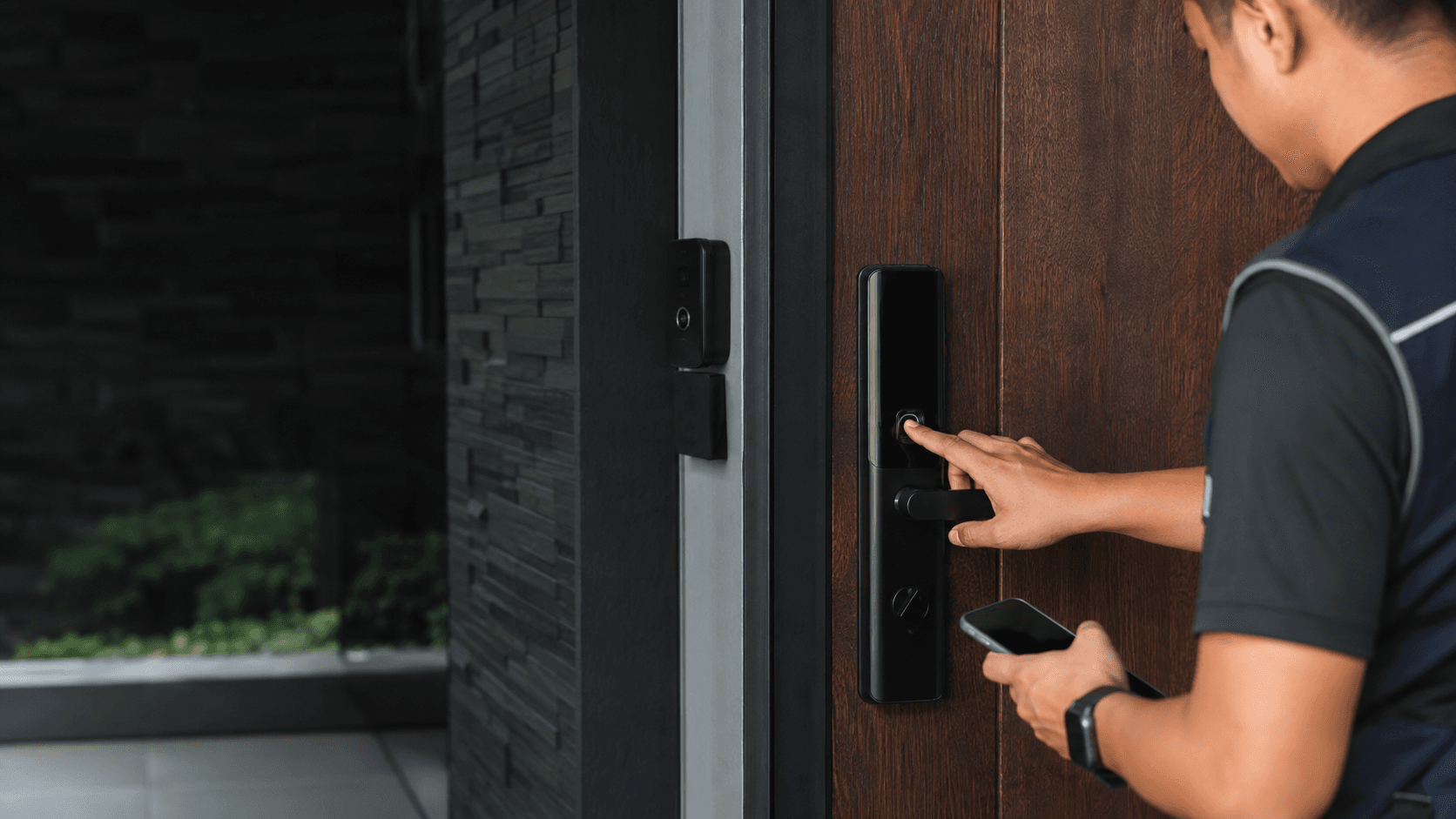
The term covers electronic locking hardware that grants entry through a numeric code rather than a cut key. In a business setting the decision is rarely about the keypad itself. It is about whether a self-contained unit can carry the door, or whether the site needs a controller that manages many doors, many users and an audit trail.
Eyonic Sdn Bhd plans, supplies and installs security and extra-low-voltage systems in Sarawak, and its published product review notes that smart locks work best when door condition, user roles and backup method are reviewed before installation. For business use, the same review asks whether a standalone smart lock or an access-control panel is the more appropriate fit.
Keypad Door Lock Commercial. What the Term Covers
A keypad door lock commercial buyers encounter is a lock body with a code entry interface built in. The code replaces or supplements the mechanical key. Everything else — how many codes exist, whether the lock talks to software, whether it fails open or closed — depends on the model, and those details sit with the manufacturer datasheet rather than with a general guide.
Two broad families exist in the market. A standalone keypad lock holds its own user list inside the unit. A networked or panel-based system moves that list to a controller, and the door carries a reader or keypad that reports back to it. The practical difference is where the user list lives and who can change it.
Eyonic's own product review frames smart lock door access as good for controlled convenience when user permissions and backup entry are planned properly. That phrasing matters. Convenience is the benefit; permissions and backup are the conditions attached to it.
Standalone Keypad Locks Versus Panel-Based Access Control
The choice between a standalone keypad lock and an access control panel is the central commercial decision, and it is decided by scale and by how often the user list changes.
A standalone unit suits a single door with a small, stable group of users. Programming happens at the door. There is no cabling back to a cabinet, no software licence and no server. The trade-off is that every change is a physical visit, and there is no central record of who entered when.
A panel-based system suits sites where doors multiply, where staff turnover is constant, or where someone needs to revoke access without walking to the door. The trade-off is cost and complexity: cabling, a controller, power and usually software. Doors that must release together in an emergency also push toward a panel, because a controller can coordinate behaviour that separate standalone locks cannot.
Neither option is universally correct. A back-of-house door at a small office and a main entrance at a public building are different problems, and the review Eyonic documents treats them as such.
Door Condition, User Roles and Backup Entry Checks
Three checks decide whether a keypad lock is viable on a given door. They are worth completing before any hardware is ordered.
- Door condition — confirm the door leaf, frame and existing hardware can accept the lock, and that the door closes and latches reliably today.
- User roles — list who needs entry, how often that list changes, and whether access must be revoked remotely or recorded.
- Backup method — agree how the door opens if the code is forgotten, the credential fails or power is interrupted.
Door condition is the check most often skipped. A lock cannot fix a door that does not close squarely, and a frame that has been modified repeatedly may not accept new hardware without repair first. This is a physical constraint, not a preference.
User roles determine whether a standalone unit is enough. A site with five permanent staff and one door can live with local programming. A site with shift changes, contractors and visitors cannot, because every departure becomes a manual task.
Backup entry is the safety net. A mechanical key override, a second credential type or a documented after-hours procedure all qualify. What does not qualify is an assumption that the code will always be available.
Keypad Door Lock Commercial Planning Across Malaysian Premises
Malaysian commercial premises vary widely in construction, and that variation shapes the hardware shortlist more than brand preference does.
Shop lots and office units in Sarawak frequently carry aluminium or glass storefront doors, roller shutters or timber doors, and each presents a different mounting and alignment problem. A lock specified for a hollow metal door may not suit a glass leaf without additional hardware. Because no verified specification data for specific models is available here, the honest position is that suitability is confirmed on site, not from a catalogue.
Climate is a second factor. Humidity and heat affect exposed hardware over time, and an entrance that faces weather will age differently from an internal door. This is a reason to inspect the actual door rather than assume two similar-looking doors behave the same way.
Traffic is the third. A door used by hundreds of people a day places different demands on a lock than a storeroom used twice a week. Traffic level, door material and user count together decide whether a standalone unit is realistic.
Eyonic's completed work in the region includes the Kuching Immigration Office, where the focus was arrival flow, staff areas, visitor movement and dependable daily operation, and KTA Sarawak Sdn Bhd, where the requirement was a practical office setup supporting staff movement, visitor handling and tidy cabling. Both illustrate the same point. the door hardware serves a movement pattern, and the movement pattern is what gets designed.
Installation Sequence From Site Survey to Handover
Eyonic's documented installation process runs through four stages, and the same sequence applies to access hardware.
- Site survey — inspect the door, frame, existing hardware, power availability and the routes people actually use.
- System proposal — set out what is being supplied and installed, based on what the survey found.
- Installation — fit the hardware, wire and configure it, and test the door in normal use.
- Handover — walk through operation, user management and the backup entry method with the people who will run it.
The survey is where the standalone-versus-panel question gets answered. A survey that only measures the door and ignores user roles will produce a lock that works on day one and creates work by month three.
Handover is where most value is lost if it is rushed. Codes need to be issued to the right people, removed from the wrong ones, and the backup method needs to be known by whoever holds responsibility outside office hours.
Keypad Door Lock Commercial Evidence Gaps and Next Practical Step
Several things commonly asked about keypad door lock commercial installations cannot be answered from verified sources, and stating them anyway would be guesswork.
There is no verified technical specification available here for any keypad door lock model — no grade ratings, cycle counts, battery life, IP ratings or credential types. There is no verified pricing for supply or installation in Malaysia, and no verified brand or model availability list for the Malaysian market. There is no verified claim about which lock suits which door material, frame type or traffic level, and no verified statement on fail-safe versus fail-secure behaviour for any specific product.
Malaysian regulatory, fire-code and egress requirements for keypad-locked business doors are also not verified here. Any site where a locked door sits on an escape route needs that question answered by the relevant authority or a qualified professional before hardware is chosen, not after.
Warranty, service interval and support terms likewise sit outside what can be confirmed from the available evidence.
What can be confirmed is the process. A site survey establishes door condition, user roles and backup entry. A proposal follows from what the survey found. Installation and handover complete the work. Where the survey shows a single door with a stable user group, a standalone keypad lock is a reasonable direction. Where it shows multiple doors, changing users or a need for records, a panel-based approach is the more sensible one.
Share the location, property type and required system with Eyonic on WhatsApp at +60 11-5111 7959 to arrange the survey that answers these questions for a specific door.