
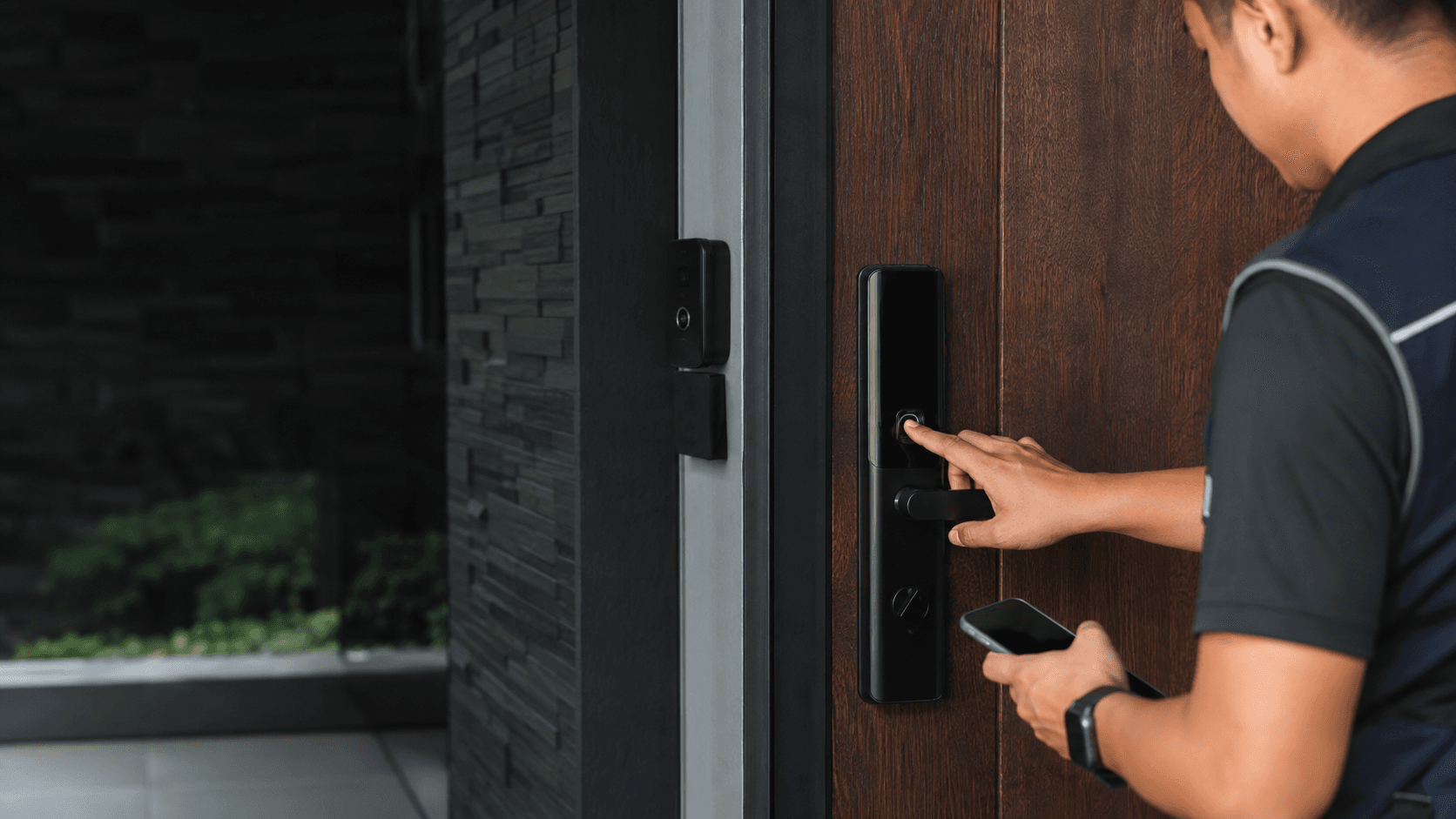
The baldwin smart lock line sits at the intersection of decorative door hardware and connected home access. Baldwin Hardware, a long-established American lock maker, builds electronic deadbolts that carry the same finishes and weight as its mechanical estate hardware, then adds touchscreen keypads and wireless radios. That combination is why the query attracts two different readers: homeowners replacing a worn deadbolt on a front door, and buyers comparing connected locks across brands.
This guide covers what the Baldwin smart lock range actually includes, how the models differ, what installation demands, and where a smart lock stops being the right tool. It draws on published product listings, Baldwin's own electronic lock pages, and installation experience from Eyonic Sdn Bhd, a Sarawak security system supplier that reviews door condition, user roles, and backup entry before recommending any lock.
What Is a Baldwin Smart Lock?
A Baldwin smart lock is an electronic deadbolt or handleset made by Baldwin Hardware that replaces a traditional keyed cylinder with a touchscreen keypad and a wireless connection. The lock still throws a physical bolt. What changes is how the bolt is commanded: a code on the keypad, a command from a hub or phone app, or a physical key where the model supports one.
Baldwin's electronic lock range is documented on its own site as blending style, security, and technology for keyless entry and enhanced connectivity. The company also collaborated with Level Home on a collection of smart locks, a collaboration reported by Window + Door, which described solid brass hardware paired with invisible smart lock technology and Matter-over-Thread, Bluetooth, and Wi-Fi connectivity options.
Two product families appear most often in search results and retail listings:
- Minneapolis 8225 — a touchscreen Z-Wave smart electronic deadbolt, listed by GoKeyless as pairing connected convenience with a polished finish.
- Boulder 8235 — a touchscreen Z-Wave smart deadbolt described in its listing as merging design with Z-Wave smart home technology.
Both are deadbolt replacements rather than full handlesets, which matters for anyone expecting to swap an entire entry set in one purchase.
Choosing the Right Baldwin Smart Lock
The choice between Baldwin models comes down to three variables: the wireless protocol the home already uses, the finish and trim already on the door, and whether the door has the bore and backset the lock requires. Working through those in order prevents the most common return.
- Confirm the existing door prep — bore diameter, backset, and door thickness — against the lock's published requirements before ordering.
- Match the wireless protocol to the home hub. Z-Wave models need a Z-Wave controller; Matter-over-Thread models need a Thread border router and a compatible ecosystem such as Apple Home.
- Check the finish against existing Baldwin trim if the door already carries Baldwin hardware, since finish mismatches are visible on the exterior.
- Decide on backup entry. A keyed override, a second code holder, or a mechanical key stored off-site all work; having none is the failure case.
- Plan user roles if the property is commercial — who issues codes, who revokes them, and what happens when a staff member leaves.
For business premises, the decision often shifts away from a standalone lock. Eyonic's own product review notes that smart locks work best when door condition, user roles, and backup method are reviewed before installation, and that for business use the company usually checks whether a standalone smart lock or an access-control panel is the more appropriate fit. A single office door with five staff is a smart lock scenario. A building with forty daily visitors and shift changes is an access-control scenario.
Baldwin Smart Lock Models and What They Require
Model-level differences matter more than brand-level marketing. The table below reflects what published listings state about each family; specifications should be confirmed against the current product page before purchase, since Baldwin has revised its electronic range as the Level Home collaboration has rolled out.
| Model | Type | Connectivity | Typical fit |
|---|---|---|---|
| Minneapolis 8225 | Touchscreen electronic deadbolt | Z-Wave | Homes with an existing Z-Wave hub; front or side entry doors |
| Boulder 8235 | Touchscreen electronic deadbolt | Z-Wave | Homes wanting a heavier visual profile on the entry door |
| Baldwin Engineered with Level | Deadbolt and grip set options | Matter-over-Thread, Bluetooth, Wi-Fi | New builds and renovations specifying a full entry set |
The Z-Wave models and the Matter-over-Thread collection are not interchangeable in practice. A household running a Z-Wave hub gains nothing from a Thread radio it cannot use, and a household standardized on Apple Home or another Matter ecosystem gains little from Z-Wave unless a bridge is already in place. Protocol fit is the first filter, not the finish.
Door Condition and Installation Constraints
Electronic deadbolts are heavier and deeper than the mechanical cylinders they replace. Three conditions cause most installation problems:
- Bore and backset mismatch. A lock built for a standard 2-1/8 inch bore and 2-3/8 or 2-3/4 inch backset will not seat in a door cut to different dimensions without additional work.
- Door thickness outside the supported range. Thick solid-wood or metal-clad doors can fall outside the bolt's reach.
- Frame alignment. A strike plate that no longer lines up will cause the bolt to bind, and a motorized or thumb-turn bolt binds more readily than a hand-turned one.
Eyonic's installation process for security work begins with a site survey and a system proposal before any hardware is fitted, and the same sequence applies to door hardware: measure first, specify second, install third. Skipping the survey step is how a lock ends up purchased twice.
Battery, Network, and Backup Entry
Every electronic deadbolt depends on two things that a mechanical lock does not: power and a network. Battery life varies with usage frequency and radio activity, and a lock that reports low battery through an app still needs someone to act on that report. Network dependence matters for remote code management — if the hub is offline, scheduled codes and remote unlocks stop working even though the keypad may still function locally.
Backup entry is the constraint that decides whether a smart lock is acceptable for a given door. A keyed override cylinder, a second person holding a working code, or a mechanical key stored somewhere other than inside the property all resolve it. A single code held by one person does not.
Practical Considerations for Baldwin Smart Lock Buyers
Baldwin hardware is positioned at the premium end of the residential lock market, and the electronic range inherits that positioning. Buyers weighing a Baldwin smart lock against a mid-market connected deadbolt are usually trading cost against finish quality, weight, and long-term trim availability rather than against feature count.
Three trade-offs are worth stating plainly:
- Finish consistency versus ecosystem flexibility. Staying inside Baldwin keeps exterior trim matched. Moving to a different brand for protocol reasons may leave visible finish differences on the same door.
- Standalone lock versus managed access. A standalone smart lock is simple to install and simple to run for a household. Once multiple doors, multiple staff, and audit requirements enter the picture, a managed access-control system becomes the lower-effort option over time.
- Retrofit versus new specification. Retrofitting an existing door is constrained by the existing bore and frame. Specifying hardware for a new door or a full renovation removes those constraints and usually costs less in labour.
For readers in Malaysia and Sarawak specifically, availability and support matter as much as the product. Baldwin's APAC smart lock app exists as a separate regional application, which indicates the brand does distribute electronic locks in the region, but local stock, spare parts, and installation support vary by supplier. A lock that cannot be serviced locally is a liability on a main entry door.
Eyonic Sdn Bhd supplies and installs security and ELV systems across Sarawak for homes, offices, shops, and industrial sites, and lists smart lock door access among its product reviews. The company's stated position is that smart locks suit controlled convenience when user permissions and backup entry are planned properly — a framing that applies to any brand, including Baldwin.
Where a Fits and Where It Does Not
A Baldwin smart lock fits a residential entry door where the finish matters, the door prep is standard, and the household already runs a compatible hub. It also fits a small office or clinic entrance with a handful of regular users and a clear code-issuing owner.
It fits less well where the door is non-standard, where dozens of people need time-limited access, where an audit trail is a compliance requirement, or where no one is available to change batteries and manage codes. In those cases the honest answer is that a different category of hardware does the job better, and a supplier who installs both should say so.
Making an Informed Choice About a
The decision reduces to four checks: protocol compatibility with the existing hub, physical fit against the existing door prep, a workable backup entry method, and local availability of the specific model and its spares. If all four pass, a Baldwin smart lock is a reasonable premium choice. If any one fails, the failure will surface after installation rather than before it.
For properties in Sarawak that need door access reviewed alongside cameras, alarms, or intercoms, Eyonic handles site survey, proposal, installation, and handover as a single sequence. Share the location, property type, and required system on WhatsApp at +60 11-5111 7959 to move from comparison to a concrete specification.