
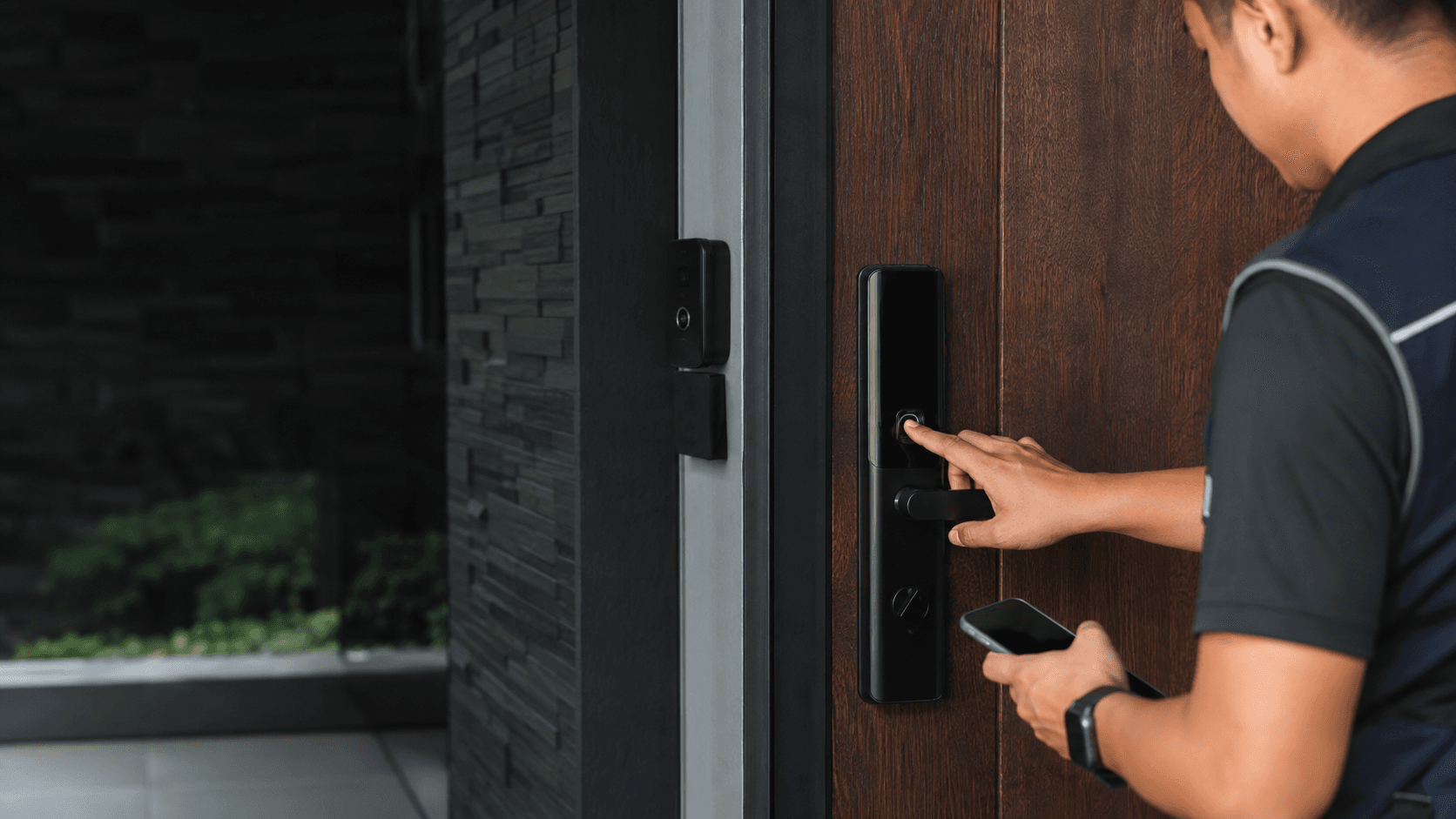
The phrase covers two different products. One is a biometric deadbolt or handle that replaces the existing lock on a hinged door. The other is a fingerprint keypad that triggers a powered opener, such as a garage door operator. Both remove the key from the entry moment, but they are installed, powered, and maintained in different ways.
Malaysia sits in a hot, humid climate, so hardware choice matters more than marketing copy. A lock that performs well in a dry, temperate showroom may behave differently after a year of monsoon-season humidity. Buyers in Sarawak and across Malaysia should weigh sensor type, power source, and backup entry before price.
Fingerprint Door Opener. What Matters Before You Choose
Three things decide whether a fingerprint door opener suits a property: the door itself, who needs entry, and what happens when the electronics fail. Everything else is secondary.
- Check the door. Measure the door thickness, backset, and existing bore holes, and confirm the door closes squarely. A warped or swollen timber door can stop a motorised deadbolt from throwing fully.
- Confirm the mounting standard. Deadbolt replacements need a compatible cross-bore and latch; a fingerprint keypad for a powered opener needs a compatible operator and radio frequency.
- Count the users. Households need a handful of enrolled fingers; offices, rental units, and shared entrances need more, plus a way to add and remove people.
- Decide the backup method. Every biometric lock should still open by mechanical key, keypad code, or app when the sensor or battery fails.
- Plan the power. Battery locks need a replacement routine; mains-powered openers need a supply point and a plan for outages.
- Test the sensor with the actual fingers that will use it. Dry skin, worn ridges, and wet hands all affect read rates.
That sequence is deliberately ordered. A lock that fits the door and the user list but has no backup entry is a liability, while a lock with excellent backup entry that does not fit the door is simply the wrong purchase.
Choosing the Right Fingerprint Door Opener
Match the hardware to the opening rather than to the brand. A residential front door, an office staff entrance, and a garage or gate each need a different device.
Residential front doors
A biometric deadbolt or handle set is the usual answer. Kwikset's Halo Touch is described as a Wi-Fi enabled smart door lock with fingerprint access, and Yale's Assure Lock 2 is listed with Wi-Fi and fingerprint access. Both replace the existing lock hardware on a standard door.
For a home, the practical questions are how many fingers can be enrolled, whether the lock still works without Wi-Fi, and whether a mechanical key remains available. A lock that depends on a cloud service for everyday entry adds a failure point that a purely local biometric lock does not have.
Offices, shops, and rental units
Shared entrances need user management, not just a sensor. The ability to add a fingerprint for a new staff member and delete it on the last day matters more than the sensor's read speed. For business use, Eyonic checks whether a standalone smart lock or an access-control panel is more appropriate, because a single lock cannot manage a whole building's permissions.
Eyonic's smart lock door access guidance notes that smart locks work best when door condition, user roles, and backup method are reviewed before installation. That review is the step most often skipped when a lock is bought online first and fitted later.
Garage doors and gates
Here the fingerprint door opener is a keypad, not a lock. LiftMaster's fingerprint keyless entry unit recognises up to 10 unique fingerprints and uses rolling code technology, and it is compatible only with specified LiftMaster operators. Compatibility is the whole decision: a keypad that does not match the operator's frequency and learn button will not work, regardless of quality.
What Is a Fingerprint Door Opener?
A fingerprint door opener is an access device that verifies a stored fingerprint template and then releases a locking mechanism or signals a powered operator to open. The sensor captures ridge detail, the processor compares it with enrolled templates, and a match triggers the release.
Two limits apply to every model. Only fingerprints registered to the lock can unlock the door, so enrolment is a deliberate administrative act rather than an automatic one. And the sensor reads a finger, not a person, so a failed read is a normal event that the backup method has to cover.
Capacities differ widely. LiftMaster's fingerprint keypad recognises up to 10 unique fingerprints. Locks aimed at households typically enrol a similar small number, while commercial access-control readers handle far more users and integrate with wider systems. Matching capacity to the real user count prevents the common problem of running out of enrolment slots after installation.
Practical Considerations for Installation
Installation quality decides long-term reliability more than the model number does. A correctly fitted lock on a sound door outperforms a premium lock on a door that does not close properly.
Door condition and fit
Timber doors move with humidity. In Malaysia, a door that fits in the dry season can bind in the wet season, and a motorised deadbolt that meets resistance will drain batteries faster or fail to throw. Checking the door's alignment before purchase avoids that problem.
Power and failure modes
Battery-powered locks need a replacement schedule, and low-battery warnings should be acted on rather than ignored. Mains-powered openers need a supply point and a plan for outages. In every case, the mechanical key, keypad code, or manual release is the fallback that keeps the door usable.
Sensor behaviour
Optical and capacitive sensors respond differently to wet, dry, or worn fingers. Enrolling the same finger twice, and enrolling a second finger per user, reduces the chance of a failed read at the door. Children and elderly users often need a slower, more deliberate placement than adults.
Integration with existing security
A fingerprint lock is one layer of a property's security. It does not replace cameras, alarms, or intercoms, and it does not record who entered unless the model includes an audit log. Where entry records matter, the lock should be chosen for its logging and integration rather than its finish.
Eyonic's project work shows how entry points sit inside a wider system. At the Kuching Immigration Office, the focus was arrival flow, staff areas, visitor movement, and dependable daily operation. At KTA Sarawak Sdn Bhd, the requirement was a practical office setup supporting staff movement, visitor handling, tidy cabling, and clearer daily site control. Both are access-flow problems, and a single door lock is only one part of the answer.
Making an Informed Choice About Hardware
The right choice follows from the door, the users, and the backup plan, in that order. Price and finish come last because they are the easiest things to change and the least likely to cause a failure.
For a single home entrance, a biometric deadbolt with a mechanical key and offline operation covers most needs. For a shared or commercial entrance, user management and integration matter more than the sensor. For a garage or gate, compatibility with the existing operator is the deciding factor.
Where a property needs several entry points managed together, a lock-by-lock approach becomes difficult to administer. That is the point at which a wider access-control design, planned alongside cameras and alarms, is worth considering. Eyonic plans, supplies, and installs security systems for homes, offices, shops, and industrial sites in Sarawak, and its installation process runs from site survey through system proposal, installation, and handover. The company's founder, Eric Yong, has worked in technical installation of digital security solutions for commercial businesses in Sarawak for more than 10 years.
Budget expectations vary by scope. Eyonic's published packages for a Hikvision CCTV system, a Hikvision alarm system, and an autogate package are each RM 1,599, covering supply, setup, and handover. Larger project work sits in a different range: the Kuching Immigration Office project carried an approximate budget of RM 12,000 to RM 28,000, and the KTA Sarawak Sdn Bhd project an approximate budget of RM 8,000 to RM 18,000. These figures describe those projects, not a price for any specific lock installation.
Share your location, property type and required system with Eyonic on WhatsApp at +60 11-5111 7959 for the next practical step.