
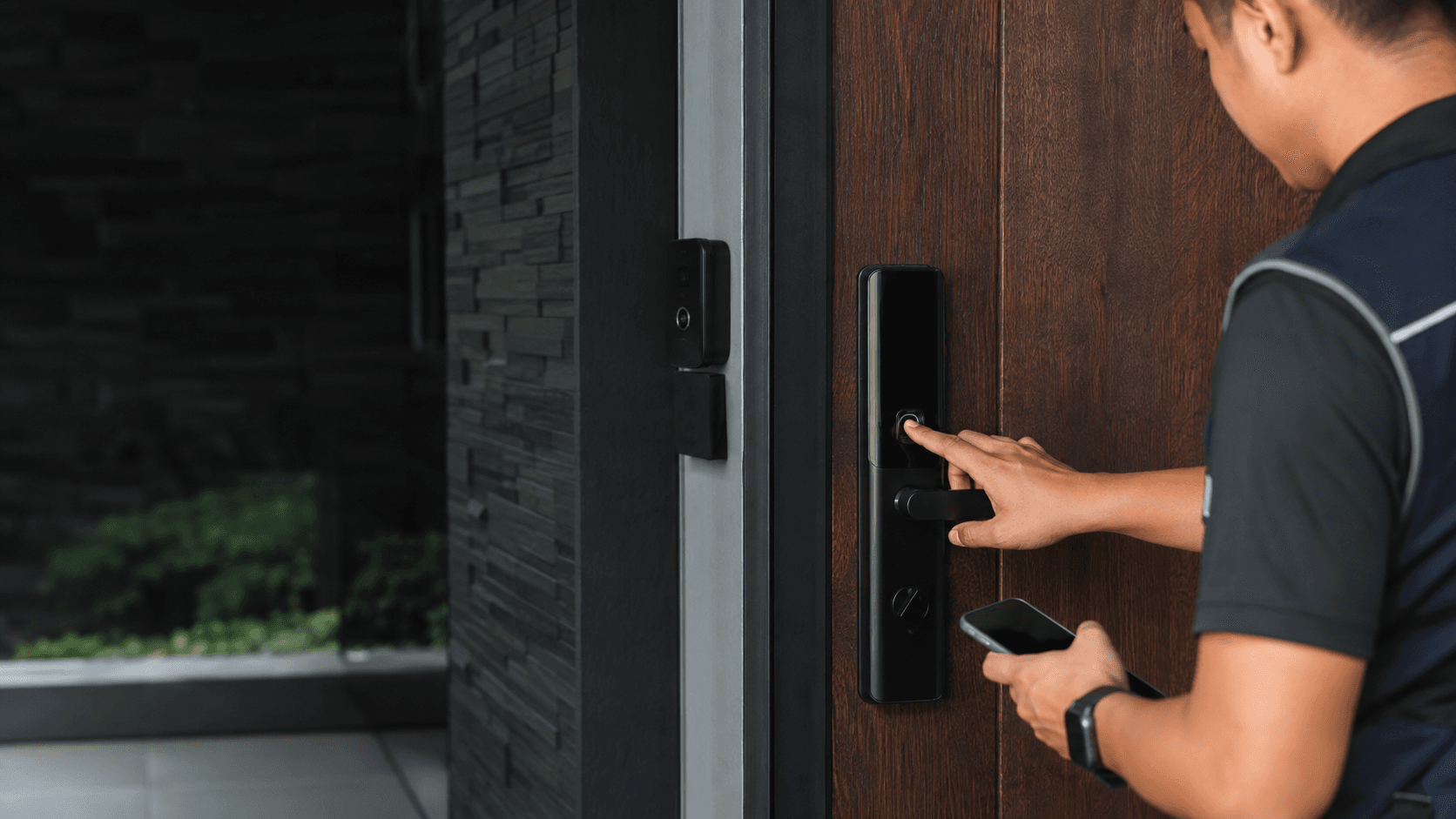
Kwikset builds electronic locks that open with a personalised access code and lock with a button press, and the brand documents an Auto-Lock feature that can be switched on or off on supported deadbolts. Those two behaviours — keyless entry and automatic relocking — define what most buyers mean by a Kwikset Automatic Door Lock.
For a Malaysian property, the hardware is only half the decision. Door condition, user roles, and a working backup entry method decide whether the lock behaves well after the first month, and those checks matter more than the model name on the box.
What the term Kwikset Automatic Door Lock actually covers
Kwikset's electronic range spans keypad deadbolts, touchscreen deadbolts, and connected smart locks that communicate with a home network. The word "automatic" is not a single product line. It describes behaviour. the bolt extends on its own after the door closes, or the lock can be driven remotely through an app or hub.
Kwikset's own support documentation for the 264 Deadbolt describes an Auto-Lock feature that a user can enable or disable through a programming sequence, with audible beeps confirming each stage. That is the clearest published example of automatic relocking in the brand's material.
Two families sit under the electronic umbrella. Standalone electronic locks work from a keypad or touchscreen and hold their own codes. Connected smart locks add wireless communication so the lock can talk to other devices, which is what enables remote locking and unlocking from a phone or tablet.
Buyers researching a Kwikset Automatic Door Lock in Malaysia should separate the two, because a standalone keypad deadbolt needs no network at all, while a connected lock depends on a hub, a bridge, or a compatible platform to deliver its remote features.
Automatic relocking and keyless entry in daily use
Automatic relocking solves a specific human failure: the door left unlocked because someone was carrying groceries, a child, or a delivery box. When the feature is active, the bolt returns to the locked position without anyone deciding to lock it.
Keyless entry changes a different habit. A code replaces a key, so a household member, a cleaner, or a staff member can be given access without duplicating metal. Codes can be changed when that access should end.
The trade-off is power. An electronic deadbolt depends on batteries, and a lock that relocks automatically uses more of that stored energy than one that waits for a hand. A dead battery on an automatic lock is a different problem from a dead battery on a manual one, because the door may already be locked when the power runs out.
That is why backup entry is not an optional extra. A mechanical key override, a second entry door, or a documented recovery method keeps a property usable when the electronics stop cooperating. Eyonic's own product guidance on smart lock door access states that these locks work best when door condition, user roles, and backup method are reviewed before installation.
Where automatic locking helps and where it frustrates
Automatic relocking suits a main entrance that is used constantly and left unattended between arrivals. It suits a shop shutter door, an office back entrance, or a rental unit where the person leaving is not the person responsible for security.
It frustrates in two situations. A door that is propped open for airflow will fight the lock, because the bolt cannot extend into a frame that is not aligned. A door used for constant two-way traffic during business hours may be better served by a lock that stays unlocked on schedule rather than one that relocks every few seconds.
Kwikset's Auto-Lock can be disabled on supported models, which is the practical answer for a doorway that needs keyless entry without automatic relocking. The feature is a setting, not a permanent property of the hardware.
Door, gate, and user-role checks before buying
Door condition decides whether any electronic deadbolt will last. A door that has dropped on its hinges, a frame that has swollen through a wet season, or a strike plate that no longer aligns will wear out a motorised bolt far faster than it wears out a key.
Door thickness and backset matter because the lock body has to fit the existing preparation. A deadbolt designed for one bore size will not drop into a door cut for another, and re-cutting a door is a workshop job rather than a five-minute adjustment.
User roles decide the feature set. A home with four residents needs a handful of codes and a simple way to add or remove one. A shop with rotating staff, a delivery entrance, and a manager who needs an audit trail is closer to an access control problem than a lock problem.
Eyonic's smart lock review guidance draws that line directly: for business use, the company usually checks whether a standalone smart lock or an access control panel is more appropriate. A single automatic deadbolt on a staff entrance is convenient. The same lock on a door with twenty daily users and a need to know who entered when is the wrong tool.
Gate and outdoor doors add weather exposure. An electronic lock rated for an interior door and installed on an exposed gate will fail early, and the failure is usually mechanical rather than electronic.
Installation and handover steps for a Malaysian property
Installation is a sequence, not a single visit. Eyonic documents its installation work as a four-stage process, and the same order applies to door access hardware.
- Site survey — check the door, frame, alignment, thickness, and existing preparation before committing to a model.
- System proposal — match the lock type to the user roles, the number of codes needed, and whether a standalone lock or an access control panel fits better.
- Installation — fit the hardware, confirm the bolt extends and retracts cleanly, and set the automatic relocking behaviour.
- Handover — test every code, confirm the backup entry method works, and show the people who use the door how to add or remove access.
The survey stage is where most problems are caught. A door that closes with a push rather than a swing, a frame that has moved, or a preparation that does not match the intended lock are all visible before money changes hands.
Handover is where most problems are prevented. A lock that nobody knows how to reprogram becomes a lock with one shared code, which defeats the purpose of keyless entry.
What a handover should confirm
Every active code should be tested at the door, not just in the app. The backup entry method should be demonstrated and the physical key stored somewhere that is not inside the property it opens. Automatic relocking should be observed with the door closed, because a bolt that extends into a misaligned strike plate will jam rather than secure.
For a business, the handover should also record who holds administrator access. That single decision determines how quickly access can be revoked when a staff member leaves.
Costs packages and what a quotation should include
Eyonic publishes three packages at RM 1,599 each: a Hikvision CCTV package, a Hikvision alarm system, and an autogate package. Each covers supply, setup, and handover for its own system. None of those packages is a door lock package, and no verified Malaysian price for a Kwikset Automatic Door Lock is available in the supplied material.
That gap matters for budgeting. A quotation for door access should state the lock hardware, the door preparation work if any, the installation labour, and the handover session. A figure that covers only the box leaves the fitting and configuration to be negotiated later.
Larger access projects sit in a different range. Eyonic's Kuching Immigration Office project, which covered arrival flow, staff areas, visitor movement, and dependable daily operation, carried an approximate budget of RM 12,000 to RM 28,000. The KTA Sarawak Sdn Bhd office project, covering staff movement, visitor handling, and tidy cabling, carried an approximate budget of RM 8,000 to RM 18,000. Those figures describe multi-point commercial work, not a single residential deadbolt, and they are useful mainly as a scale reference.
A quotation should also say who handles the network side if a connected lock is chosen. A lock that depends on a hub or a bridge is only as reliable as the network it sits on.
Support backup entry and long term reliability
Reliability on an automatic lock comes down to three things: the door stays aligned, the batteries get changed before they fail, and the backup entry method is real rather than theoretical.
Alignment is the one most often ignored. A door that has to be lifted to close will eventually stop the bolt from extending, and the lock will be blamed for a hinge problem.
Battery discipline is the second. Automatic relocking draws power on every cycle, so a busy door consumes more than a quiet one. A spare set of batteries kept on site removes the urgency from a low-battery warning.
Support matters most for connected locks. A standalone keypad deadbolt can be managed by whoever holds the programming instructions. A connected lock may need someone who understands the hub, the app, and the network, and that is where a local supplier relationship earns its place.
Eyonic's own project record shows the kind of environment where dependable daily operation is the requirement rather than a feature: the Kuching Immigration Office work centred on arrival flow, staff areas, and visitor movement, all of which depend on hardware that behaves the same way on a busy Tuesday as it did on installation day.
For a Malaysian property, the sensible order is to settle the door, the user roles, and the backup method first, then choose the lock that fits those answers. Share the location, property type, and required system with Eyonic on WhatsApp at +60 11-5111 7959 to move from research to a site-specific assessment.