
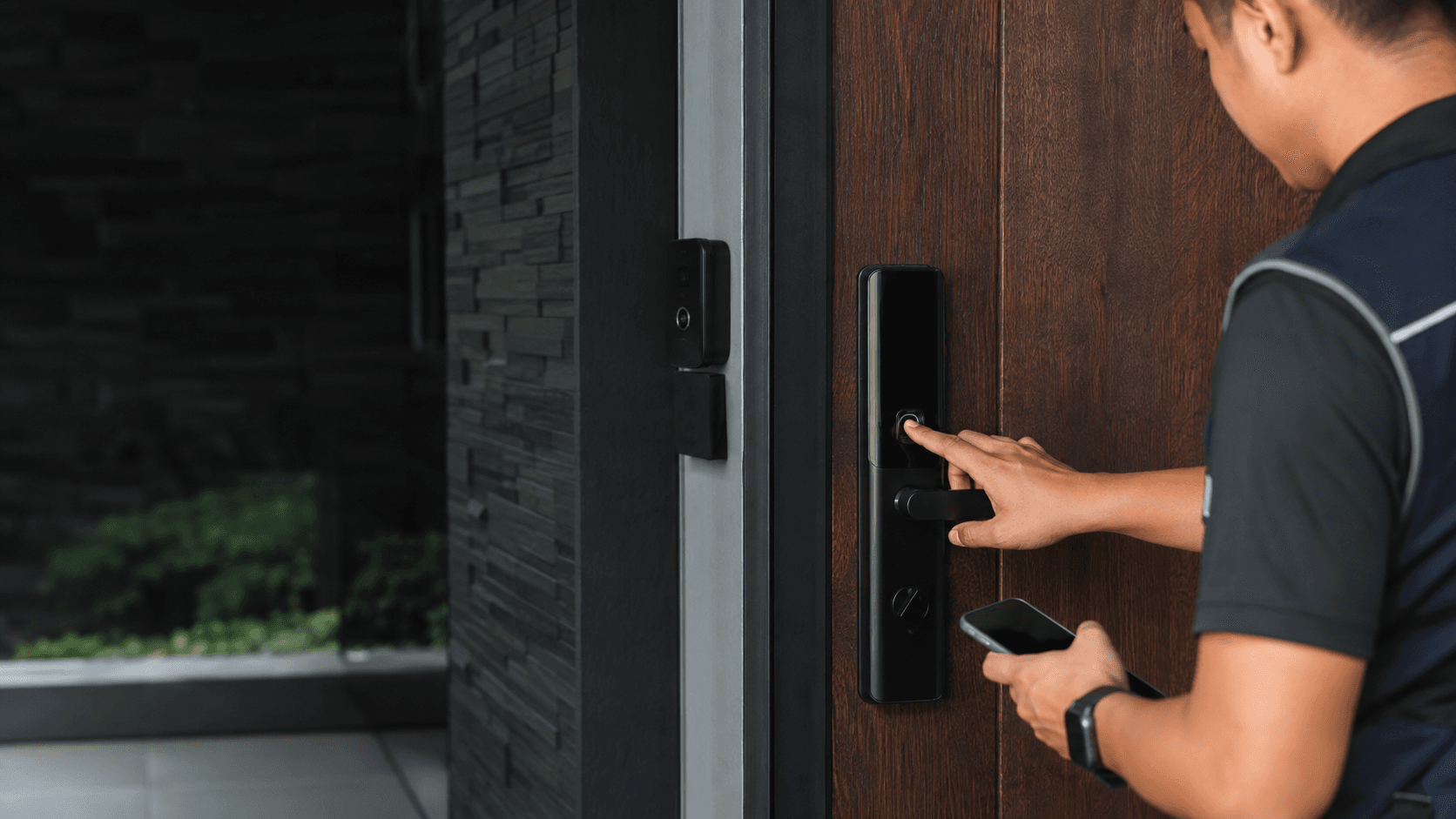
The appeal is simple. no key to carry, no hole to drill in many designs, and a record of who entered. The trade-offs sit in door type, glass thickness, power backup and how many people need daily access. This guide works through those points in order, using published product information from glass door lock suppliers and Eyonic's own installation experience in Sarawak.
Glass Door Fingerprint Lock. What Matters Before Choosing
Most buyers start with the lock and work backwards. It usually pays to reverse that. The door decides the lock, not the other way around.
- Confirm the door type. swing door or sliding door, framed or frameless.
- Measure the glass thickness, because clip-on and no-drill bodies are sized to a range.
- Count the users and decide how many fingerprints, cards or codes are needed.
- Check the power source and whether emergency power or a mechanical key exists.
- Decide whether the lock stands alone or connects to an app, Wi-Fi or an access-control panel.
- Plan the backup entry method before installation, not after.
That sequence matters because a glass door fingerprint lock is a hardware fit problem first and a technology choice second. A lock rated for a 10 mm to 12 mm frameless panel will not suit a thin framed door, and a swing-door model will not mount on a sliding track.
What Is a Glass Door Fingerprint Lock?
A glass door fingerprint lock is an electronic lock body that reads a fingerprint and releases a latch or bolt on a glass door. Published supplier listings show the common pattern: fingerprint plus RFID card plus keypad code, with remote or app control as an optional extra.
Elock Security describes its fingerprint glass door locks as typically offering three unlock methods — RFID card at 13.56 MHz, code and fingerprint — with remote control optional, and notes the locks suit both swing doors and sliding doors with no drilling required in many cases. That combination is what separates these locks from a plain mechanical glass door lock.
Two practical details follow from that design. First, the fingerprint sensor is the primary credential, so enrolment quality and sensor type affect daily reliability. Second, because most units also accept a card or code, a failed fingerprint read is rarely a lockout — provided the backup credential was set up during commissioning.
Fingerprint Glass Door Locks and Door Type
Swing doors and sliding doors need different hardware. A swing glass door uses a lock body that replaces or sits beside the existing patch fitting, while a sliding glass door needs a body that clears the track and the frame edge. Automatic sliding doors add another constraint, because the door operator already controls movement and the lock has to work with it rather than against it.
Frameless glass is the most common fit for clip-type locks. Framed aluminium doors usually need a different body shape, and some installations are better served by an access-control panel driving an electric bolt rather than a standalone lock.
Choosing the Right Glass Door Fingerprint Lock
Selection comes down to four variables: door type, glass thickness, credential mix and whether the site needs central control.
| Consideration | What to check | Why it matters |
|---|---|---|
| Door type | Swing or sliding, framed or frameless | Determines the lock body shape and mounting method |
| Glass thickness | Measured panel thickness in millimetres | Clip-type bodies are sized to a specific range |
| Credentials | Fingerprint, card, code, app, mechanical key | More methods reduce lockout risk for mixed users |
| Power | Battery, rechargeable cell, emergency power point | Decides how the door behaves when power runs out |
| Control | Standalone or connected to a panel or app | Affects user management and audit records |
For a single office entrance with a handful of staff, a standalone glass door fingerprint lock with fingerprint, card and code is usually enough. For a site with shift changes, contractors and a need to review entry records, a connected lock or a panel-based system is the more workable route.
Eyonic's own product guidance makes the same distinction: smart locks work best when the door condition, user roles and backup method are reviewed before installation, and for business use the choice between a standalone smart lock and an access-control panel is worth settling early.
Where These Locks Fit Well
Offices, shops, clinics and club rooms are the common settings in supplier listings, and the reason is traffic pattern rather than prestige. These are doors that a defined group uses many times a day and that a manager wants to control without issuing and re-cutting keys.
Eyonic's completed work in Sarawak shows the same pattern in practice. The Kuching Immigration Office project focused on arrival flow, staff areas, visitor movement and dependable daily operation, and the KTA Sarawak Sdn Bhd project covered staff movement, visitor handling, tidy cabling and clearer daily site control. Both are environments where entry hardware has to survive constant use rather than occasional use.
Practical Considerations for Glass Door Fingerprint Lock Installation
Installation is where most of the risk sits. A lock that fits the door but fails on power, alignment or user setup will cause more trouble than a simpler mechanical alternative.
Eyonic's installation process follows site survey, system proposal, installation and handover. That order exists because the survey answers questions a product page cannot: whether the glass is tempered, whether the frame can take a lock body, where power can be drawn from, and how the door closes under normal use.
Power Backup and Failure Behaviour
Battery-powered locks avoid cabling but introduce a maintenance task. Rechargeable models remove the cost of disposable batteries but still need charging discipline. Where a door must never be left unsecured, an emergency power point or a mechanical key override is the safer design.
The failure mode is worth deciding in advance. If the lock loses power, does the door fail open or fail closed? For a shop entrance after hours, fail closed is usually preferred. For a fire escape route, local requirements take priority and the lock choice has to respect them.
Users Credentials and Records
Fingerprint capacity is rarely the limiting factor for a small office. The harder question is who administers the lock. If one person holds the admin credential and leaves, the site needs a recovery path. Setting up at least two admin users and a mechanical or code backup during handover avoids that problem.
Where entry records matter, a connected lock or panel gives a reviewable log. A standalone lock generally does not, which is a real limitation for sites that need to answer questions about who entered and when.
Making an Informed Choice About
The decision usually resolves into three routes. A standalone glass door fingerprint lock suits a single entrance with a stable user group. A connected lock suits a site that wants app management or remote control. A panel-based access-control system suits a building with multiple doors, shift patterns or audit needs.
Cost is not the deciding factor at the low end, because the hardware is only part of the total. Mounting, power, commissioning and user setup all carry labour, and a poorly fitted lock costs more over time than a well-specified one.
Eyonic's published package pricing gives a sense of how the company structures comparable work: the Hikvision CCTV Package, Hikvision Alarm System and Autogate Package are each listed at RM 1,599, covering supply, setup and handover. Larger project work sits in a different band — the Kuching Immigration Office project carried an approximate budget of RM 12,000 to RM 28,000, and the KTA Sarawak Sdn Bhd project an approximate RM 8,000 to RM 18,000.
For a single glass door, the practical next step is a site survey rather than a product order. The survey confirms door type, glass thickness, power route and user count, and those four answers determine which lock is worth buying.
Eyonic Sdn Bhd is a security system supplier in Sarawak, Malaysia, working on CCTV and ELV systems for homes, offices, shops and industrial sites. Founder Eric Yong has more than ten years in the industry, with a focus on technical installation of digital security solutions for commercial businesses in Sarawak. Share your location, property type and required system with Eyonic on WhatsApp at +60 11-5111 7959 for the next practical step.