
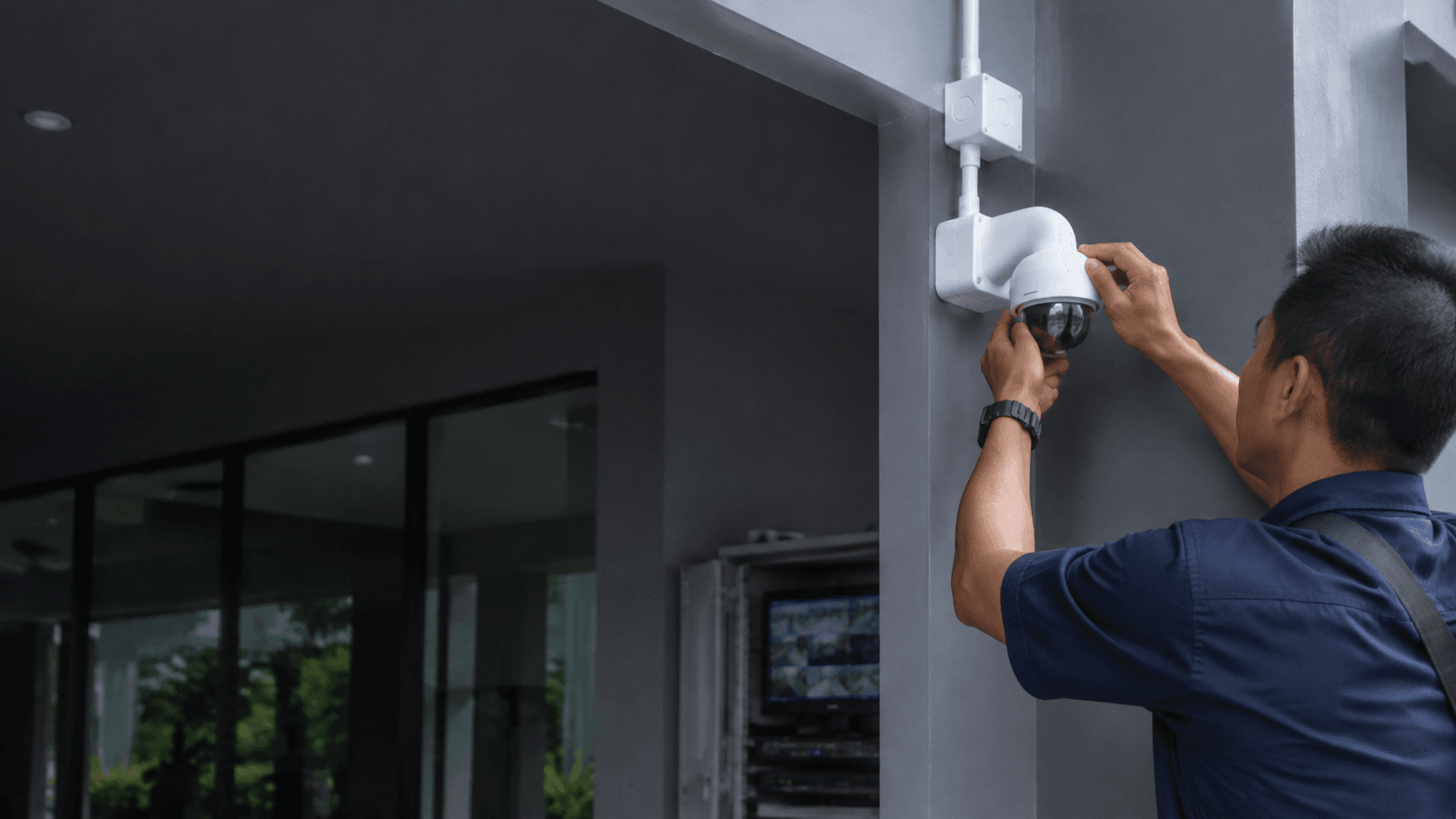
The brand sits in the value-focused tier of the surveillance market. Competitor listings describe Wbox cameras, recorders, cables, and accessories sold through distribution, while app-store entries describe W Box VMS and W Box VMS1 as video surveillance software for live preview, playback, and device management. Those are topic signals from third-party pages, not verified specifications, so this article separates what is publicly described from what still needs confirmation before purchase.
What Wbox CCTV covers across cameras, recorders, and software
Public listings group the range into three layers: cameras, recording hardware, and software for viewing and management.
Camera listings on retail and distributor pages describe bullet and dome housings, fixed lenses, and resolution tiers such as 2MP and 5MP. Recorder listings describe DVR and NVR units, including 8-channel models. Software appears as W Box VMS and W Box VMS1 on Google Play, published under SnapAV and Snap One, with features listed as live video preview, multi-channel viewing, playback, snapshot handling, and device management.
Those descriptions come from retail and app-store pages rather than official Wbox documentation. Treat them as directional. Model numbers, lens options, IR range, and codec support should be confirmed against the datasheet for the exact unit being quoted, because the same brand name can cover several hardware generations with different firmware behaviour.
Cameras, recorders, and the software layer
The practical split matters because each layer carries its own support path. Cameras and recorders are physical hardware with warranty and firmware questions. Software is where remote viewing, playback, and user access are configured, and where phone compatibility problems usually surface first.
App-store listings for W Box VMS note compatibility with IP network cameras and DVR series, and user reviews on those listings mention issues with newer phone models. That is a real planning consideration: a working recorder can still feel unreliable if the viewing app lags behind current mobile operating systems.
Where Wbox sits against mainstream brands
Wbox competes on distribution reach and price rather than on published specification depth. A forum discussion on IPVM describes attempts to pair W Box cameras with Hikvision NVRs, which points to a common buyer situation: mixing brands to save cost. Mixed-brand setups can work, but they depend on protocol support and firmware versions that are rarely guaranteed across generations.
For buyers already standardising on a mainstream platform, staying within one ecosystem removes a layer of uncertainty. For buyers who need a specific price point, Wbox hardware may fit, provided the recorder and camera are confirmed as a matched pair before payment.
How a Wbox CCTV setup is planned before installation
Planning a Wbox CCTV system follows the same sequence as any small surveillance project. Eyonic's published installation process runs through four stages.
- Site survey to review the property, entry points, and existing cabling or network conditions.
- System proposal covering camera positions, recorder location, and viewing requirements.
- Installation of cameras, recorder, cabling, and configuration.
- Handover with user testing and mobile viewing setup.
Eyonic's CCTV service page describes planning, supply, and installation with camera placement, recording, and remote viewing for homes, offices, shops, and industrial sites. The same page lists site survey, camera placement, NVR setup, and remote viewing as distinct service elements.
Lighting is the step most often skipped. Eyonic's review of ColorVu-style cameras recommends checking actual lighting conditions before confirming placement, because low-light performance claims are measured under specific conditions that rarely match a real corridor or car porch. The same caution applies to any Wbox camera chosen for night coverage: verify the lighting at the exact mounting point rather than relying on a specification line.
What the site survey should settle
A survey should confirm where cables can run, whether the recorder sits somewhere with power and ventilation, and how the site's internet connection will carry remote viewing. It should also identify which areas need identification-grade coverage and which only need presence detection, since that decision drives camera count and cost more than brand choice does.
Recording, storage, and retention
Retention length depends on camera count, resolution, frame rate, and hard drive capacity. Those figures should be calculated for the specific Wbox recorder being proposed rather than assumed from a package description. A recorder rated for a given channel count does not automatically deliver a fixed number of days of storage.
What to confirm about firmware apps and device management
Firmware and app support are the weakest publicly documented part of the Wbox CCTV picture, and they are the part most likely to affect daily use.
A WBOX Technologies support site lists firmware downloads, a CMS application, remote troubleshooting sessions, and product availability, and points users to ADI Global Distribution for supply. ADI's own contact page lists a W Box technical support line for video surveillance products. Those two pages are the clearest public support route found in this research.
Before committing, confirm the following in writing:
- The firmware version shipped on the recorder and whether updates are still issued for that model.
- Which app is intended for remote viewing, and whether it is current on both Android and iOS.
- Whether the camera and recorder are a matched pair from the same generation.
- Who provides technical support locally, and what happens if a unit fails.
Compatibility between Wbox cameras and other recorder brands is not confirmed by any primary source reviewed here. A forum thread describes an attempt to run W Box cameras on a Hikvision NVR, but a discussion thread is not a compatibility statement. If mixing brands is the plan, test one camera against the intended recorder before buying the full set.
Remote viewing and mobile app risk
Remote viewing depends on the app, the recorder's network configuration, and the site's upload speed. App-store reviews for W Box VMS mention problems on newer phones, which is a reminder that mobile access should be tested on the actual devices that will be used, not assumed from a feature list.
in Malaysia. supply installation and support questions
This is where the public record is thinnest. No primary source reviewed for this article confirms Wbox distribution, pricing, or warranty terms in Malaysia.
Malaysian buyers therefore face a practical question before brand selection: whether the chosen system can be supplied, installed, and supported locally. A brand with strong distribution in North America may have no equivalent channel here, which changes the risk profile even when the hardware itself is capable.
Eyonic Sdn Bhd is a security system supplier based in Sarawak that plans, supplies, and installs CCTV and ELV systems for homes, offices, shops, and industrial sites. Its published project work includes the Kuching Immigration Office, where the focus was arrival flow, staff areas, visitor movement, and dependable daily operation, and KTA Sarawak Sdn Bhd, an office setup supporting staff movement, visitor handling, and tidy cabling. Those projects describe the kind of planning that applies to any brand, including Wbox CCTV.
Eyonic's founder, Eric Yong, has more than ten years in the industry and works on technical installation of digital security solutions for commercial businesses in Sarawak. That experience is relevant to the local question: what can be installed cleanly, supported quickly, and maintained over years of daily use.
Questions to settle before choosing a brand
Ask who holds stock locally, what the lead time is for replacement units, whether the installer has worked with the specific model before, and what the warranty process looks like in practice. A brand that cannot answer those questions locally carries more operational risk than its specification sheet suggests.
Where Wbox fits and where it does not
Wbox CCTV suits buyers who can confirm a local supply and support route and who are comfortable with a value-tier platform. It fits less well where the site needs guaranteed long-term firmware support, documented integration with an existing platform, or a single accountable vendor for hardware and software together.
Practical next step for a enquiry
The useful starting point is not a brand decision but a site decision. Camera count, placement, lighting, cabling routes, and retention requirements determine cost and reliability far more than the logo on the housing.
Eyonic's published packages start at RM 1,599 for a Hikvision CCTV package covering camera supply and setup, basic recording configuration, and mobile viewing handover. Comparable packages exist for alarm systems and autogate. Those figures give a reference point for what a small installed system costs in this market, and they show the gap between a package price and a project price: the Kuching Immigration Office work carried an approximate budget of RM 12,000 to RM 28,000, and the KTA Sarawak Sdn Bhd office project an approximate budget of RM 8,000 to RM 18,000.
For a Wbox CCTV enquiry specifically, the sequence is to confirm local supply and support first, then confirm the exact camera and recorder pairing, then plan placement against real lighting conditions. If any of those three cannot be confirmed, the brand choice should be revisited before installation begins.
Share your location, property type and required system with Eyonic on WhatsApp at +60 11-5111 7959 for the next practical step.