
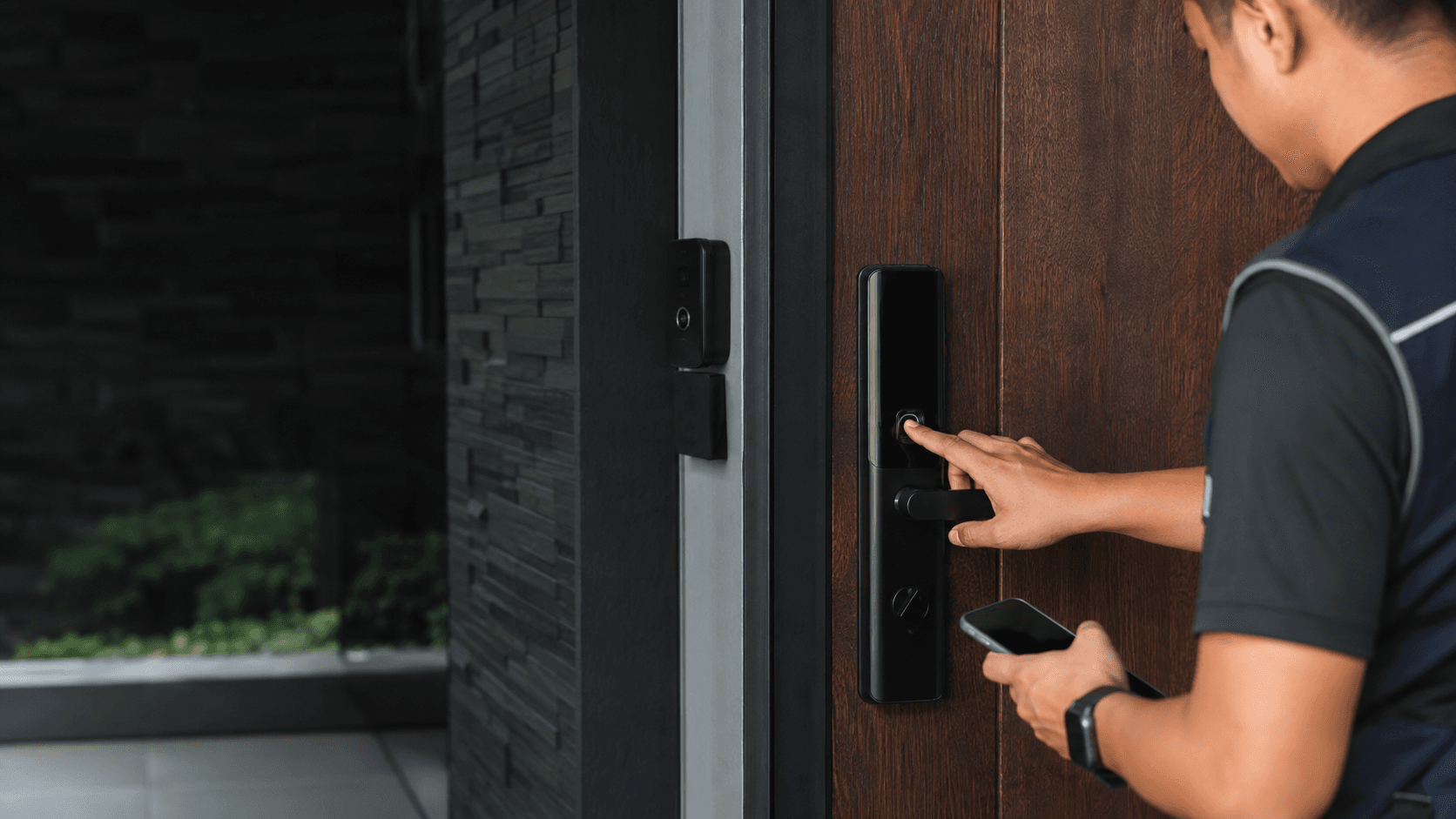
The phrase best kwikset smart lock points to a decision, not a single product. Kwikset builds several smart lock families, and the right one depends on how a door is used, who needs entry, and what happens when power or connectivity fails. Eyonic Sdn Bhd, a security system supplier in Sarawak, treats smart lock selection as part of access planning rather than a standalone hardware purchase.
This guide covers model families and control methods, door and user checks, backup entry, and local supply and installation in Sarawak. It avoids model-level specifications and pricing because those details are not verified here.
Best Kwikset Smart Lock. What the Choice Actually Depends On
Kwikset smart locks share a common purpose: replacing a mechanical key with a code, a phone, or both. The differences between models sit in how the lock is controlled and how it connects to the rest of a building.
Eyonic's own product review notes that smart locks work best when door condition, user roles and backup method are reviewed before installation. For business use, the same review states that Eyonic usually checks whether a standalone smart lock or an access-control panel is more appropriate. That check matters because a lock that fits a home entrance may not fit an office with shift changes and visitor traffic.
Three control patterns appear across Kwikset's range. A keypad or touchscreen lock works without a phone and suits shared entrances. A Bluetooth or app-controlled lock suits a single household where phones are always present. A lock that connects to a hub or smart home platform suits buildings that already run other connected systems. Each pattern carries a different failure mode, and the failure mode is what should drive the choice.
Kwikset Smart Lock Models and Control Methods
Kwikset groups its smart locks into families rather than one flagship product. Public Kwikset pages describe keypad and touchscreen deadbolts, Bluetooth-connected locks, and models built for home automation platforms. The company also publishes a comparison page for its own range.
Because verified model-level specifications are not available for this article, the practical approach is to compare families by control method rather than by model number. A keypad deadbolt is the simplest to operate and the easiest to hand over to staff or family. A touchscreen model removes worn keys but needs a clean, dry finger and a screen that is cleaned regularly. An app-controlled lock adds remote management but depends on a phone, an account, and a working network.
Connectivity is the second axis. Some Kwikset locks communicate directly with a phone over Bluetooth, which keeps setup simple but limits remote control. Others are designed to join a broader smart home or hub environment, which adds remote access and scheduling but also adds a device that must stay online. The trade-off is consistent. more remote capability means more parts that can fail.
Which control method fits which door
A main entrance used by several people benefits from a keypad or touchscreen, because entry does not depend on one person's phone. A private office or a back door used by one or two people can run on app control without inconvenience. A door inside a building that already has a managed access system is usually better served by that system than by a standalone lock.
Door Condition and User Roles Before Installation
Door condition decides whether a smart lock can be fitted at all. A deadbolt needs a door with enough thickness and a frame that accepts the bolt. A warped door, a misaligned strike plate, or a frame that has been repaired can stop a lock from seating correctly, and no amount of configuration fixes a mechanical mismatch.
Eyonic's review of smart lock door access states that smart locks are good for controlled convenience when user permissions and backup entry are planned properly. That wording places permissions ahead of hardware. In a home, permissions may mean a permanent code for family and a temporary code for a cleaner. In an office, permissions may mean separate codes for staff, contractors, and visitors, with the ability to remove a code the same day someone leaves.
User roles also determine how many credentials a lock must hold. A lock with a small number of code slots will not serve a building with rotating staff. A lock that stores codes only on the device makes auditing difficult. These are planning questions, and they are cheaper to answer before installation than after.
Backup Entry and Access Planning
Every smart lock needs a way in when the primary method fails. A dead battery, a dropped phone, a forgotten code, or a network outage can each block entry on their own. Backup entry is the part of the plan that decides whether a failure is an inconvenience or a lockout.
Kwikset's public product pages describe keyed backup as a feature of its smart lock range, which means a mechanical key can still open the door. That is useful, but it also means the key must be stored somewhere other than inside the building. A key kept in a drawer behind the locked door provides no backup at all.
For a business, backup entry should also cover staff turnover. If a code is the only way in and the person who set it has left, the backup method becomes the primary method. Planning the handover at installation avoids that outcome.
Local Supply and Installation in Sarawak
Supply and installation context matters in Sarawak because a lock bought online may arrive without anyone to fit it correctly. Eyonic's installation process for its security work follows a site survey, a system proposal, installation, and handover. The same sequence applies to door access: the door is inspected, the right lock type is proposed, the unit is fitted, and the user is shown how to manage codes.
Eyonic's completed work includes the Kuching Immigration Office project, which focused on arrival flow, staff areas, visitor movement, and dependable daily operation. That project is a useful reference point for how door access fits into a wider building plan rather than standing alone. Eyonic also completed a practical office setup for KTA Sarawak Sdn Bhd in Kuching, covering staff movement, visitor handling, and tidy cabling.
For a standalone smart lock, the installation itself is usually short. The longer work is deciding where the lock sits in the building's access plan, and whether it should connect to anything else. A lock that is fitted without that decision often gets replaced within a year.
What local installation changes
A local installer can check the actual door before a model is ordered, which prevents the common case of a lock arriving for a door it cannot fit. A local installer can also return if a code needs resetting or a lock needs re-pairing, which matters more for a business than for a home.
What to Confirm Before Ordering
Five checks cover most of the risk in a Kwikset Smart Lock purchase. Working through them in order keeps the decision tied to the door and the people who use it.
- Confirm the door and frame condition, including door thickness, deadbolt bore, and strike plate alignment.
- Confirm user roles and permissions, including how many people need entry and how codes are added or removed.
- Confirm the backup entry method, including where a mechanical key is stored and who can reach it.
- Confirm the control method, whether keypad, touchscreen, phone app, or a connection to an existing system.
- Confirm local supply and installation support, including who fits the lock and who handles a fault later.
Two further points sit outside the list but affect the outcome. The first is power. a lock that runs on batteries needs a replacement routine, and a lock that runs on wired power needs a supply at the door. The second is the building's existing systems. If the property already has CCTV, an alarm, or an intercom, door access is easier to manage when it is planned alongside them rather than added afterwards.
Eyonic supplies and installs security systems across Sarawak, including CCTV, alarm systems, autogate packages, keyphone intercoms, and smart locks. Published package pricing covers a Hikvision CCTV package, a Hikvision alarm system, and an autogate package at RM 1,599 each. Smart lock pricing is quoted per door because the work depends on the door and the access plan.
Share your location, property type and required system with Eyonic on WhatsApp at +60 11-5111 7959 for the next practical step.