
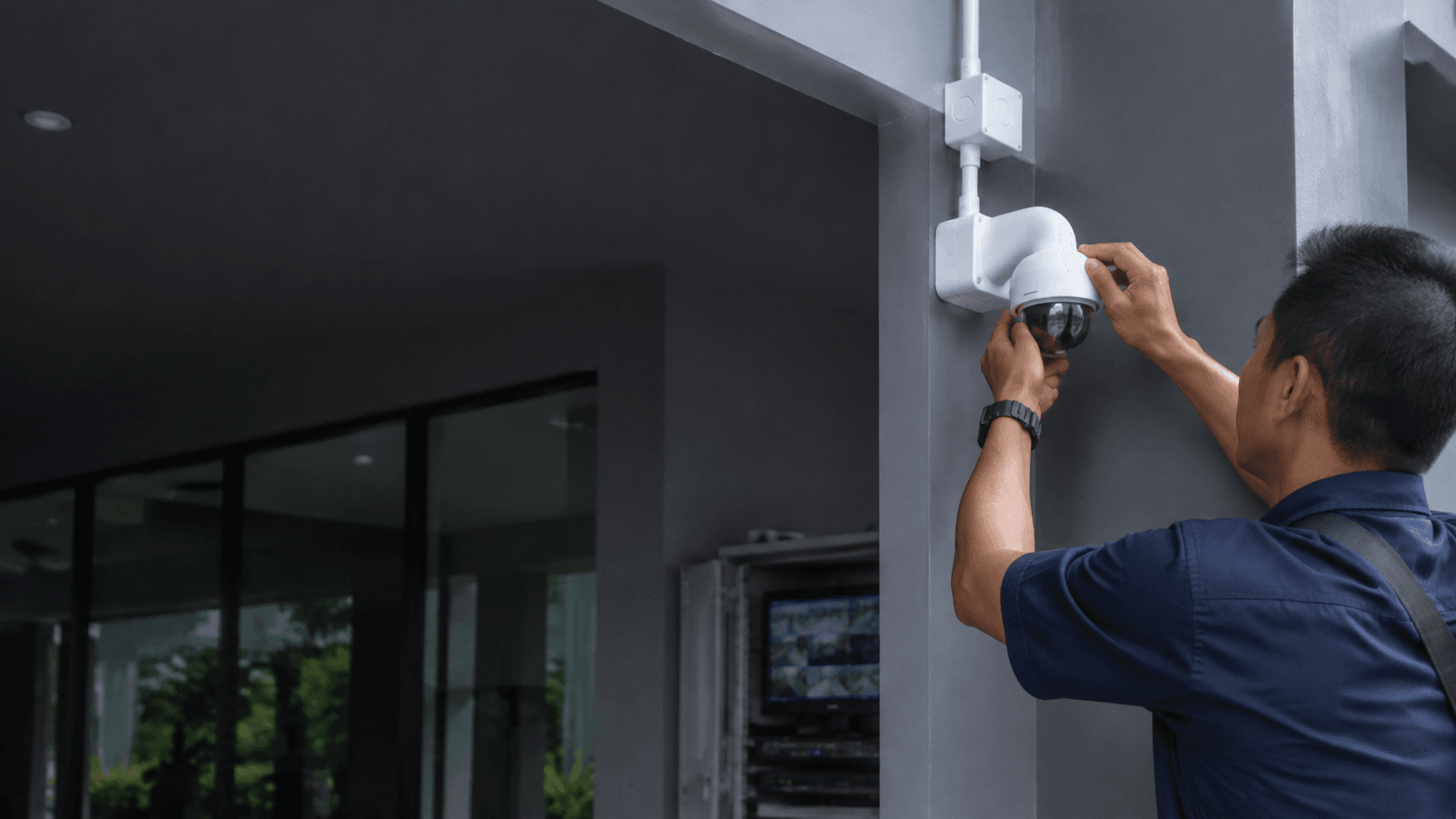
Eyonic Sdn Bhd, a security system supplier in Sarawak, plans, supplies and installs monitoring systems with camera placement, recording and remote viewing for homes, offices, shops and industrial sites. The work follows a defined sequence rather than a product drop-off.
- Site survey — the door, approach, lighting and existing cabling are reviewed on location.
- System proposal — the camera, recording and viewing arrangement is set out before any work starts.
- Installation — cameras, NVR setup and cabling are installed and configured.
- Handover — recording and remote viewing are demonstrated and tested with the user.
That four-stage sequence is the same process Eyonic uses for CCTV installation work in Sarawak, and it applies to a door camera system because the door is simply the most demanding camera position on most properties.
Door Camera System. What the Setup Involves
A door camera system combines a camera at the entrance, a recording device, and a way to view footage remotely. The camera captures the door approach; the recorder stores the footage; remote viewing lets the owner check the entrance from a phone.
Eyonic's CCTV service covers camera placement, recording and remote viewing, and NVR setup is listed as part of the same scope. Those four elements — placement, recording, NVR setup and remote viewing — are the practical components of a door camera system, whether the property is a house, a shop office or an industrial site.
The door position creates specific demands that a general perimeter camera does not face. People approach from a narrow angle, often in shade, and the camera has to capture a face and a movement direction rather than a wide scene. That is why placement and lighting checks come before any hardware decision.
Wired, battery and network options
Door cameras generally fall into three power arrangements: wired to existing doorbell wiring, battery-powered, or network-powered over Ethernet. Wired suits doors that already have low-voltage wiring. Battery suits rented premises or doors without wiring, at the cost of periodic charging. Network-powered suits sites where Wi-Fi at the door is unreliable, because the same cable carries power and data.
The right choice depends on what already exists at the door. A site survey answers that question directly; a product page cannot.
Door Camera System Placement and Lighting Checks
Placement and lighting are checked on site before a door camera system is confirmed, because the door is usually the hardest position on the property to record well.
Eyonic recommends checking actual lighting conditions before confirming placement for ColorVu-style cameras. That guidance matters at a door specifically: a porch light, a corridor light or a shaded recess changes what the camera sees at night, and the difference between a lit approach and a dark one affects where the camera should point and what it should be set to capture.
What gets checked at the door
The checks that matter most at an entrance are the approach angle, the height and angle of the camera, the light sources that fall on the door at night, and whether the camera's view is blocked by a gate, pillar, wall or overhanging roof. A camera mounted too high records the top of a head; a camera facing a bright light records a silhouette.
Recording and viewing are checked alongside placement. The recorder has to be positioned where it can be maintained, and remote viewing has to work on the connection the property actually has, not the connection assumed at the point of sale.
Where a door camera system fits well — and where it does not
A door camera system suits a property where the entrance is the main point of interest: a home with a single front door, a shop office where visitors arrive at one entrance, or a site where staff and visitor movement passes a controlled door.
It fits less well where the entrance is one of several uncontrolled openings, or where the door faces a public corridor with no fixed approach line. In those cases the door camera still records, but the coverage question shifts to the wider perimeter, and a single door unit will not answer it.
Eyonic's Kuching Immigration Office project is a useful reference point for that distinction. The work focused on arrival flow, staff areas, visitor movement and dependable daily operation — a public office where the entrance is one part of a larger movement pattern, not the whole requirement.
How Eyonic Handles a Door Camera System Project
Eyonic runs a door camera system project through the same four stages used for its CCTV installation work in Sarawak: site survey, system proposal, installation and handover.
The site survey establishes what exists at the door — wiring, lighting, mounting surfaces and network reach. The proposal sets out the camera, recording and viewing arrangement before work begins. Installation covers mounting, cabling, NVR setup and configuration. Handover covers testing and demonstrating recording and remote viewing so the system is usable on day one.
Eyonic Sdn Bhd is based in Sarawak and works across homes, offices, shops and industrial sites. The company's founder, Eric Yong, has been in the industry for more than 10 years and is experienced in technical installation of digital security solutions for commercial businesses in Sarawak.
For a door camera system, the handover stage is where most of the practical value sits. A camera that records but cannot be viewed remotely, or a recorder that fills without anyone noticing, is not a working system. Testing recording and remote viewing with the user at handover is what closes that gap.
Evidence Gaps and What to Confirm
Several details that buyers commonly ask about are not published by Eyonic and should be confirmed directly rather than assumed.
There are no published technical specifications for any door camera model — resolution, field of view, storage capacity and power requirements are not stated. There is no published price for a door camera system. Eyonic's listed RM 1,599 packages cover a Hikvision CCTV package, an alarm system and an autogate package; none of them is a door camera system, so that figure should not be applied to one.
Warranty terms, response times and after-sales service levels are not published. Neither is the number of completed door camera installations. There is also no published Malaysian regulatory, licensing or data-protection guidance for door-facing cameras, and no published performance data for night vision, motion detection or two-way audio on any specific unit.
Those gaps are not a reason to avoid the category. They are a reason to ask specific questions before committing: which camera model is proposed, what it records at night at this door, where footage is stored, how long it is kept, and what happens if the unit fails.
Questions worth putting in writing
Ask for the proposed camera model and its recording behaviour at the actual door, not in general. Ask where footage is stored and for how long. Ask what the handover covers and who tests remote viewing. Ask what the warranty covers and how a fault is reported. A supplier who answers those in writing before installation is easier to work with than one who answers them afterwards.
Next Practical Step
The most useful first move is a site survey, because placement and lighting at the actual door determine everything that follows. Share your location, property type and required system with Eyonic on WhatsApp at +60 11-5111 7959 for the next practical step.
For a property in Sarawak, that conversation can cover the door position, existing wiring, lighting at night and how footage will be viewed. For a door camera system anywhere else in Malaysia, the same three details — location, property type and required system — are enough to start.