
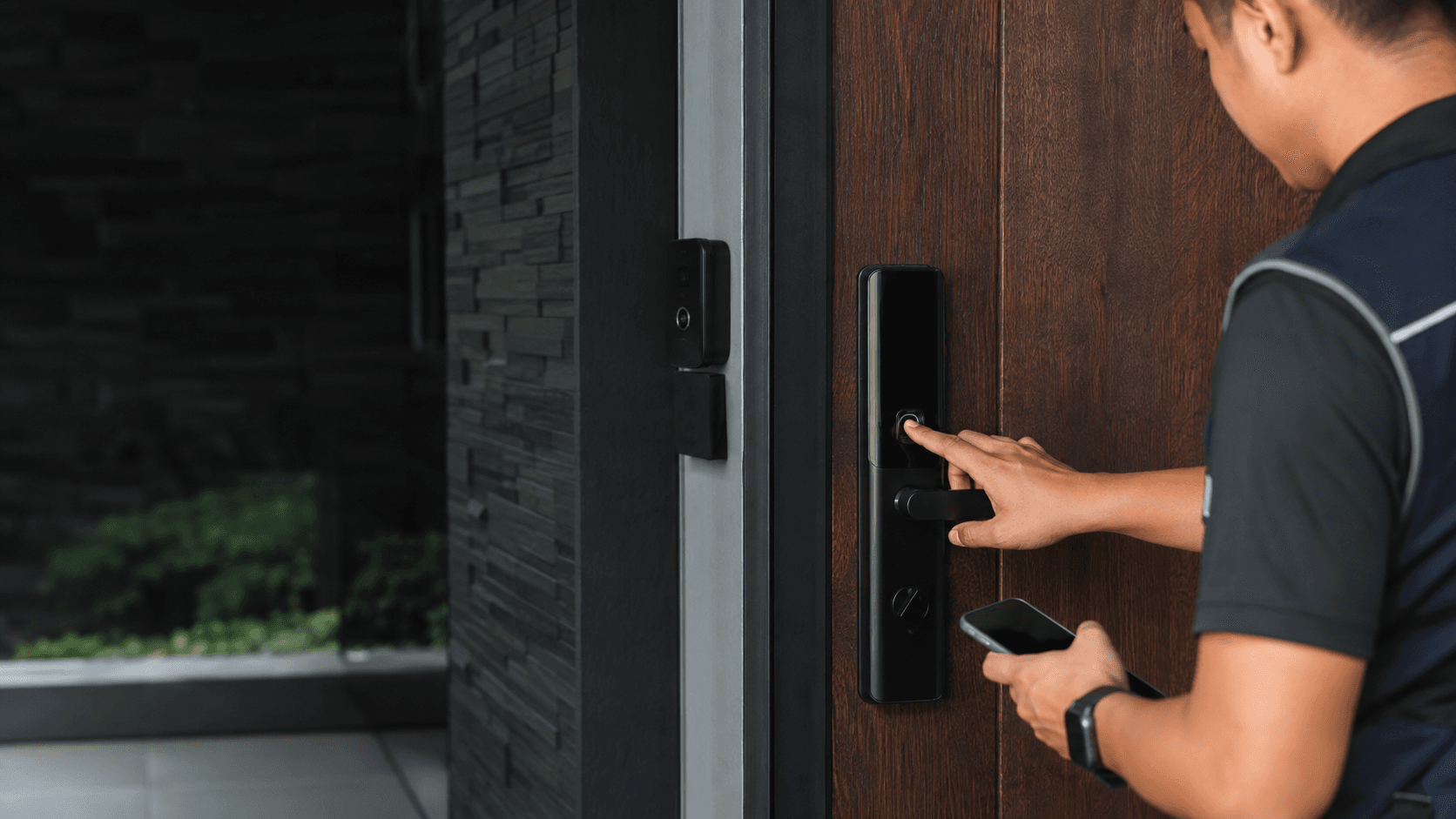
The term covers a family of electronic locks rather than a single product. Yale builds locks that open by fingerprint, numeric code, RFID card, or a phone app, and some models combine several of those methods on one door. The common thread is that the credential is stored electronically instead of cut into metal, so access can be added or removed without changing the hardware.
That matters most where keys are awkward to manage. A household that keeps losing spare keys, a shop that hands keys to shift staff, and an office that needs a record of who entered all run into the same problem: a cut key cannot be un-cut. Electronic credentials can be deleted.
Yale Digital Door Lock. What the Term Covers
A Yale digital door lock is a battery-powered lock that verifies an electronic credential before releasing the bolt. The credential is the part that varies. Fingerprint models read a stored print. Keypad models accept a numeric code. Card models read an RFID tag or card. App models connect over Bluetooth or Wi-Fi so a phone can unlock the door and, on some models, so entry activity can be reviewed remotely.
Two distinctions matter when comparing options. The first is whether the lock is standalone or wired into a wider access control system. A standalone lock manages its own users and needs no panel. A lock tied to an access control panel becomes one door in a larger system, which suits sites where many doors, staff credentials, and entry records need to sit in one place. Eyonic's own product guidance notes that for business use it usually checks whether a standalone smart lock or an access-control panel is the better fit, because the answer changes what gets installed and how access is administered later.
The second distinction is the entry method mix. A lock with only a keypad fails differently from a lock with a keypad plus a mechanical key override. Buyers who want the fewest possible ways in should understand that reducing entry methods also reduces the ways back in when something goes wrong.
Fingerprint, PIN, Card and App Entry Compared
Each entry method trades convenience against a specific failure mode. None is universally better, and the right mix depends on who uses the door and how often.
Fingerprint entry suits a small, stable group of regular users. It removes the need to carry anything, and it cannot be shared by accident the way a code can. It struggles with wet, dirty, or worn fingers, which is a real consideration on an external door in a humid climate or on a site where hands are frequently soiled.
PIN code entry suits households and small teams because a code can be issued and revoked in seconds. The weakness is that codes get shared, written down, or observed. A short code on a door facing a public corridor is easier to compromise than the same code on an internal door.
RFID card entry suits offices, shops, and any site where staff already carry a card for other doors. It is fast and consistent, and cards can be cancelled individually when someone leaves. The cost is that cards get lost or lent, so the system needs a clear rule about reporting a missing card.
Mobile app entry suits people who want remote visibility and temporary access for visitors or contractors. It depends on the phone, the app, and the network, so it should never be the only way through a door that must open on demand.
The practical conclusion is that most doors benefit from two independent methods, at least one of which does not depend on power, network, or a phone.
Door Condition Checks Before a Yale Digital Door Lock Is Fitted
Door condition decides whether a lock can be fitted at all, and it is the check most often skipped when a lock is bought online first. A lock body has to sit in the door, the bolt has to align with the strike, and the door has to close squarely enough for the bolt to throw without binding.
Several conditions cause problems. A door that has swollen or dropped on its hinges may close but not align, so the bolt drags. A hollow or lightweight door may not have enough solid material where the lock body needs to sit. An existing cutout from an older lock may not match the new lock's footprint, which can mean patching and re-cutting rather than a straight swap. Metal gates and grilles raise a different set of questions about mounting and weather exposure.
Because no verified compatibility list for Malaysian door types, gate frames, or existing deadbolt cutouts was supplied for this article, the honest position is that compatibility has to be confirmed against the actual door rather than assumed from a product listing. A site survey is the point at which that gets settled. Eyonic's installation process begins with a site survey for exactly this reason: the survey is where the physical constraints of the door are established before anything is ordered.
Weather exposure is part of the same check. An external door that takes direct rain, or a gate that sits in full sun, places demands on a lock that an internal door does not. Placement and exposure should be confirmed on site rather than inferred from a photograph.
User Roles and Backup Entry for Homes and Offices
User roles determine how the lock is administered, and they differ sharply between a home and a workplace. In a home, the usual pattern is a small number of permanent users plus occasional access for a cleaner, a relative, or a contractor. In an office, the pattern is a larger group with joiners and leavers, plus a need to know who entered and when.
Before ordering, it helps to answer four questions in writing:
- Who needs permanent access, and who needs access only for a defined period?
- Who is allowed to add or remove a user, and how is that authority handed over when that person leaves?
- What is the backup entry method if the battery is flat, the network is down, or a phone is lost?
- Does the site need entry records, and if so, who reviews them and how often?
Backup entry deserves particular attention because it is the failure path. A mechanical key override, a physical key kept off-site, or a second independent entry method all serve the same purpose: getting through the door when the primary method fails. The worst outcome is a door with a single electronic method and no way in when that method stops working.
Battery failure is the most predictable of these events, and it is manageable rather than alarming. Most electronic locks give warning before the battery is exhausted, and the response is to replace the battery on a schedule rather than wait for the warning. The point to settle at the planning stage is who holds responsibility for that schedule, because in a rental property or a shared office it is often nobody.
For business sites, the standalone-versus-panel question returns here. A standalone lock keeps administration simple but spreads user management across each door. A panel centralises it, which matters once a site has several controlled doors and staff who move between them. Eyonic's project work for the Kuching Immigration Office centred on arrival flow, staff areas, visitor movement, and dependable daily operation, which is the same set of concerns that decides how door access should be administered on a busy site.
Installation Sequence Eyonic Follows on Site
Eyonic's installation process runs in four stages, and the same sequence applies to door access work.
- Site survey, where the door, frame, existing cutout, exposure, and user requirements are checked on site.
- System proposal, where the recommended lock or access arrangement is set out against what the survey found.
- Installation, where the hardware is fitted and the entry methods are configured.
- Handover, where users, credentials, and backup entry are explained and tested.
The order matters because each stage removes a category of risk. The survey removes the risk of buying hardware that will not fit. The proposal removes the risk of choosing a standalone lock where a panel was needed, or the reverse. Installation is where alignment and mounting are resolved. Handover is where the people who use the door daily learn how to add a user, remove one, and get in when the primary method fails.
Handover is also where the backup method should be tested rather than described. A key override that has never been tried is an assumption, not a backup.
Yale Digital Door Lock Questions Buyers Ask Before Ordering
Does a Yale digital door lock need Wi-Fi? Not necessarily. Fingerprint, PIN, and card entry work locally without a network. Wi-Fi or Bluetooth is needed only for app-based unlocking and remote activity review, so a lock can be fully useful without any network connection.
What happens when the battery runs flat? The lock stops releasing the bolt electronically, which is why a mechanical override or a second independent entry method should be confirmed before installation. Battery replacement is routine maintenance, and the schedule should be assigned to a named person.
Can one lock serve both a home and a small office? It can, but the administration differs. A home usually needs a short list of permanent users and occasional guest access. An office needs joiners and leavers handled cleanly and, often, a record of entry. The lock may be the same; the rules around it are not.
Is a standalone lock or an access control panel the better choice? A standalone lock suits a single door with a small user group. A panel suits a site with several controlled doors and staff who need consistent credentials across them. Eyonic checks this distinction for business use before recommending hardware.
What should be confirmed before ordering? The door's construction and existing cutout, how the door closes and aligns, exposure to weather, the number and type of users, the backup entry method, and whether entry records are needed. These are survey questions, not catalogue questions.
For readers in Sarawak who want the door assessed before hardware is chosen, Eyonic handles planning, supply, and installation for homes, offices, shops, and industrial sites. Share your location, property type and required system with Eyonic on WhatsApp at +60 11-5111 7959 for the next practical step.