
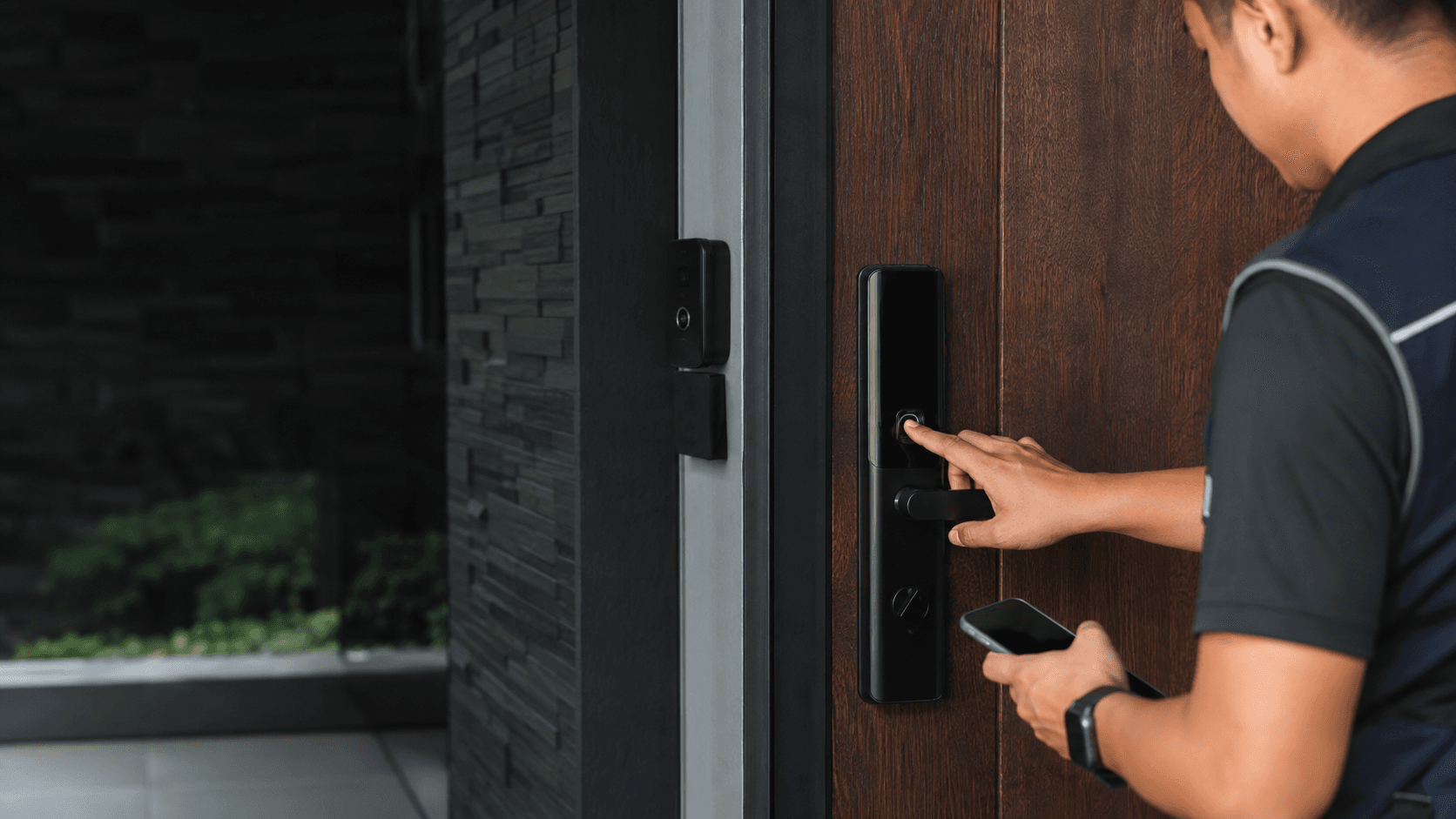
The term gets used loosely online. Some pages mean a Euro profile cylinder that drops into an existing mortise case. Others mean a full mortise lock body, or a networked electronic locking system. Knowing which one applies changes what has to be measured before anything is ordered.
CES is a locking systems manufacturer based in Velbert, Germany, and its range splits into mechanical locking systems and electronic access control systems. Bridgeport Worldwide is the official North American distributor for CES European profile cylinders and mortise locks, which confirms the mechanical side is distributed through regional partners rather than sold direct everywhere.
What the CES name covers
CES Gruppe is the manufacturer identity behind the brand. The company describes itself as developing mechanical locking systems and electronic access control systems, manufactured in Velbert. That single sentence explains why searches for a Ces Door Lock return two very different product families.
The mechanical family is the older, more widely distributed side. The electronic family covers networked security, digital access management and system platforms. A reader who wants a keyed cylinder and a reader who wants a managed door both land on the same brand name, which is why the term is ambiguous in practice.
Distribution matters for anyone outside Europe and North America. Bridgeport Worldwide handles CES profile cylinders and mortise locks for North America, and its page lists dealer, distributor, OEM, fabricator and specifier support. That structure implies the brand reaches most markets through trade channels rather than consumer retail.
Mechanical cylinders and mortise locks in the CES range
The mechanical side is where most Ces Door Lock searches actually belong. Two product types dominate the results: profile cylinders and mortise locks.
Profile cylinders are the removable keyed barrel that sits inside a lock case. CES makes these in the European profile format, and Bridgeport Worldwide names Schlage-C keyway profile cylinders among the range. A cylinder is a component, not a complete lock, so replacing one does not require replacing the door hardware around it.
Mortise locks are the full lock body that sits inside a pocket cut into the door edge. CES describes its mortise locks as suited to commercial doors, fire-rated doors, sliding doors, swing doors and emergency exits. That is a wider brief than a domestic cylinder swap, and it usually means the door itself was built or specified for that lock case.
One documented CES cylinder is the CES Key Cylinder 815 with thumb turn, listed by Casson Hardware. The listing describes a cylindrical form with a small aligned notch for finger rotation, and it references door thickness and cylinder measurement as part of the specification. It also notes keying options such as keyed alike and keyed differently, and finishes including satin stainless, polished chrome, satin brass, polished brass, antique brass, oil rubbed bronze, black lacquered, white and bronze.
That listing also distinguishes 90-degree and 360-degree cylinders. The distinction matters because a 90-degree cylinder turns a quarter turn to unlock, while a 360-degree cylinder rotates a full turn. Which one fits depends on the lock case already in the door, not on preference.
Electronic and access-control locking systems
The electronic side of the CES range is a different purchase entirely. CES describes electronic access control systems, smart access management, networked security and digital access management as part of its offering.
These systems are specified rather than bought off a shelf. They involve credentials, user permissions, door controllers and a management layer. A single door can be handled by a standalone electronic lock, but a building with multiple controlled doors usually needs a panel-based approach instead.
Eyonic's own product guidance makes the same split for smart lock door access: standalone smart locks work for controlled convenience when user permissions and backup entry are planned properly, and for business use the choice between a standalone smart lock and an access-control panel is reviewed before installation. That logic applies to any electronic Ces Door Lock decision, because the door count and the user count drive the architecture.
Backup entry is the constraint that catches people out. An electronic lock with no mechanical override and no documented recovery path becomes a problem the first time a credential fails or a controller loses power. Planning the backup method before installation is cheaper than solving it afterwards.
Matching a Ces Door Lock to door thickness and cylinder size
Cylinder sizing is the most common reason a Ces Door Lock order goes wrong. A profile cylinder has to span the door leaf plus any backplate, rose or escutcheon on each face. If the cylinder is too short it will not engage the lock case properly; if it is too long it protrudes and becomes a physical weakness.
The CES Key Cylinder 815 listing treats door thickness and cylinder measurement as specification inputs, and it offers a custom quote route when dimensions differ from standard. That is the honest position for any cylinder purchase: standard sizes cover common doors, and anything else needs measuring.
Measurement has to happen on the actual door, not from a model number. Door leaf thickness, the distance from the door face to the lock case centre, and the thickness of any trim on the inside and outside all feed into the required cylinder length. Multipoint locks add another constraint, because the cylinder has to align with a gearbox rather than a simple mortise case.
Handing is the second check. A mortise lock body is handed, meaning a left-hand door and a right-hand door need different lock configurations. Getting this wrong means the latch faces the wrong way and the door will not close correctly.
Ces Door Lock checks before ordering or installation
These checks apply whether the door is getting a mechanical cylinder or an electronic lock. Working through them in order prevents most returns and rework.
- Measure the door leaf thickness at the lock edge, not at the hinge or the centre of the door.
- Measure the existing cylinder length from the outside face to the inside face, including any trim or rose.
- Confirm the handing of the door and whether the existing lock case is handed.
- Decide the keying requirement. keyed alike across several doors, keyed differently, or a thumb turn on the inside.
- Choose the finish against the existing hardware, since cylinder finishes are visible on both faces of the door.
- Confirm the backup entry method if the lock is electronic, including what happens during a power failure.
Two of these checks are frequently skipped. Handing is often assumed rather than verified, and backup entry is often deferred until after installation. Both are cheap to confirm beforehand.
There is also a compatibility limit worth stating plainly. No verified data confirms that a specific CES cylinder will fit a specific multipoint lock or door hardware set. That has to be confirmed against the actual door hardware before ordering, because cylinder formats look similar while the internal dimensions differ.
Getting a Ces Door Lock supplied and installed in Malaysia
Malaysian availability is the practical gap. No verified CES pricing, distributor or warranty information for Malaysia is available, so a buyer cannot assume the brand is stocked locally in the same way it is in Europe or North America.
What can be confirmed is the general route. Eyonic Sdn Bhd is a security system supplier in Sarawak that plans, supplies and installs monitoring and access systems for homes, offices, shops and industrial sites, and its product range includes smart locks alongside Hikvision cameras. Eyonic's documented process runs through site survey, system proposal, installation and handover.
That process suits a door access decision because the survey is where door thickness, cylinder size, handing and user roles get recorded. Eyonic's smart lock guidance states that door condition, user roles and backup method are reviewed before installation, which is the same set of inputs a Ces Door Lock specification needs.
For a multi-door site, the comparison is between a standalone lock and an access-control panel. Eyonic has completed work for the Kuching Immigration Office, focused on arrival flow, staff areas, visitor movement and dependable daily operation, and for KTA Sarawak Sdn Bhd, covering staff movement, visitor handling, tidy cabling and clearer daily site control. Both are examples of door and movement planning rather than single-lock supply.
Where a site needs a specific CES-branded cylinder or mortise lock, the honest sequence is to confirm the exact model and dimensions first, then confirm whether it can be sourced, then install. Skipping the first step and ordering from a photograph is how mismatched cylinders end up on site.
For readers weighing a mechanical cylinder against an electronic lock, the deciding factors are user count, door count and whether audit or remote management is needed. A single office door with a handful of keyholders is usually a cylinder question. A building with staff turnover, visitor logging or multiple controlled doors is an access-control question, and the lock hardware follows from that decision.
Share your location, property type and required system with Eyonic on WhatsApp at +60 11-5111 7959 for the next practical step.