
The phrase covers two different purchases that share almost nothing except a lens. One records events for later viewing. The other watches a property continuously and sends footage to a recorder or phone. Malaysian buyers searching for a video camera for home often arrive expecting a single product page and instead need to decide which of those two jobs matters more.
Video Camera For Home. What The Term Covers
Consumer camcorders are handheld devices built for deliberate recording: holidays, school events, family gatherings. They are carried, pointed, and switched on when something worth keeping happens. Home surveillance cameras are fixed in position and record whether or not anyone is watching, feeding a recorder or a remote-viewing app.
The two categories differ in how they are powered, where they sit, and what happens to the footage afterwards. A camcorder runs on a battery and stores clips on a memory card. A surveillance camera is normally wired to a permanent power source and connected to a recorder or network so that footage survives the camera being removed.
For most Malaysian households weighing a video camera for home, the deciding question is not image quality but purpose. Recording a child's graduation and monitoring a front gate are separate problems, and a device chosen for one rarely serves the other well.
Camcorder Or Surveillance Camera For A Malaysian Home
A camcorder suits households that want to create footage. It is portable, self-contained, and needs no installation. The trade-off is that it only records what someone chooses to point it at, and it must be charged, carried, and stored between uses.
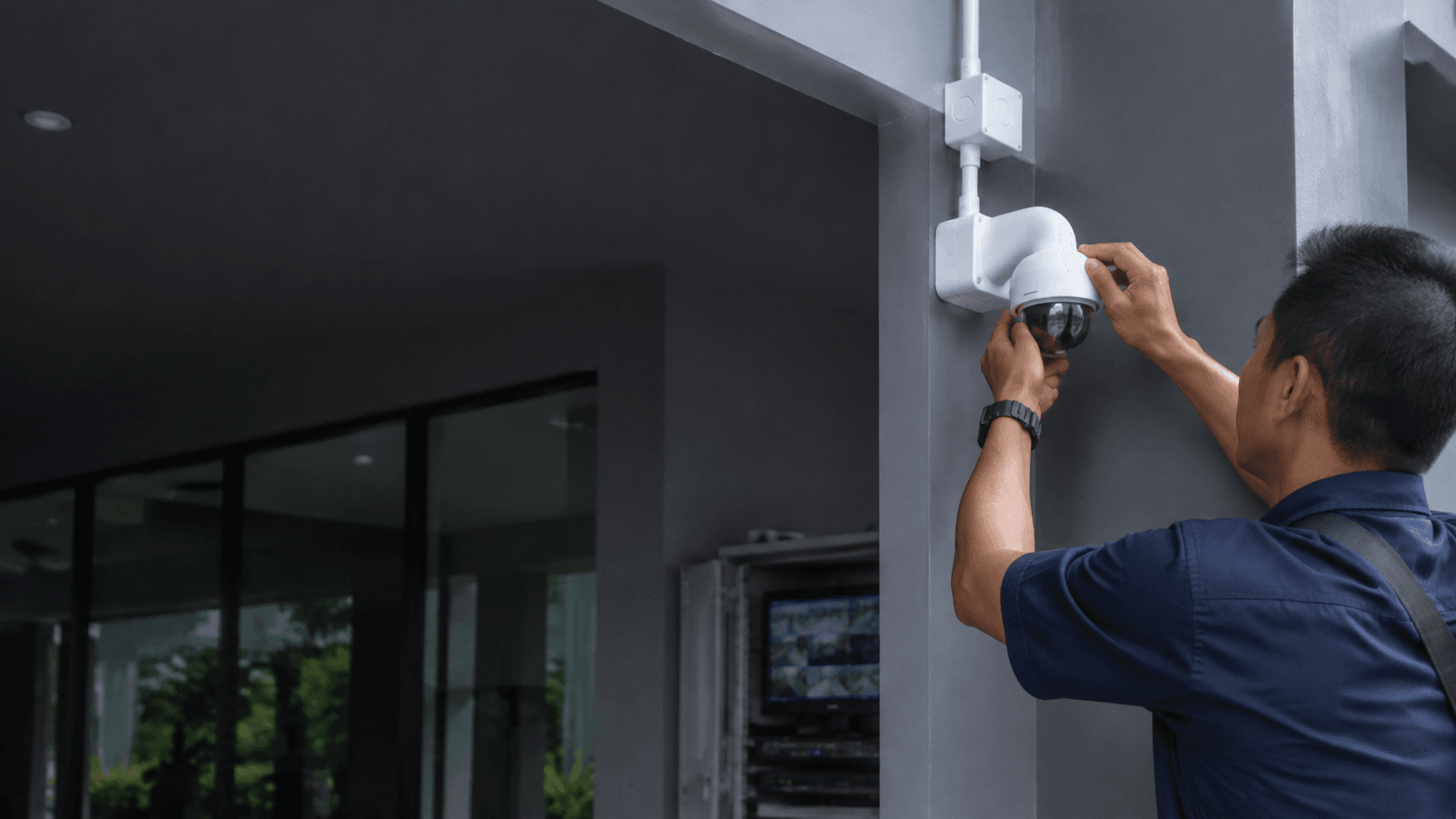
A surveillance camera suits households that want a record of what happened at a fixed location. It works unattended, which is the point. The trade-off is that it requires mounting, cabling or a power source, and a recorder or app to make the footage useful.
Malaysian homes add a few practical considerations. Terrace houses and bungalows typically have an approach, a gate, and a car porch worth covering. Apartments and condominiums usually restrict what can be drilled into common-area walls, so placement is often limited to the unit's own entrance or interior. A camcorder sidesteps all of this because it is never fixed in place.
Where both needs exist, they are usually met by two separate purchases rather than one compromise device. A camcorder for family recording and a small surveillance setup for the entrance do different jobs and do not compete for the same budget line.
Where camcorders still make sense
Camcorders remain the better choice when footage is the product: a wedding, a graduation, a child's performance, a family trip. They are also simpler to own, since nothing is installed and nothing is wired.
Where surveillance cameras make sense
Fixed cameras make sense when the goal is coverage of a location over time: an entrance, a gate, a porch, a back door, a small shop attached to a home. The value comes from continuous or motion-triggered recording rather than from anyone operating the device.
What A Home Video Camera Setup Involves
Eyonic's CCTV installation process runs through four stages: site survey, system proposal, installation, and handover. The sequence matters because placement decisions made before a survey are guesses.
- Site survey. The property is reviewed to identify entry points, existing cabling routes, power availability, and the areas that actually need coverage.
- System proposal. A camera and recorder configuration is proposed based on what the survey found, rather than on a fixed package applied to every home.
- Installation. Cameras are mounted, cabling is run, and the recorder is set up.
- Handover. Recording is configured and mobile viewing is set up so the household can check footage remotely.
The handover stage is where a home video camera setup either becomes useful or becomes forgotten. Remote viewing configured at handover means footage can be checked from a phone without returning to a recorder. Basic recording configuration means the system keeps capturing after everyone stops thinking about it.
Camera placement and NVR setup are the two decisions that shape the result most. Placement determines what is covered and what is missed. NVR setup determines how long footage is kept and how it is retrieved. Both are settled during the survey and proposal stages, not after installation.
Video Camera For Home Costs In Malaysia
Eyonic lists three packages at RM 1,599 each. The Hikvision CCTV Package covers camera supply and setup, basic recording configuration, and mobile viewing handover. The Hikvision Alarm System covers a control panel and sensors, siren and zone setup, and user testing and handover. The Autogate Package covers motor recommendation, remote-control setup, and safety testing and handover.
Larger or more complex work is priced by project rather than by package. Two completed Eyonic projects give a sense of the range: the KTA Sarawak Sdn Bhd office setup in Kuching carried an approximate budget of RM 8,000 to RM 18,000, and the Kuching Immigration Office project carried an approximate budget of RM 12,000 to RM 28,000.
Those project figures describe commercial and public-office work, not a typical single-home installation, and they should not be read as a home price. They are useful mainly for understanding how scope drives cost: more cameras, longer cable runs, and more complex buildings move a job out of package pricing and into project pricing.
There is no supported standalone price for a single camera. Households that want one camera and nothing else are in a different pricing situation from households buying a package, and the package price is the only home-relevant figure currently evidenced.
What the package price does and does not cover
The RM 1,599 Hikvision CCTV Package covers camera supply and setup, basic recording configuration, and mobile viewing handover. It does not, on the available evidence, describe a fixed camera count, a fixed resolution, or a fixed storage duration. Those depend on the property and the proposal that follows the survey.
Lighting And Placement Checks Before Confirming A Camera
Eyonic recommends checking actual lighting conditions before confirming placement for ColorVu-style cameras. This is a step that is easy to skip and expensive to get wrong, because a position that looks adequate in daylight can behave differently after dark.
The check is straightforward. look at the intended position at the times of day that matter, not just during a daytime visit. A porch light that is switched off at night, a neighbour's wall that blocks an angle, or a reflective surface that catches light can all change what a camera actually sees from that spot.
Placement also has to account for what the household wants covered rather than what is easiest to reach. A camera mounted where the cable run is shortest may miss the gate entirely. A camera aimed at a public footpath may capture more of the street than of the property.
For homes where the entrance is the main concern, the practical sequence is to identify the approach, the gate, and the door, then check lighting at each before confirming a position. For homes covering a wider perimeter, the same check applies to each proposed point individually.
Questions that come up during placement
Whether a camera should face outward toward the street or inward toward the door depends on what the household wants recorded. Outward coverage captures approach and arrival. Inward coverage captures the doorway itself. Many homes end up wanting both, which is a camera-count decision rather than a camera-type decision.
Whether existing wiring can be reused depends entirely on the property. The site survey exists to answer that question before installation begins, because the answer changes both the proposal and the cost.
. Practical Next Step
The useful next step is not choosing a model but describing the property. Location, property type, and the system required are the three pieces of information that let a supplier move from a general answer to a specific proposal.
Eyonic Sdn Bhd is a security system supplier in Sarawak, Malaysia, specialising in CCTV and ELV systems, with planning, supply, and installation for homes, offices, shops, and industrial sites. The company's founder, Eric Yong, has worked in the industry for more than ten years, with experience in technical installation of digital security solutions for commercial businesses in Sarawak.
Completed work includes the Kuching Immigration Office, where the focus was arrival flow, staff areas, visitor movement, and dependable daily operation, and the KTA Sarawak Sdn Bhd project, which needed a practical office setup in Kuching supporting staff movement, visitor handling, tidy cabling, and clearer daily site control. Both are commercial and public-sector examples rather than home installations, and they illustrate the kind of scoping that a home survey also follows.
Share your location, property type and required system with Eyonic on WhatsApp at +60 11-5111 7959 for the next practical step.