
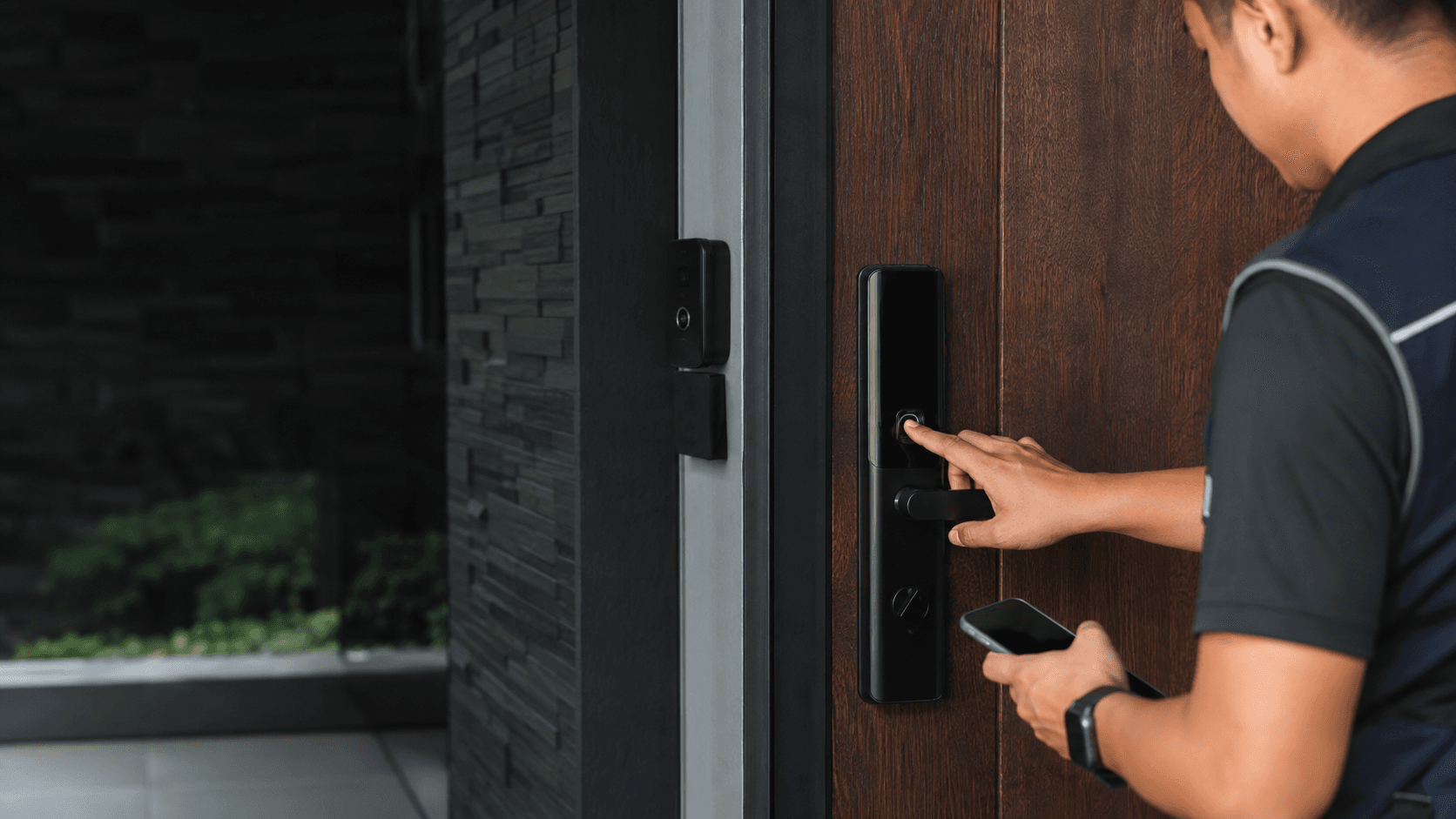
Two things decide whether the setup behaves well in daily use: the connectivity route between the app and the lock, and the backup entry method kept for the moments the app is unavailable. Everything else — brand, finish, keypad style — sits behind those two.
Keyless Entry Door Lock With App: What the Term Covers
The phrase describes a lock that can be opened without a physical key and can also be operated from a phone application. In practice it covers a wide spread of hardware, and the differences matter more than the shared label.
At one end sit retrofit units that fit over an existing deadbolt on the inside of the door, leaving the outside handle and key cylinder untouched. At the other end sit full replacement deadbolts and lever sets, where the whole exterior assembly is swapped. Between them sit keypad deadbolts with an added wireless module, and mortise-style locks used on some apartment and office doors.
Access methods vary just as widely. A keyless entry door lock with app control commonly supports some combination of app unlock, numeric codes, fingerprint reading, physical key override, and — on newer hardware — phone-based wallet credentials that tap against the lock. Not every unit carries every method, and the combination determines how the door behaves when a phone is flat or a network is down.
For a household in Malaysia, the practical question is rarely which method sounds most advanced. It is which methods remain usable by every person who needs to enter, including those who will not install an app.
How App Control Reaches the Lock
An app does not talk to a lock directly over the internet. The command travels a chain, and every link in that chain can fail independently.
The phone sends the request to the manufacturer's cloud service. The cloud service relays it to whatever gateway or radio the lock uses. The lock receives the instruction and drives the motor or solenoid that retracts the bolt. If any link is missing, the app shows a failure while the door itself is unaffected.
This is why two locks that look identical in a product photo can behave completely differently. One may hold a direct Wi-Fi connection to the home router. Another may rely on Bluetooth, which only works within a short range of the door. A third may need a separate bridge or hub plugged in nearby, which then carries the traffic onward.
The chain also explains a common source of confusion. A lock can be perfectly functional as a keypad or key entry device while its app features are effectively dormant, because the bridge was never installed or the Wi-Fi signal does not reach the door.
What changes when the internet drops
Local access methods — keypad codes, fingerprints, a physical key, and Bluetooth within range — generally continue to work when the internet connection fails, because they do not depend on a remote server. Remote unlock from outside the property does not, because the command has nowhere to travel.
Power is a separate failure path. Most app-controlled locks run on batteries, and a depleted battery disables electronic entry until it is replaced or bypassed. That is why the backup method is not a minor detail; it is the part of the design that determines whether a flat battery becomes an inconvenience or a lockout.
Connectivity Choices and What They Change
Connectivity is the single largest variable in how a keyless entry door lock with app behaves day to day. The table below contrasts the main routes by what each one changes for the person using the door.
| Route | Remote access from outside | Local access at the door | Extra equipment |
|---|---|---|---|
| Direct Wi-Fi at the lock | Available while the lock holds a connection | Works without the phone | None beyond a reachable Wi-Fi signal |
| Bluetooth only | Not available away from the door | Works within short range | None |
| Bluetooth with a bridge or hub | Available through the bridge | Works within short range | A bridge or hub, powered and in range |
| Panel or controller based | Depends on the controller's own network path | Works through the controller | A control panel and its wiring |
The trade-off is straightforward. Direct Wi-Fi removes a piece of hardware but depends on signal strength at the door, which is often the weakest point in a house because doors sit at the building's edge. A bridge adds a device and a power point but can be placed where reception is reliable. Bluetooth alone is the simplest and the most limited.
Battery behaviour differs by route as well. A lock holding a live Wi-Fi connection draws more power than one that wakes only for a Bluetooth handshake, so the same battery capacity can translate into noticeably different service intervals depending on how the lock is configured.
Door, Power and Backup Checks Before Ordering
Most failed installations trace back to something that could have been measured in advance. Working through these checks in order prevents ordering hardware that will not fit or will not stay connected.
- Confirm the door and frame condition, including whether the door closes squarely and whether the existing strike plate aligns without forcing.
- Confirm the backset and bore measurements, since replacement deadbolts are sized to the existing holes and a mismatch means drilling or a different product.
- Confirm Wi-Fi reach at the door itself rather than elsewhere in the property, because signal at the doorway is usually weaker than in the room behind it.
- Confirm the power plan, including battery type, expected replacement interval, and whether a low-battery warning reaches the app before the lock stops responding.
- Confirm the backup entry method and who holds it, whether that is a physical key, a memorised code, or a second device.
- Confirm which user role each person needs, separating permanent household or staff access from temporary or time-limited access.
Door condition deserves particular attention on older properties. A lock motor has to overcome whatever resistance the door and frame present, and a door that needs lifting to close will wear a motorised mechanism faster than one that swings freely. This is a mechanical constraint, not a software one, and no app setting compensates for it.
User roles are the other check that is easy to skip. A keyless entry door lock with app control typically distinguishes between owners who can add and remove users, regular users with standing access, and temporary users with a defined window. Deciding those roles before installation avoids handing out credentials that later need revoking.
Where a Standalone Lock Stops and Access Control Starts
A standalone smart lock suits a single door with a small, stable group of users. It is the right shape of solution for a home, a small office entrance, or a rented unit where the door hardware is the only thing being managed.
The fit changes once the requirement grows past one door. Multiple entry points, staff who move between sites, visitor logging, and time-based restrictions across several doors are access-control problems rather than lock problems. A standalone lock can be part of that picture, but it does not become a management system by adding users to an app.
Eyonic's own product review guidance makes the same distinction: smart locks work best when door condition, user roles and backup method are reviewed before installation, and for business use the usual check is whether a standalone smart lock or an access-control panel is the more appropriate choice. That review step is where a single-door decision and a site-wide decision separate.
There is a practical middle ground worth naming. A site may run a standalone lock on one staff entrance while the main movement of people is handled by other systems entirely. Eyonic's work at the Kuching Immigration Office focused on arrival flow, staff areas, visitor movement and dependable daily operation — the kind of requirement where door hardware is one component among several rather than the whole answer.
For sites weighing that boundary, the useful question is not which lock is best but how many doors, how many distinct user groups, and how much record-keeping the site actually needs. Those three answers usually settle whether a standalone lock is sufficient.
Questions Buyers Ask
Does app control work without Wi Fi
Local methods generally keep working without an internet connection, because keypad codes, fingerprints and Bluetooth handshakes do not need a remote server. Remote unlock from outside the property does need a network path to the lock, whether that is direct Wi-Fi or a bridge.
What happens when the battery runs out
Electronic entry stops until power is restored, which is why a physical key or another independent backup method matters. Many locks provide a warning before the battery is exhausted, and some accept a temporary external power source at the terminals, but the reliable fallback is a method that does not depend on the lock's own power at all.
Can app control be added to an existing keypad lock
Sometimes, if the manufacturer sells a compatible wireless module or bridge for that model. It is not a universal upgrade, and a lock without that option stays a local-entry device. Checking the specific model's accessory list is the only way to know.
Is a retrofit lock or a full replacement the better choice
A retrofit keeps the existing exterior hardware and is less invasive, which suits rented properties and doors in good condition. A full replacement gives more control over the exterior finish and access methods but requires the door to match the new hardware's dimensions. Door thickness, backset and bore size decide which option is even available.
How should user access be organised
Separate permanent access from temporary access, and keep the ability to add or revoke users with as few people as practical. On a keyless entry door lock with app control, the value of the app is largely in that control over who holds access and for how long, so the role structure is worth deciding before the lock is fitted rather than after.
For properties in Sarawak where door hardware sits alongside CCTV, alarm or intercom work, Eyonic reviews the door condition, user roles and backup method before recommending an approach. Sharing the location, property type and required system on WhatsApp at +60 11-5111 7959 gives the next practical step.